
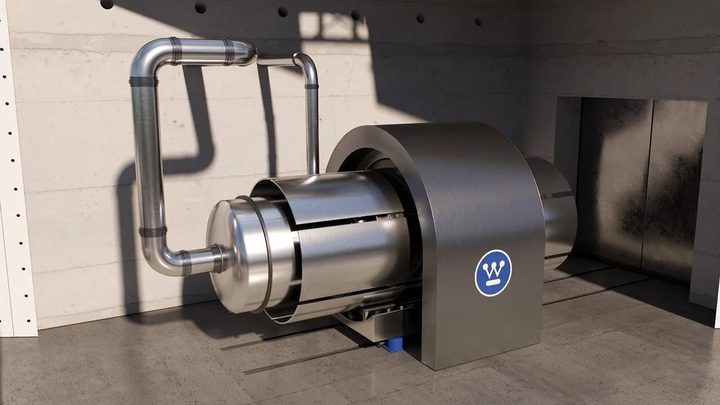
Westinghouse Electric has submitted its Preliminary Safety Design Report (PSDR) for the eVinci Microreactor to the National Reactor Innovation Center (NRIC) at the U.S. Department of Energy (DOE), a major milestone in a process that began last October.
America largely abandoned nuclear energy after the Three Mile Island disaster in 1979, but it is making a comeback thanks to the astronomical energy (and cooling) requirements of today’s frontier AI models. A recent study by the Washington Post and The University of California, Davis, found that using ChatGPT to generate a single 100-word email can consume up to nearly a liter and a half of water and enough energy to power 14 LED light bulbs for an hour. And as AI models grow ever larger and more complex, their power demands are expected to increase in step, with AI data centers consuming multiple megawatts up to a full gigawatt of electricity.
With the submission of the PSDR, Westinghouse can now deploy the eVinci for testing at the NRIC’s Demonstration of Microreactor Experiments (DOME) facility. The NRIC is tasked with developing four new experimental facilities and two large reactor test beds by 2028 where it will conduct “comprehensive technology demonstrations” before finalizing a pair of advanced nuclear technology experiments by 2030.
“The completion of the PSDR for the eVinci test reactor is an important step towards enabling a microreactor developer to perform a test in our DOME facility,” said Brad Tomer, acting director of NRIC. “As a national DOE program and part of INL, the nation’s nuclear energy research laboratory, NRIC is committed to working with private companies such as Westinghouse to perform testing and accelerate development of advanced nuclear technologies that will provide clean energy solutions for the U.S.”
The eVinci works “essentially as a battery,” according to Westinghouse. It uses very few moving parts, instead relying on “the first ever 12-foot nuclear-grade heat pipe” to transfer heat from the nuclear core. In addition to providing electrical power for remote sites and installations, the reactor can also generate the high temperature heat needed to produce hydrogen fuel. Each reactor unit is designed to operate 24/7 for eight years at a time. When a reactor expends all of its fuel, Westinghouse will swap it out wholesale for another sealed reactor.
Westinghouse is far from the only company pursuing nuclear energy solutions to power AI data centers. Oracle announced plans in September to use three small nuclear reactors to power its new 1-gigawatt AI data center, Amazon’s AWS recently purchased a 960-megawatt data center campus from Talen, and Microsoft is currently seeking to reopen the Unit 1 reactor at Three Mile Island itself to power its AI data centers.


