

Alongside the announcement of its new RTX 5090, 5080, 5070 Ti, and 5070 GPUs at CES 2025, Nvidia revealed its next version of the wildly popular Deep Learning Super Sampling, or DLSS. Nvidia has expanded DLSS several times over the past few years, and DLSS 3, which is available today, is already a mainstay in hundreds of PC games. DLSS 4 looks to push that even further, which is where its ability to “see into the future” comes into play.
Promising neural rendering capabilities, DLSS 4 is one of the key features of Nvidia’s new range of RTX 50-series graphics cards. DLSS 4 introduces Multi Frame Generation, an AI-driven technology that is said to significantly enhance gaming performance by generating up to three additional frames for each rendered frame. Essentially, it can predict
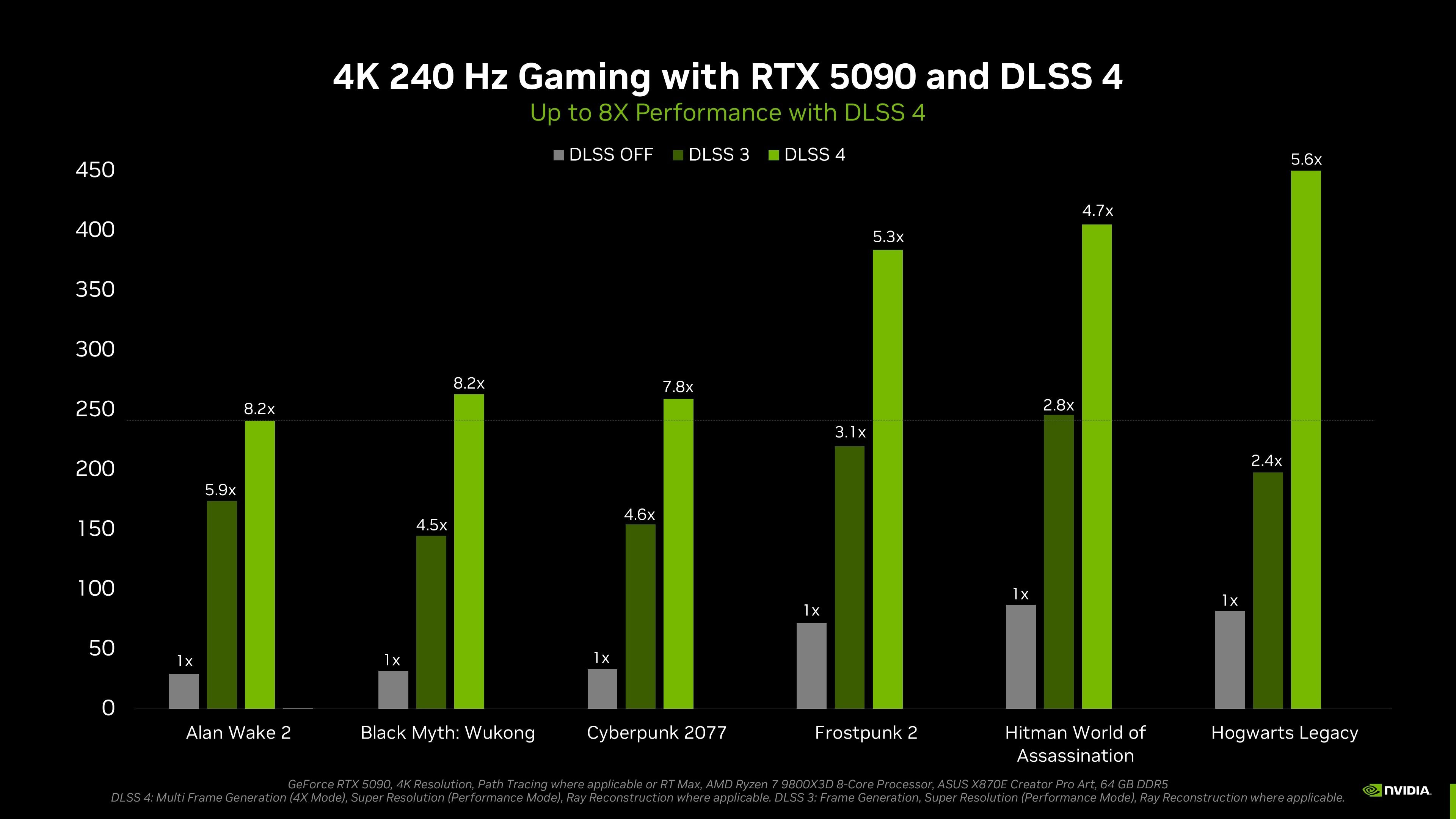
This innovation can boost frame rates by up to eight times compared to traditional rendering methods, providing gamers with smoother and more responsive experiences. As per Nvidia, this significant performance boost on the GeForce RTX 5090 enables 4K gaming at 240 frames per second (fps) with full ray tracing.
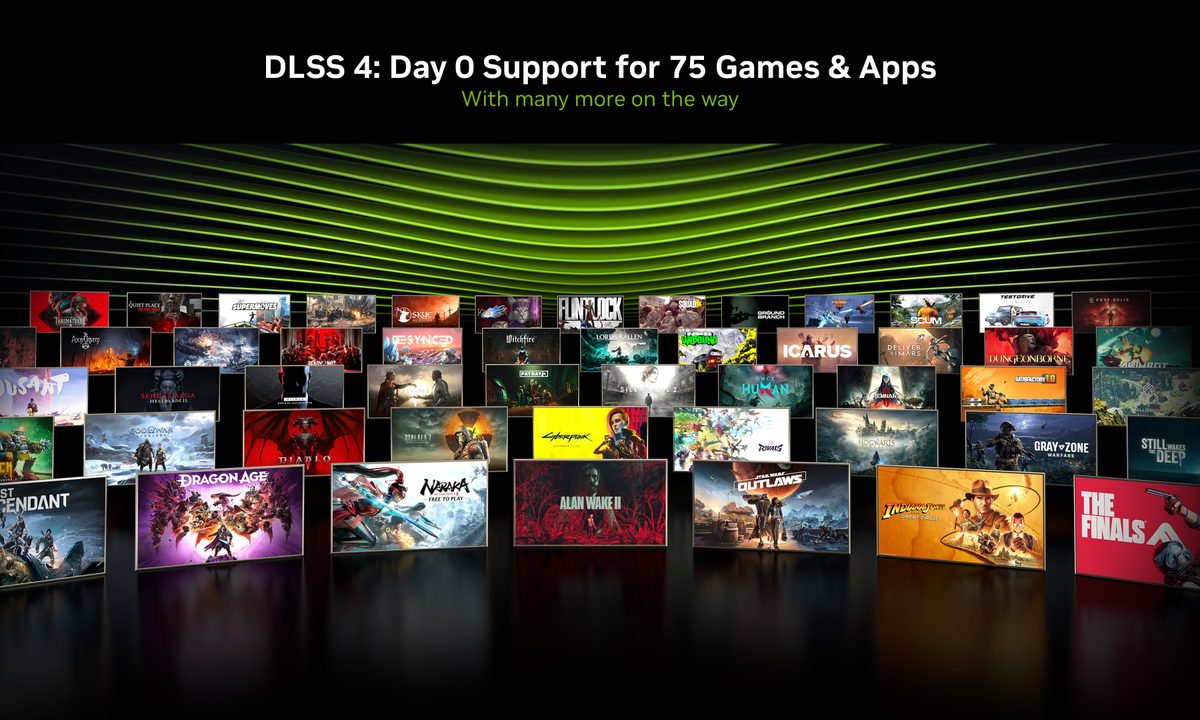
At launch, about 75 games are set to support DLSS 4, including titles like Cyberpunk 2077, God of War Ragnarök, Indiana Jones and the Great Circle, and more. The integration of DLSS 4 into these games is expected to deliver higher frame rates and improved visual quality, enhancing the overall gaming experience. As more developers adopt this technology, the library of DLSS 4-supported games is likely to expand, offering broader access to its benefits across various genres and platforms.
DLSS 4 Multi Frame Generation builds upon its predecessor with new hardware and software innovations to significantly enhance frame generation efficiency. While DLSS 3 Frame Generation created one additional frame using game data and an optical flow field, generating multiple frames was previously impractical due to the high computational cost and impact on GPU performance.
DLSS 4 introduces a new AI model that is 40% faster, uses 30% less VRAM, and requires only one run per rendered frame to generate multiple frames. For example, in Warhammer 40,000: Darktide, this approach increased frame rates by 10% while reducing memory usage by 400MB in 4K at max settings. Additionally, Nvidia has replaced traditional hardware optical flow with a more efficient AI model, further reducing computational costs.

Despite these efficiencies, DLSS 4 still requires the GPU to execute five AI models across Super Resolution, Ray Reconstruction, and Multi Frame Generation within milliseconds. To meet this challenge, Nvidia’s RTX 50 Series GPUs feature 5th Generation Tensor Cores with up to 2.5x the AI processing power, ensuring smooth and rapid frame generation.
To enhance frame pacing and ensure smooth gameplay, Nvidia is introducing hardware Flip Metering in its Blackwell architecture, which shifts frame timing to the display engine. This is said to eliminate the inconsistencies seen with CPU-based pacing in DLSS 3.
The enhanced Blackwell display engine also doubles pixel processing capability, enabling higher resolutions and refresh rates. Together, these advancements allow DLSS 4 to generate 15 out of every 16 pixels with sharp image quality, smoothness, and low latency.
DLSS 4 will be exclusively available on the new RTX 50-series graphics cards. The desktop models including the RTX 5090 and RTx 5080 are scheduled to launch on January 30. The RTX 5070 Ti and RTX 5070 will start rolling out in February. Nvidia also revealed RTX 50-series mobile graphics cards, which are expected to arrive in March.


