  1. Home
  2. Computing
  3. News

DeepSeek has a new rival, and you can try it out right now

Add as a preferred source on Google
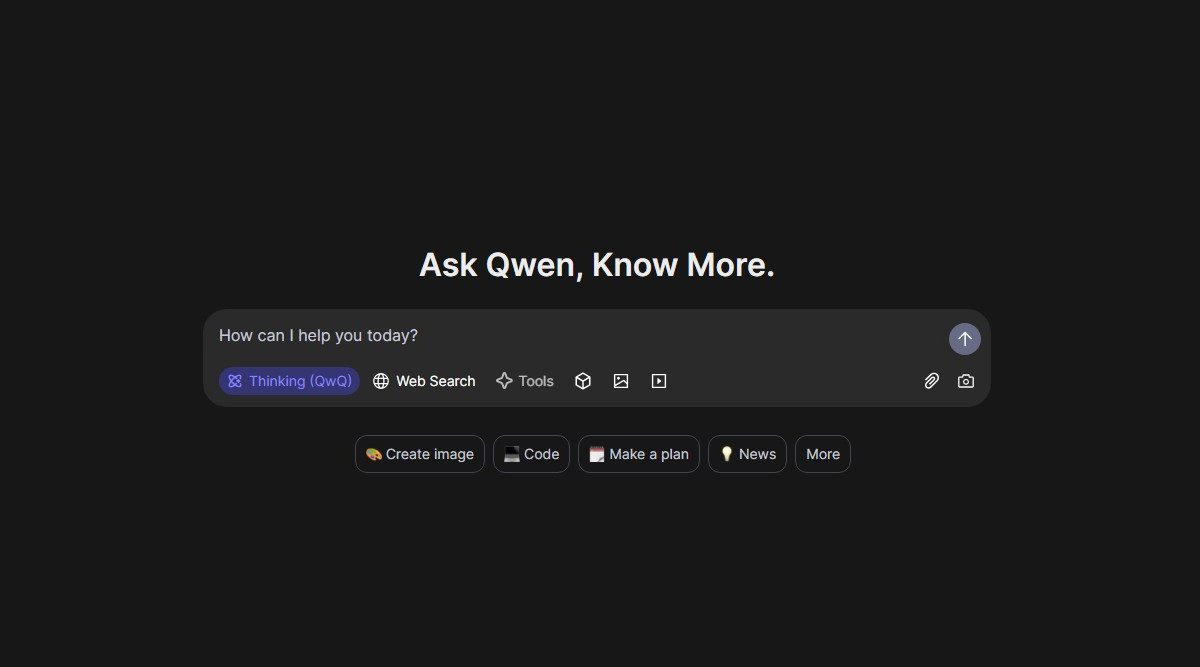
A screenshot of Alibaba's Qwen Chat.
Qwen Chat / Alibaba

Alibaba has just unveiled its latest reasoning model, and it seems that DeepSeek and OpenAI might have something to worry about — at least if all of Alibaba’s promises turn out to be true. It’s open-source, so I checked it out. You can try it out for free, too, although unsurprisingly, you’ll find that there are some things it won’t talk to you about.

The new model, dubbed QwQ-32b (Quan-with-Questions) runs on much fewer parameters, meaning that it requires less resources, but Alibaba claims that it performs at the same level as DeepSeek or OpenAI’s o1-mini.

Recommended Videos

DeepSeek’s R1 large language model (LLM) was all the rage earlier in February when it came out, suddenly capable of rivaling the golden standard set by ChatGPT and other alternatives, but at a much lower cost. It seems that Alibaba might be pushing the envelope even further here.

DeepSeek AI running on an iPhone.
Nadeem Sarwar / Digital Trends

As explained by VentureBeat, DeepSeek-R1 requires 671 billion parameters to run, 37 billion of which are activated. Meanwhile, Alibaba’s new QwQ-32b can get by with 32 billion parameters. Those numbers are totally abstract to many, but there’s a huge difference in compute power; while DeepSeek R1 requires 1600GB of VRAM to run, QwQ-32b can get by with just 24GB of VRAM. In most cases, this will mean Nvidia’s H100 or equivalents, but even the gaming-focused RTX 4090 sports 24GB. The latest RTX 5090 ups that to 32GB.

Alibaba’s QwQ-32b is available under an Apache 2.0 license, meaning that companies and researchers can use it. More importantly, we can use it by trying out Alibaba’s Qwen Chat. Like DeepSeek, it comes with some limitations, but also has a couple of immediate perks that I noticed quite quickly.

It seems to give quite in-depth answers even to quick, simple questions. This can be good, but in a way, it was mostly annoying as it gives you a lot of unnecessary context that you didn’t ask for. I like that it shows you its whole reasoning process, though, which is similar to ChatGPT’s Deep Thinking feature — but with much less depth.

When asked about political matters, Qwen Chat flags it as inappropriate. There might be ways to jailbreak it — it was possible with DeepSeek, after all — but I haven’t managed to just yet.

Whether Alibaba’s claims turn out to be true remains to be seen, but it looks like ChatGPT and DeepSeek now have a new rival.

Monica J. White
Monica is a computing writer at Digital Trends, focusing on PC hardware. Since joining the team in 2021, Monica has written…
Spooked by the MacBook Neo, Asus shows off affordable Intel Wildcat Lake laptops
Its new Wildcat Lake laptops bring faster screen specs to Apple’s affordable fight
Computer, Electronics, Laptop

Asus isn’t waiting for Apple’s lower-cost laptop story to settle. Its new Intel Wildcat Lake Vivobook 14SE and 16SE have launched in China, giving Windows laptop makers an early chance to crowd Apple on price and visible hardware.

The sharper threat is the Vivobook 16SE, which starts at CNY 4,599, about $675, with a higher-end display model at CNY 4,999, around $734. That pricier version adds a 16-inch 2560 x 1600 screen with a 144Hz refresh rate, variable refresh rate support, and a 400-nit brightness rating.

Read more
Intel reveals Project Firefly to make cheap Wildcat Lake laptops that rival MacBook Neo
Project Firefly standardizes Wildcat Lake laptop designs so PC makers can chase Apple with lower prices and cleaner hardware
Crowd, Person, Audience

Intel is trying to make budget Windows laptops look a lot less bargain-bin.

Project Firefly, launched in China alongside Intel’s Wildcat Lake laptop chips, gives PC makers a common hardware playbook for thinner, cleaner, lower-cost systems that can take a more direct swing at MacBook Neo. The promise is simple, fewer compromises where budget laptops usually show them most.

Read more
The RAM crisis is about to get uglier, and your new gadgets could pay for it
Nvidia’s next AI monster may squeeze the RAM market even harder
RAM memory chips

The memory market is already in terrible shape, and Nvidia's new Rubin could be kicking it while it's already down. According to a Fast Company report, citing a forecast from Citrini Research, the company's next-gen AI platform could require more than 6 billion GB of LPDDR memory in 2027. With the LPDDR (low-powered memory) primarily being used in phones, tablets, and other portable devices, the price hikes might get even worse.

And if the report is true, Nvidia alone may consume more memory than Apple and Samsung combined.

Read more