  1. Home
  2. Computing
  3. News

Phone based tool aims to bridge the gap in hardware troubleshooting

Add as a preferred source on Google
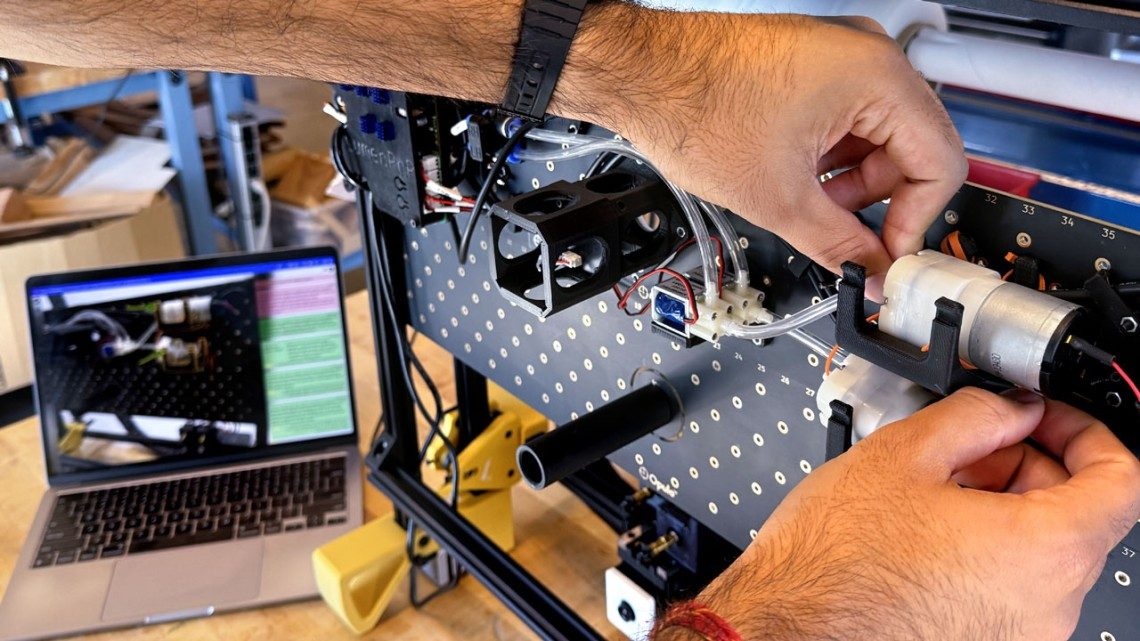
The SplatOverflow tool developed by a research team at Cornell Tech.
Amritansh Kwatra

A research team from Cornell Tech is addressing the lack of technical support for various end-user hardware options, using a tool they developed that renders 3D models via a mobile device.

The tool, called SplatOverflow is intended to use the renders to make hardware issues easier to identify and diagnose. It is based on the similarly named tool StackOverflow, which performs an identical function for software issues.

Recommended Videos

“As tools for designing and manufacturing hardware become more accessible, smaller producers can develop and distribute novel hardware. However, processes for supporting end-user hardware troubleshooting or routine maintenance aren’t well defined. As a result, providing technical support for hardware remains ad-hoc and challenging to scale,” the team said in its research blurb.

SplatOverflow is the brainchild of Amritansh Kwatra, a Ph.D., an information science fellow at Cornell Tech. The research was directed by Thijs Roumen, assistant professor at Cornell Tech. The research was carried out at Matter of Tech Lab.

What SplatOverflow does is put the design information, documentation, and end-user discussions, in one place, making it easier for people who might not have expertise in hardware, Kwatra told the Cornell Chronicle.

The tool first creates a 3D model of the device that needs troubleshooting, with information about the model included. This allows the specialist and the user to view the scene together to identify the issue. The rendered model is called a “SplatOverflow scene.” It includes two parts– a 3D Gaussian Splat the 3D rendering of the device that needs troubleshooting; and the computer-aided design (CAD) model, of the additional information.

SplatOverflow allows experts to compare the 3D Gaussian Splat with the CAD model, to get a clearer idea of the original design and function. Users reporting a remote issue can point on a virtual 3D model where they believe the issue originates.

In their research, the team demonstrated SplatOverflow troubleshooted issues on various hardware, including a pick-and-place machine, a 3D printer, and an open-source e-reader.

Roumen noted the team is looking into SplatOverflow being used in several use cases, such as machine sanitation, maintenance in agriculture, and education, among others– also noting the tool is available for others to develop within other contexts.

“We are thrilled to explore longer-term deployment, to see how we can gradually grow this into a real, open-source platform for hardware support,” he said.

SplatOverflow and its research will be presented at the Association of Computing Machinery’s CHI conference on April 30, in Yokohama, Japan.

Fionna Agomuoh
Fionna Agomuoh is a Computing Writer at Digital Trends. She covers a range of topics in the computing space, including…
Anthropic launches Claude design to simplify visual creation with AI
Finally, AI that designs your slides so you don’t have to
Claude

Anthropic has introduced a new AI-powered design tool called Claude Design, aimed at helping users create visual content such as prototypes, presentations, and marketing assets through simple conversational inputs. The product, developed under Anthropic Labs, is currently available in research preview for paid Claude subscribers and is being rolled out gradually.

Claude Design is powered by the company’s latest vision model, Claude Opus 4.7, and is positioned as a tool that bridges the gap between technical design expertise and everyday creative needs.

Read more
AI triggered a RAMmageddon so bad that Apple looks like the sensible choice
Laptop prices got so stupid in 2026, that Apple turned into the value king.
Student using MacBook Neo in classroom.

I really didn't want to believe it, but here we are. Apple is now looking like the sensible laptop brand. Not the cool underdog. Not the affordable alternative. Apple, in 2026. The reason is not that the company suddenly became generous, but rather the rest of the competition has suddenly become so deranged that a MacBook lineup starting at $599 feels weirdly grounded.

Apple's MacBook Neo starts at $599, while Microsoft's own 13-inch Surface Laptop now starts at $1,199 after this month's price hikes. This isn't a small gap that you can ignore. Meanwhile, Apple's MacBook Air with M5 starts at $1,099 with 16GB of memory and 512GB of storage, which looks like one of the few premium laptops still priced by human beings.

Read more
AI mode in Chrome gets a big upgrade to save you some tab hopping
Chrome just made tab hopping a thing of the past with its upgraded AI Mode, and it's genuinely useful.
Google AI mode mockup showing new feature

If you have ever gone down a rabbit hole while searching for something online, you know the drill. You open one tab, follow a link, open another, and another, and suddenly you have 14 tabs open and zero answers.

It was one of the reasons that forced me to switch to Arc Browser, which offered easier-to-manage vertical tabs, which, incidentally, Google Chrome also added a week back. But Google is not stopping there, and is adding a meaningful upgrade to AI Mode in Chrome to fix this issue.

Read more