
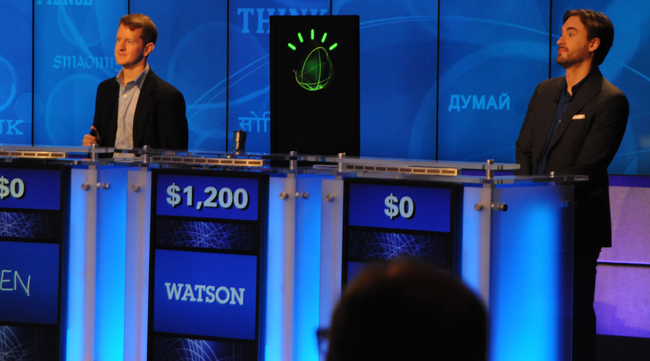
After beating Jeopardy champions (but losing to a politician), helping out in the medical field, coming up with its own pastry recipe, going to college to brush up on its math and language skills, and fielding customer service calls, you might be wondering what’s next for IBM’s Watson supercomputer? To help the company gain new perspective on what else Watson can be used for, IBM brought the supercomputer to the University of Southern California where 100 students competed at the IBM Watson Academic Case Competition.
The company kicked off the competition by demonstrating Watson’s abilities, after which the participants were divided into 24 teams and were given 48 hours to come up with a new use for the computer accompanied by a feasible business plan. Each team had at least one business student and one engineering student member, and since the teams were filled pretty quickly, a lot more students had to sign up on a waist list. If the competition’s grand winner ends up having its idea used, Watson’s next field is legal research, where it will be tasked to sift through old court records, digital evidence, and relevant articles.
The winning team believes Watson could be used not just to look for evidence for legal departments, no matter how obscure, but also to predict each piece of evidence’s probability of success. The team that won second place suggests using Watson for employee training “by crunching data pertaining to the employers’ HR needs, the employees’ career goals, and the range of training options available that can help both parties succeed.” Finally, the team that placed third in the competition proposes Watson be made to assist doctors in cases dealing with post-traumatic stress disorder (PTSD), so it can help the doctors diagnose those who need help and even come up with treatment plans tailored for each patient.
According to IBM, its collaboration with universities gives it a way to “tap into the minds of our next-generation of leaders,” as well as to ignite students’ interest in the STEM fields. It has collaborated with a number of other universities in the past, and even won the historical Jeopardy show in front of 10,000 students. There’s no word on whether Watson will actually be used for all three purposes mentioned above. But as IBM execs were there during the competition and were the ones who scrutinized the entries to decide on the winners, it’s not unlikely for the company to put Watson to work in those fields.


