
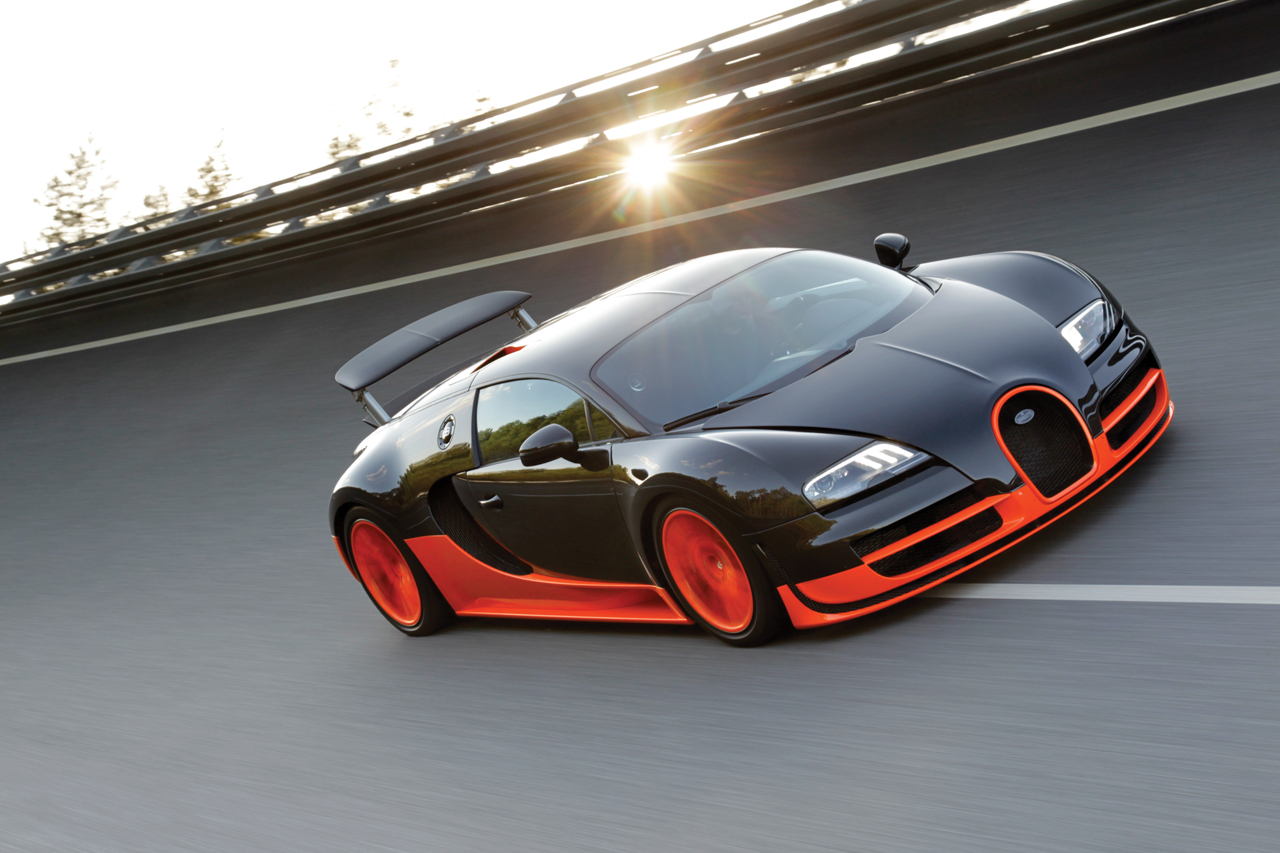
 You may remember the Guinness Book of World Records declaring the Bugatti Veyron Super Sport the world’s fastest production car in 2010. You may also remember the Hennessey Venom GT coming very close to beating the Veyron’s record recently.
Yet neither of these cars are the fastest production car in the world, Guinness says. While the numbers don’t lie, neither the Veyron SS nor the Venom GT meets the world record authority’s standards for a “production car.”
The Veyron SS was declared speed king in 2010 after clocking 267.8 at Volkswagen’s top secret German test track. However, Bugatti deactivated the car’s electronic speed limiter for the record run. Veyron Super Sports sold to customers are limited to 258 mph.
Guinness considers this a modification, and since cars going after speed records can’t be altered in any way, the Veyron SS has officially been disqualified.
A certain car builder in Texas was probably very happy to hear this news. The Hennessey Venom GT, a modified Lotus with 1,244 horsepower, recently hit 265.7 mph.
So will the Venom be taking the Veyron’s place in the Guinness Book of World Records? Nope; Guinness doesn’t consider it a production car either, because Hennessey hasn’t built enough copies.
To qualify for the record, carmakers must build at least 50 examples of a contender per year. Hennessey hasn’t even built 10 Venom GTs.
So what is the fastest production car in the world, according to Guinness? It’s the car the Veyron SS beat in 2010, the 1,287 hp SSC Ultimate Aero. With a top speed of 257.41 mph, it beat the standard Veyron in 2007.
SSC has talked about building a second, more powerful model to take on the Veyron SS, but that is now redundant. No one likes to win based on a technicality, though.
Meanwhile, Bugatti is reportedly working on a new model. Maybe it will set a new speed record while satisfying Guinness’ rules.
Is Guinness being fair, or did the Veyron SS deserve to lose its crown? Tell us in the comments.


