
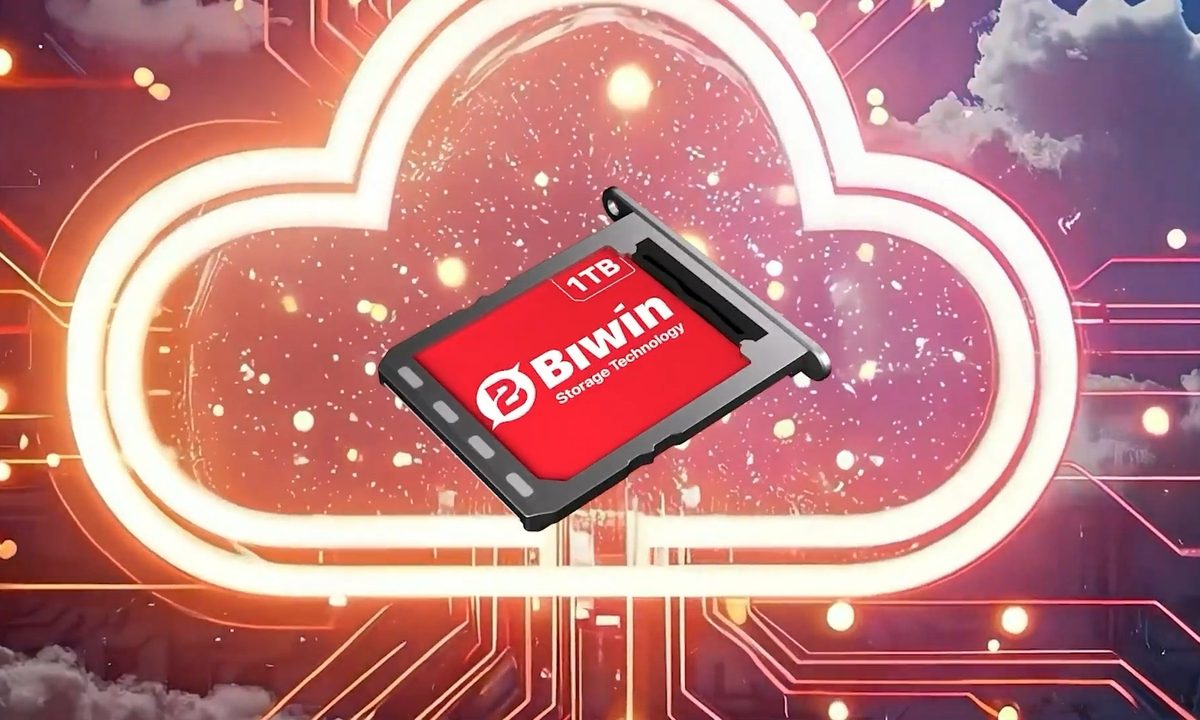
MicroSD cards have long been the go-to choice for compact, removable storage, finding their way into everything from cameras and drones to gaming handhelds like the newly launched Nintendo Switch 2. Yet while the microSD Express standard has managed to push speeds up to 985 MB/s, it’s still far from the performance offered by some of the best SSDs. However, a new storage format spotted in China aims to close that gap, delivering SSD-grade speeds in a footprint barely larger than a microSD card.
Measuring at just 15 x 17 mm, the Mini SSD from storage manufacturer Biwin was first showcased at Computex early this year. The drive is barely larger than a SIM card, yet it’s said to be capable of sequential reads up to 3,700 MB/s and writes up to 3,400 MB/s over a PCIe 4.0 x2 interface. In comparison, the microSD Express which is used by the new Nintendo Switch 2 tops out at 985 MB/s while full-sized SD Express cards can theoretically reach 3,940 MB/s.
Available in 512GB, 1TB, and 2TB capacity options, it also boasts IP68 dust and water resistance, along with drop protection of up to three meters. This level of durability means that one can easily carry it around, use it in the field, or swap between devices without the need of any special care.
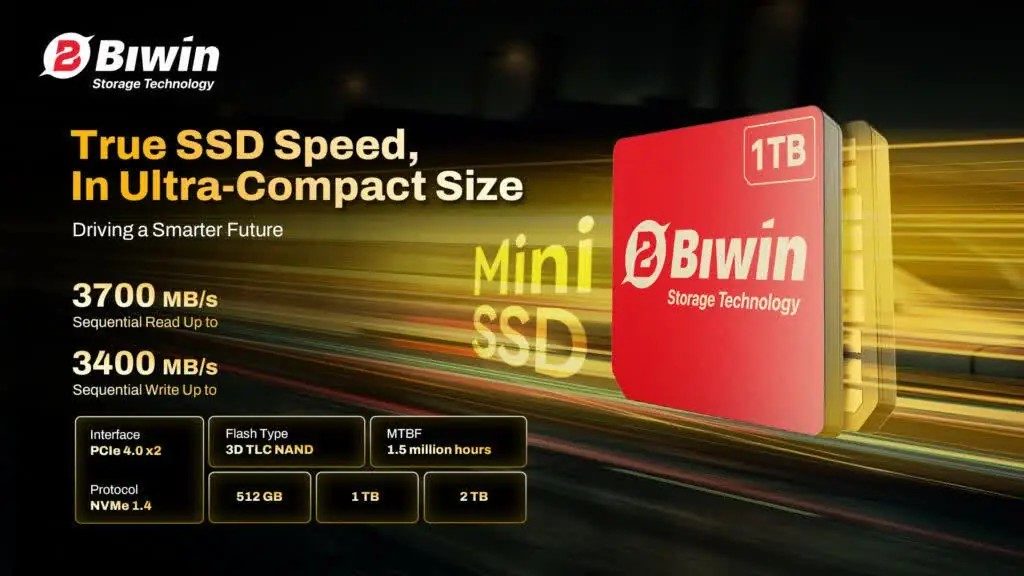
While Biwin refers to the drive as the Mini SSD, it is also codenamed ‘1517’ which is the same as its physical dimensions. This particular naming approach is similar to how JEDEC, the global standards body for the microelectronics industry, designates other M.2 SSD sizes such as 2280, 2242, and 2230.
For now, the Mini SSD remains a proprietary format. For it to achieve widespread adoption, it would require support from multiple manufacturers and industries, or formal recognition by a standards body. Without such backing, it risks remaining a niche innovation.
The good news is that support has already begun starting with the upcoming GPD Win 5 handheld update with AMD’s Strix Halo processor, and the OneXPlayer Super X hybrid laptop, where its tiny footprint allows more room for bigger batteries and better cooling. It’s also where this Mini SSD was first spotted in the wild, as reported by The Verge, giving us a glimpse of its potential before it even hits mainstream devices.
The best handheld gaming PCs are bound to be early adopters, but imagine smartphones, laptops, cameras, and even desktop PCs enjoying full SSD speeds without resorting to bulky expansion bays. Video editors could shoot and transfer 8K footage, game consoles could ship slimmer, cooler, and quieter, while still offering relatively fast load times. The possibilities also extend into industrial and enterprise gear where drones could capture terabytes of high-resolution imagery.
If the performance claims hold true, the Mini SSD or 1517, could mark an important step in storage technology, offering generous data transfer speeds and capacity in an exceptionally compact form factor. While broader industry support will determine whether it becomes a mainstream standard or remains a specialized solution, its early appearances in upcoming devices suggests promising potential.


