  1. Home
  2. Computing
  3. Legacy Archives

Dell announces flexible new touchscreen monitors

Add as a preferred source on Google

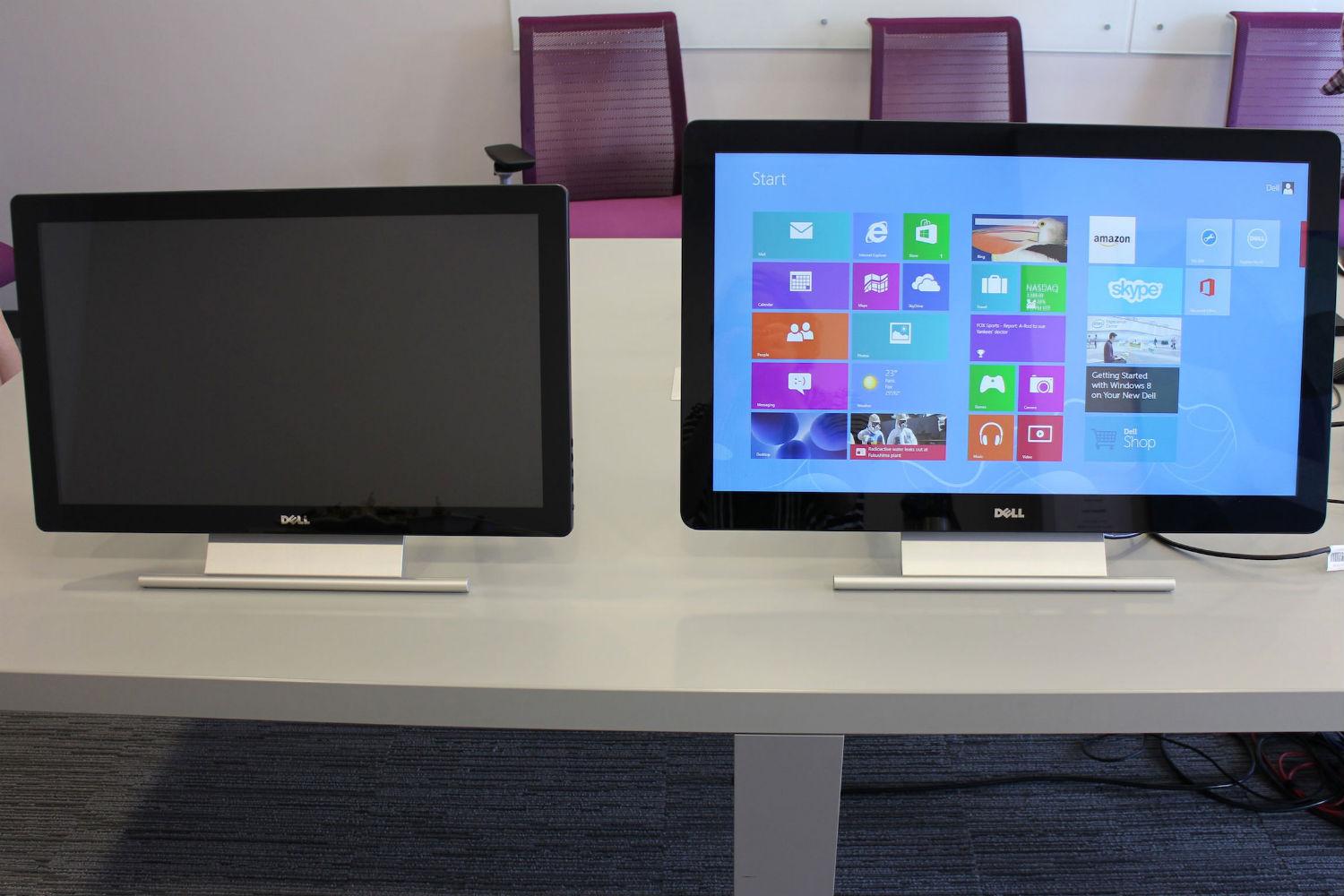
In addition to unveiling new Latitude Ultrabooks earlier this week, Dell also announced three new touchscreen monitors designed for Windows 8. The touch HD monitors boast multitouch capabilities that won’t break the bank. 

Dell’s three monitors include a 20-, 23-, and 27-inch model. The 23-inch (the P2314T) and the 27-inch versions (the P2714T) have full HD 1920 x 1080 touchscreen displays with 8 million:1 dynamic contrast ratio. That’s great and all, but the coolest part about these monitors is the stand, which lets you easily adjust the angle. Both monitors are capable of 60-degree angles, which means they can lie pretty flat – but not completely flat – making it easier to slide the monitor closer to you and type right on the display.

The 20-inch monitor (E2014T) isn’t as robust as its bigger brothers. Though it has a touchscreen, its resolution is only 1600 x 900. Its hinge also doesn’t have the same flexibility as the larger versions as it’s only capable of tilting five degrees forward or backward. It has a 2ms response time, and a high dynamic contrast ratio of 8 million:1. 

Recommended Videos

Port-wise, with all three monitors you’re getting MHL (Mobile High-Definition Link), DisplayPort, HDMI, VGA, and USB, making it possible to connect your smartphone or tablet to the monitor. 
Dell-23-Touch-Monitor-vs-27
Image used with permission by copyright holder

For those of you who are intrigued by the touch capabilities of Windows 8, but aren’t about to go out and buy a touchscreen laptop just  so you can swipe around on your display, Dell’s new monitors are a good compromise. Instead of buying a new $1,000 or more laptop, these touch monitors are an affordable option, starting at $250 for the 20-inch model. Of course, those prices increase for the larger sizes, with the 23-inch model going for $450 and the 27-inch version for $700. All three monitors are available now in the U.S., Canada, and Latin America regions, and will be available in Asia and Europe in September. 

Jennifer Bergen
Former Computing Editor
Jennifer Bergen is the Computing Section Editor at Digital Trends and is in charge of all things laptops, desktops, and their…
Topics
Intel may bring back older desktop CPUs because DDR5 is getting too expensive
Older Intel Core CPUs from 10th to 14th Gen may get a second life
Intel Core i5-12400F box sitting in front of a gaming PC.

Intel may be preparing an unusual response to the ongoing memory crunch. According to Chinese outlet ITHome, citing ChannelGate, the company’s latest production plan includes restarting production of 13th-gen and 14th-gen Core processors.

The move is expected to increase supply across Intel’s 10th, 12th, 13th, and 14th Gen CPU families, especially in mainland China. For DIY PC builders, the timing is important. DDR5 memory prices have climbed sharply, making newer platforms harder to justify for anyone trying to build an affordable gaming PC.

Read more
Amazon wants to design in-house chips for Kindles, Fire TV, and Echo speakers
Apple did it first. Amazon is doing it now, starting with 40 million chips a year and a partner most people have never heard of.
Amazon Kindle Scribe dark mode featured image.

Apple's decision to design its own chips reshaped the consumer electronics industry. Amazon may be about to make the same call, just about two decades later.

Supply chain analyst Ming-Chi Kuo reports that Amazon is preparing to shift away from externally sourced processors for its consumer electronics lineup, marking what he describes as the company's first major processor procurement change in 20 years. The transition is expected to begin in 2027.

Read more
AI wants to summarize it all. TripAdvisor’s misleading reviews show AI will also ruin your travel plans
Spotless, friendly, and totally wrong. AI summaries are hiding the reviews that actually matter.
Tripadvisor logo on MacBook

Planning a trip is stressful enough without wondering if the glowing hotel summary you just read was written by an AI that skipped the scary parts. As it turns out, that might be exactly what's happening on TripAdvisor.

According to an investigation by consumer group Which?, reported by the Guardian, TripAdvisor's AI-generated review summaries are smoothing over serious guest complaints, and in some cases, downright dangerous ones.

Read more