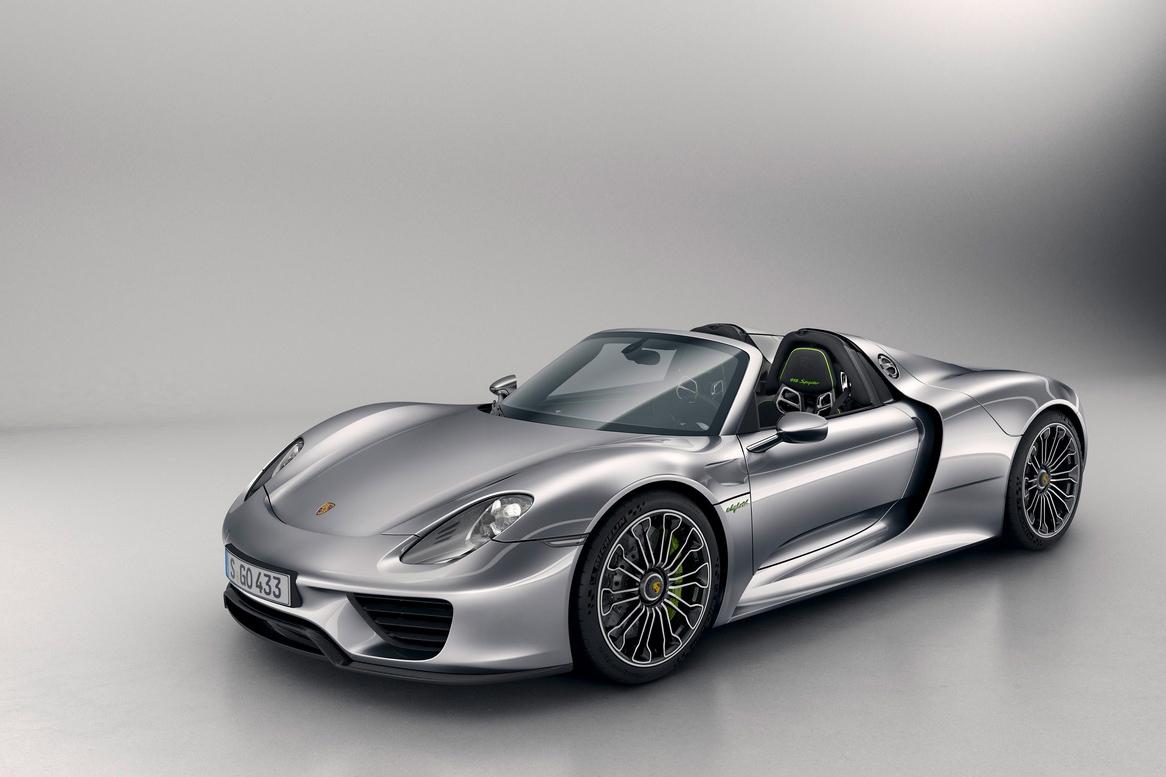
The hotly anticipated Porsche 918 Spyder has been unveiled and – not surprisingly – the halo car goes toe-to-toe with the LaFerrari and McLaren P1.
The LaFerrari and the McLaren P1 no longer have the hybrid supercar realm all to themselves. Porsche officially pulls the veils off the 918 Spyder at the Frankfurt Motor Show this week, making it a three-way race for hybrid halo car dominance.
Porsche makes a convincing case with the 918 Spyder. Constructed of carbon fiber, the two-seater open-top supercar weighs only 3,692 pounds – and much of that weight comes from it prodigious powertrain. Porsche bolted a race-inspired 4.6-liter V8 behind the rear seats that produces 608 horsepower and 390 pound-feet of torque. And that’s just for the gas engine.
Cleverly, engineers designed many of the car’s accessories to be powered not by the V8 engine but by electricity. This means neither an alternator nor an air-conditioning condenser hinders the engine’s power output. Just as clever is the V8’s exhaust system, which doesn’t exhaust down or out the back but instead towards the sky, This not only makes for a very dynamic look from the rear of the car but also keeps the onboard lithium-ion battery packs from being overheated.
The 918 Spyder has two more power sources besides the V8: a 154-horsepower electric motor also turns the rear axle while a 127-horsepower electric motor spins the front wheels. This takes total system power output to an impressive 887 horses and 590 lb-ft of torque. With the V8 and both electric units spinning, 918 Spyder will do 0-62 mph in 2.8 seconds and 0-124 in 7.9 seconds. Which, ironically enough, is actually faster than your soul can leave your body.
Porsche gave its latest halo car four drive modes: the standard E-Power, which provides an electric-only range of up to 18 miles at speeds up to 93(!) mph; Hybrid mode, which works to give the driver the most efficient power delivery (i.e. it zaps power and gas) and provides up to 85 mpg; Race Hybrid, which ramps up gear ratios, spins the electric motors at full tilt while throttling up the V8; and lastly Hot Lap, which puts all the ponies to the pavement in true ‘melt the polar caps, baby; we’re going for speed’ style.
Just like the Audi nanuk quattro concept, the 918 features four-wheel steering that, according to Leftlane News, is the equivalent of adding 50 horsepower or removing 220 pounds from the car while on the track.
The Porsche 918 Spyder, however, is not cheap. The base unit will run around $1,030,000. If that weren’t enough, you can spec the Porsche halo car with a $95,000 “Weissach Package” that drops curb weight down to 3,615 pounds and opens up the paint color options to several historic Porsche racing-inspired hues and adds – on the interior – six-point safety harnesses along with Alcantara upholstery.

Remember, this car wasn’t built to be a big seller. It was built to prove a point: that Porsche is capable of going toe-to-toe with the best of them in terms of super cars and hybrids supercars at that. The best bit for us non-billionaires is that most of the technologies that debuted under the skin of the Spyder will eventually trickle down to lower-range Porsches in the years to come.