1. Home
  2. Computing
  3. Smart Home
  4. News

Laser chips promise faster, greener indoor wireless at gigabit speeds

New optical system tackles crowded Wi-Fi networks with high-speed links and lower energy use.

Add as a preferred source on Google
Electronics, Hardware, Screen
The image conceptually represents the compact, chip-scale platform integrating the 5x5 VCSEL array and custom beam-shaping optics to create a structured grid of uniform square spots. H. Safi (University of Cambridge)

Indoor wireless is hitting limits as more devices crowd the same spectrum. Streaming, video calls, and smart home gear are pushing networks harder while power use rises. A new class of laser chips offers a different path by moving data onto light.

Researchers built a chip-scale optical link that delivers ultra-fast indoor connections with lower energy use. Instead of broadcasting signals widely, it sends data through controlled infrared beams, opening more usable capacity while avoiding interference in dense spaces.

Recommended Videos

At the core is a chip with 25 microscopic lasers, each carrying its own stream. Working in parallel, they push throughput far beyond a single source. In testing, the setup reached more than 360 gigabits per second across a short indoor link.

The gains are not just speed. Power use drops significantly, offering a more efficient way to handle rising demand.

Laser array proves the speed

Performance comes from a 5 by 5 array of vertical-cavity surface-emitting lasers, each acting as its own high-speed channel.

In tests over two meters, individual lasers delivered about 13 to 19 gigabits per second. With 21 active channels, total throughput reached 362.7 gigabits per second, among the fastest chip-scale optical results so far.

The limit came from the receiver hardware, not the transmitter, suggesting higher speeds are possible with better components.

A custom optical setup also shapes each beam into a defined square, limiting overlap so multiple links can run side by side without interference.

Why light changes the equation

Radio networks struggle in crowded spaces where signals interfere and capacity gets stretched. Light avoids those limits by offering more bandwidth and precise control over where signals go.

Instead of blanketing a room, the system creates a grid of targeted beams with minimal spillover. Measurements show uniform coverage across the target area, helping maintain stable performance for multiple devices.

The setup runs at about 1.4 nanojoules per bit, roughly half that of comparable Wi-Fi systems. The tradeoff is range, as the current setup works over short distances and depends on line of sight.

Where this goes next

This approach is meant to complement existing networks by offloading heavy traffic in high-demand indoor spaces.

The hardware fits on a sub-millimeter chip built with standard processes, making integration into fixtures or access points plausible, though no commercial timeline is given.

As demand rises, combining radio and light-based links could become standard, with laser systems handling the heaviest traffic.

Paulo Vargas
Paulo Vargas is an English major turned reporter turned technical writer, with a career that has always circled back to…
Windows 11 just fixed one of Search’s dumbest limitations, and you’ll wonder how you lived without it
One less character, one less annoyance every time you search your PC.
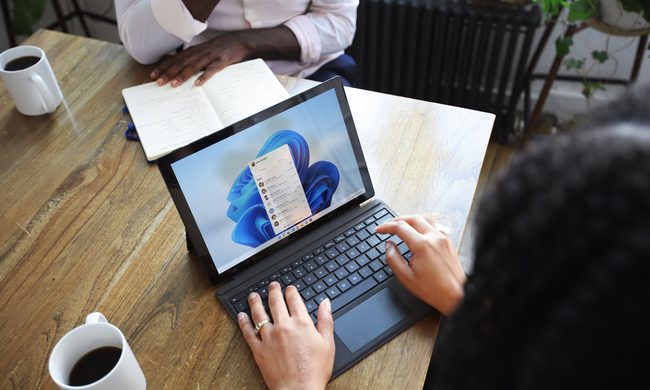
Person sitting and using a Windows Surface computer with Windows 11.

If you have ever typed two letters into the Windows 11 search box, paused, and watched nothing useful happen until you added more characters, you already know exactly why this Windows 11 update matters. 

Microsoft's June 2026 Patch Tuesday update, part of a release Windows Latest calls the biggest of the year (via Windows Latest), quietly fixes that. Windows Search can now find and prioritize files with as few as two characters, down from the old three-character minimum.

Read more
Brazil’s secret World Cup weapon taught the team when to ignore it
The data said he wasn't running enough. The footage said he was always in the “perfect tactical position.”
Soccer ball in net

Brazil has more World Cup titles than anyone, five of them to be precise, but after going through five straight tournaments without adding to that count, the team is leaning hard on data this time. 

Every player wears a sensor-packed "smart vest" tracking field position (via GPS), heart rate, and a stat called "player load," the same kind of numbers that your Whoop band or Apple Watch brags about, but tuned specifically for the sport.

Read more
Meta employees are revolting against its AI rules and it’s a lesson for us all
Employee frustration is spilling into public view as Meta doubles down on AI
Meta Connect 2025

Meta's aggressive push into artificial intelligence is facing growing resistance from an unexpected group: its own employees.

According to a recent report from WIRED, frustration inside Meta has reached a boiling point following a series of AI-related restructuring efforts, layoffs, and workplace policies. The tensions became public this week when an employee interrupted a company-wide livestream with an expletive-filled rant directed at Meta's AI leadership, shocking thousands of colleagues watching the presentation.

Read more