
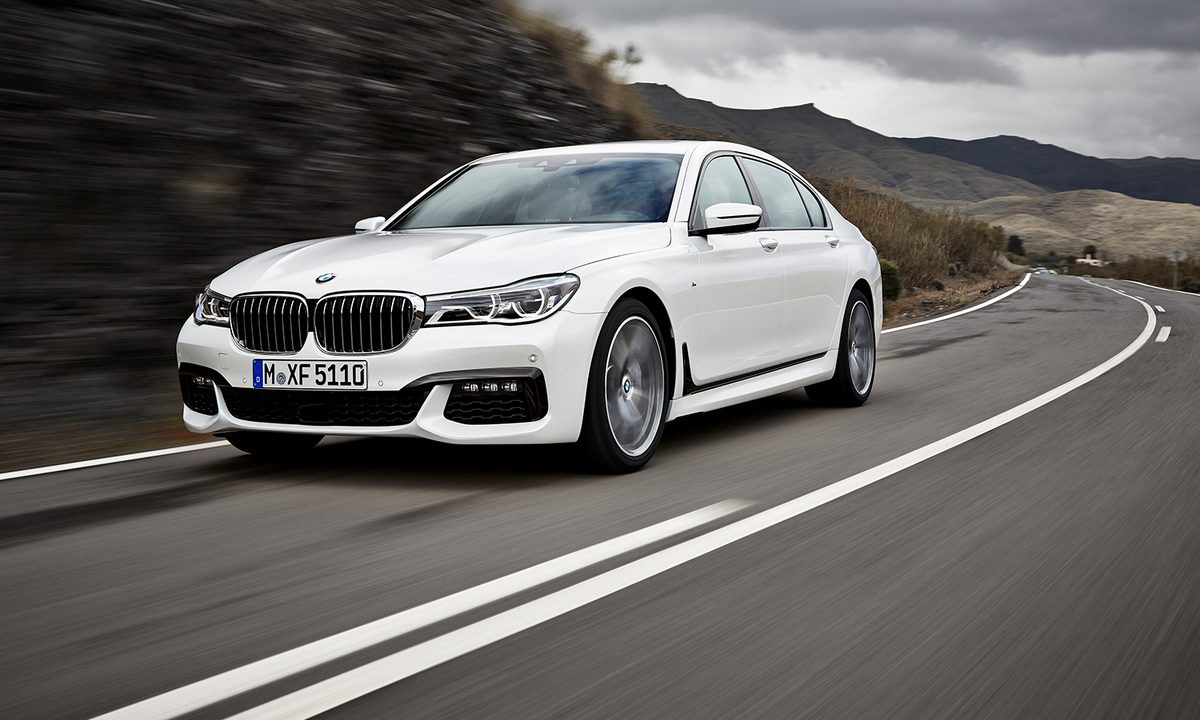
“Bavaria’s newest flagship is a palatial limousine with technology for days, but being your own chauffeur is just as fun.”
- Luscious interior looks (and feels) like a first-class airline cabin
- Bountiful new technology including world’s first gesture control in a production car
- Less weight and improved driving dynamics from 2015
- Semi-autonomous capabilities
- One hell of a status symbol
- Exterior styling doesn’t knock your socks off
- Around $7,000 spendier than last year’s model
“Why you can trust Digital Trends – We have a 20-year history of testing, reviewing, and rating products, services and apps to help you make a sound buying decision. Find out more about how we test and score products.“
Bavaria’s newest flagship is a palatial limousine with technology for days, but being your own chauffeur is just as fun.
The sixth-generation of the BMW 7 Series sedan is primarily made for affluent clients with high standards of luxury, so it was a bit of a surprise to learn we’d be getting our first taste at a private racetrack called Monticello.
The four-door is lighter for 2016 — 286 pounds lighter thanks to a blend of carbon fiber, aluminum, and high-strength steel — but the 7 Series is still a big fella, and a high-speed track is no place to hide your flaws.
Until the 740e plug-in hybrid arrives next year, there are two members of the 7 Series family: the range-topping 750i xDrive and its less expensive two-wheel drive sibling, the 740i. Either car would look positively smashing parked outside a Tuscan villa, but we spent our time in the more powerful 750i at BMW’s first drive event in New York. After all, if you’re testing a flagship, you might as well go big.
Three laps at Monticello
Stepping into the all-new 7 Series feels less like getting in a car and more like entering a high-end executive suite. Before you ever reach the door, an LED “Light Carpet” springs to life, illuminating the ground below as a symbol of royal welcome. Clearly, this is not your average clunker.
After settling in, I set off from the pits and the exhaust note of a 4.4-liter twin-turbo V8 crackled through the air. Foot to the floor, 445 horsepower and 480 pound-feet of torque pushed my chariot to 60 mph in a quick 4.3 seconds (the 740i’s 320-hp six does it in 5.4), but there was a potential problem ahead. I was in a 4,610-lb luxury car, and was supposed to keep pace with an X6M around a series of technical switchbacks. Uh oh.


However, despite the car’s bulk and 17.2 feet of length, it handles extremely well. There’s definitely some evidence of the heft in the back, but dive, pitch, and roll are kept to a minimum through excellent suspension tuning, all-wheel drive traction, and optional Integral Active Steering. Also known as four-wheel steer, the system turns the rear wheels in opposing directions at low speeds and matching direction at high speeds, sharpening reflexes by moving the pivot point of the vehicle farther back.
Hot laps were just the start of the fun though, because soon after, we headed for the slalom to test the vehicle’s responsiveness, braking, and chassis control. I accelerated to 30 mph and flung the car through the cones in series of simulated lane changes, and the electric steering responded beautifully. There’s not a ton of feedback there, but it feels tight, linear, and precise.
Executive Lounge
Adrenaline bender over, it was time to relax, take a load off, and enjoy the 7 Series’ rear lounge. To accomplish that, I crawled into the back for a brief chauffeured ride, hoping for a glimpse into the life of the one percent.
The rear compartment delights you with first-class amenities and an endless supply of gadgets.
I thought back to the flagship’s product presentation as I settled in. When describing the ambient interior lighting, BMW Chief Designer Karim Habib said the fixtures were strategically placed to obscure the rubber weather seal on the windows, because 7 Series customers “shouldn’t have to look at that.” That’s right: the people that buy this car have such high standards that plebeian materials like rubber are intentionally hidden from view.
The extravagance doesn’t stop there, because the cabin is adorned with gorgeous ambient lighting — of which there are six color choices — and some of the finest Alcantara and Merino leather on the planet. An Ambient Air Package fills your nostrils with several soothing scents, and the comfort seats melt stress away with eight massage programs with three levels of intensity.
Ride underway, I delved into the endless collection of gadgets within reach, starting with the removable Samsung tablet between the seats. From this device, you can tweak chair position, massage settings, climate control, ambient lighting and perfume strength, surf the Web, crank the fantastic Bowers & Wilkins sound system, and use the bevy of BMW apps, the coolest of which is the automaker’s Vitality Program.


The program allows occupants to engage in “active training” while on the move, which essentially means pressing your shoulders, legs, and arms into the seat at varying levels of intensity until it tells you to stop. Dual 10-inch screens work alongside the tablet to walk you through it, and to further strengthen the first-class cabin comparisons, the 7 Series boasts two fold-out tables and footrests as well. I got into the car looking for a taste of grandeur, and that’s exactly what I got.
If you prefer to relieve tension in a more involved way, simply slide up to the driver’s position and experience the vehicle’s true genius. While the rear compartment delights you with first-class amenities and an endless supply of gadgets, the front is a gateway to the ultimate driving machine underneath. Bolstered by lightweight Carbon Core construction inspired by the brand’s “i” lineup, the BMW is simply one of the most dynamic, exciting, and comfortable cars in its class. Want a difference experience? Pick a different seat.
First!
Relaxed and revitalized, it was time to get back behind the wheel to try something new. You see, the BMW 7 Series has historically been an innovative lineup — it was the first production car with onboard navigation and a moving map, the first sedan with a six-speed automatic, and now, it’s the first mass-market car with gesture control.
The new 7 Series is the first series production car with gesture control.
It’s a fairly simple system, one that recognizes a handful of gestures with a 3D sensor above the center console. Swipe to the right to decline phone calls, point with one finger to accept, and draw a circle with your index finger to increase or decrease volume. There are also a couple programmable gestures that you can associate with an action of your choosing, such as “go home,” “call lawyer,” and presumably “liquidate all assets.”
While it’s definitely fun to play with, there’s a bit of lag between gesture recognition and computer response, which can result in missing your volume target. It’s easy to keep your eyes on the road though, and luckily, all functions can be controlled through the pinch-to-zoom touchscreen or the iDrive 5.0 scroll wheel.
The 7 Series also offers semi-autonomous features, the selection of which is limited more by government regulation than technological capability. Under the right conditions, the luxury car will steer itself by reading the lines on the road, speed up or slow in conjunction with the car ahead, and even stop and go on its own with Traffic Jam Assistant. This is accomplished by use of a stereo camera and various radar sensors, which equate to a chauffeur-like experience even when you’re behind the wheel.


That being said, self-driving tech is just the tip of the iceberg. The 7 offers gadgets like Night Vision with pedestrian and animal detection, brilliant laser headlamps, and even remote control parking, which scans open spots as you drive by and can park itself autonomously with the press of a button. But due to legislative red tape, the latter two aren’t available in the U.S., which may be just the boost you need to book a one-way ticket to Munich.
Conclusion
The DT Accessory Pack
Up your game and the get the most out of your gear with the following extras, hand-picked by our editors:
Automatic Smart Driving Assistant ($170)
Track fuel usage and vehicle wear-and-tear over time.
Cobra DSP 9200 BT Radar Detector ($400)
Read our review of Cobra’s first digital radar detector here.
BMW Connected iOS App (Free)
Allows BMW drivers to analyze their driving style and transfer navigation info between phone and car.
Driving a company flagship is always interesting because there’s no holding back. The brand, like its customers, spares no expense to offer the ultimate experience in luxury, performance, and style, and BMW has done so here.
Obviously, the 7 Series is not cheap. The 740i starts at $81,300, while the range-topping 750i xDrive asks for a bit more at $97,400. The option packages really add up in this car as well, because my loaded demo car came fitted with the four-wheel steering Autobahn Package ($4,100), the semi-autonomous Drive Assistance Plus II ($1,700), the Rear Executive Lounge Seating Package ($5,750), and the M Sport Package ($3,000) among other things, raising price up to about $125,000.
For the average full-size luxury buyer, the car might just be worth it. Simply put, it’s technical tour de force, a palatial paradise that still manages to hold up to the brand’s “ultimate driving machine” tagline. It feels like driving money. And driving money feels good.
Highs
- Luscious interior looks (and feels) like a first-class airline cabin
- Bountiful new technology including world’s first gesture control in a production car
- Less weight and improved driving dynamics from 2015
- Semi-autonomous capabilities
- One hell of a status symbol
Lows
- Exterior styling doesn’t knock your socks off
- Around $7,000 spendier than last year’s model


