
“Why you can trust Digital Trends – We have a 20-year history of testing, reviewing, and rating products, services and apps to help you make a sound buying decision. Find out more about how we test and score products.“
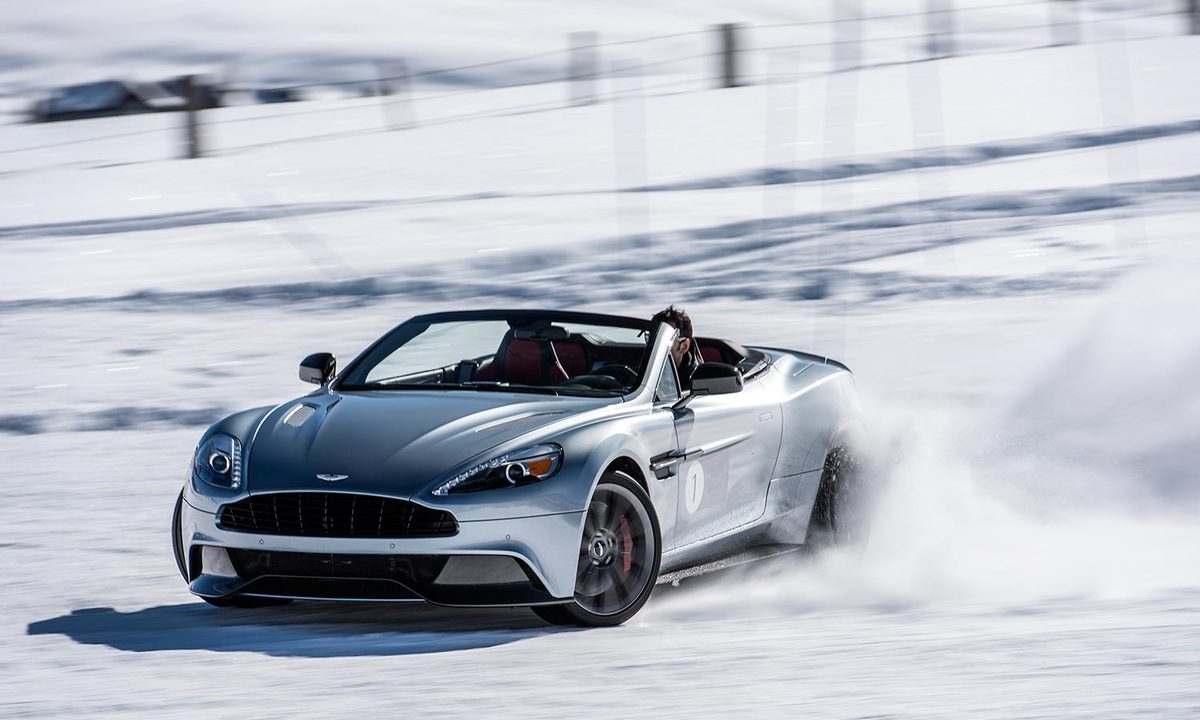
Aston Martin’s On Ice program dissolves rear-wheel drive stereotypes while customers absorb a stunning Colorado mountain backdrop.
I weathered seven long, bothersome winters in Boston. Frigid and scowling, I’d labor on foot through wads of snow from one destination to another. Winter meant my sun-loving Mazda Miata would hide in a garage for months while my stout Jeep Wrangler would trudge anywhere my feet couldn’t take me.
Icy, treacherous roads were the enemy of fun and efficiency. Less traction, the expense of winter tires, and timid traffic soiled each driving experience. As much as I adored the pace of life and driven nature of the east coast, California’s all-season driving serenity beckoned. And, with the exception of the Golden state’s draught conditions, I hadn’t missed winter’s frozen favors.
That was until Aston Martin invited me to its ice driving program in Crested Butte, Colorado. Three days and hours of snow-shredding laps later, I succumbed to a new addiction, many miles and vastly different from my permanently 75-degree homeland.
Wipe the slate clean
I know you did the math the moment you saw “ice” and “Aston Martin” in the same sentence: rear-wheel drive, front-engined, carbon fiber-clad sports cars don’t belong in the snow. They can’t possible brake well enough, change directly quickly, or put the power down.
I smugly carried that logic with me up until the moment one of Aston Martin’s driving instructors sent a V12 Vantage into a 360-degree spin, caught it, broke before the next corner, and tidily skirted around the bend before hauling ass down the straight. Once I’d finished cackling with laughter from the passenger seat, I was sent off to Aston Martin’s trackside yurt to learn what the hell just happened.


Once inside, hands still rattling from the previous moment’s excitement, Paul Gerrard (Aston Martin On Ice lead instructor) blew further craters in my equations. First, Gerrard explained, Aston Martin vehicles are engineered for balance above all. That’s why their engines are mounted as far rearwards as possible and transmissions are grouped with the differential in a rear transaxle setup. This combination applies weight evenly over the front and rear axles, eliminating what Gerrard referred to as the “nose-heavy muscle car stigma.”
The results are neutral handling, stable braking, and minimal dive or pitch under aggressive acceleration/deceleration. So confident is the UK automaker in its equilibrious design that it opts to use off-the-shelf winter tires for its driving program instead of studded ones like other manufacturers.
As Gerrard wrapped up his tutorial on the cars and the day’s events, Aston Martin’s instructors (each with a race-bred resume) patiently waited to prove their fearless leaders’ points from behind the wheel.
Fight the habit
Aston’s curriculum kicks off on the skid pad. Buckled into the four-door, 552 horsepower Rapide S, we’re taught how to apply steering angle and throttle to combat slip.
Smoothly bringing the steering wheel back to a neutral position is the quickest way to regain control.
After what seemed like an eternity, I managed to rewire my brain to control slides and modulate throttle. Stage two was an even greater challenge, though: maintaining a drift. Pacing the circumference of a coned-off circle, I’d wait for the instructor’s demand to “punch it,” before stabbing the throttle to break the bond between rear tires and icy ground. From there, I’d lightly discipline the steering wheel to work in sync with spoon-fed throttle. The resulting performance was (eventually) a sideways lap or two around the skid pad.

Relieved that I hadn’t sent a $200,000 sports car into a snowbank, it was time for braking practice. On the road, only the most dramatic maneuvers will lock up a modern vehicle’s brakes. With just a fraction of that stability on ice, it’s far easier to illicit an uncontrollable forward slide unless you’re well prepared. With about 300 yards of runway, I learned to combat the limits of braking effectiveness with measured pedal inputs. By easing onto the brake pedal instead of slamming down full-force, I was able to scrub speed before turning or trail brake through a corner.
As my confidence grew, I began to realize that these cars (and their massive brakes) had far more in them than I had been willing to tap… but that was a lesson for the full course.
Untapped potential
Staged at the entrance to a mile-long circuit, I gazed at a panoramic of snow-capped mountains from the supple leather throne of an Aston Martin Vanquish Volante. Top down and heater cranked, I toggled the supercar’s traction management system to “Race Mode” and (slowly) took off for the first corner.
“Balance is everything.”
Lap after lap I grew in appreciation for both the absurdity of my James Bond-esque predicament and the masterful engineering of these vehicles. Cycling through every model in Aston Martin’s lineup, it was clear that the nimble 430 hp V8 Vantage was the best suited for faster lap times, but both the Vanquish and DB9 GT grand tourers afforded effortless performance. Indeed each car shared a confidence to their movements that enabled me to push harder as the hours passed. By my final laps, the instructors had coaxed me to brake deeper into each corner, to elicit more speed out of each straight, and, better yet, to use 500 horses like my own brand of vengeance on my old, frosty nemesis.
The right tool for the job
“That’s it,” I thought, “I’m ready to go pro.”
But before I could even research how to finance a half-million-dollar racecar, one of the instructors had gestured for me to hop in the passenger seat. “Let’s try a hot lap,” he said. “Why not,” I figured, “might as well see how my future competition stacks up.”
Approximately eight seconds later, I was plastered to the leather-wrapped doorsills as my “rival,” had taken the first corner at approximately double my best speed. With a confusing mixture of envy and bliss, I flopped from one seat bolster to the other, sheepishly recognizing the cavernous gap between my skill set and that of a true professional. As much as I marveled at my captor’s talent behind the wheel, I was just as impressed by how much more performance a stock Aston Martin had at its disposal.
Boisterous V12 engine daring the surrounding mountains to unleash their freshly harvested snow, I decided not to mourn the racing career that would never be, but instead to embrace what may well have been the best day of my life.
Aston Martin doesn’t market its “On Ice” program and yet word of mouth continues to bring more customers each year to the Rocky Mountain wonderland. It isn’t cheap to dine on perfectly cooked local elk, stay in Crested Butte’s famous Tipple House, or get private instruction from some of the world’s best drivers, but if you have the means, this experience can turn even the most winter-dissenting individual into an arctic admirer.
Highs
- Poise under braking
- Graceful balance through corners
- Communicative steering
- Avalanche-inducing engine notes
Lows
- Visibility isn’t generous in the Rapide S
- I wasn’t permitted to stay at the track forever


