  1. Home
  2. Cars
  3. News

Rubber ducky, you’re the one … to test self-driving technology at MIT

Add as a preferred source on Google

In order to make self-driving cars viable, the automotive industry has recruited some of the best software developers, hardware engineers, and mobility analysts humanity has to offer. There’s a new community working to push autonomous technology forward, but these researchers aren’t human at all.

Buried deep within the halls of MIT’s Computer Science and Artificial Intelligence Lab (CSAIL) lies a small suburb called Duckietown, a mock-up municipality used to test and develop driverless technology. Populated entirely by rubber ducks riding on autonomous robo-taxis, Duckietown is the culmination of a graduate-level class that could prove invaluable to automakers in the future.

Recommended Videos

“We believe a tool like this will help create a common platform and language for researchers to build on,” said CSAIL postdoctoral associate Liam Paull, who co-leads the Duckietown course. “We hope this will make it easier for computer scientists to continue to work together to bring autonomous vehicles into the real world.”
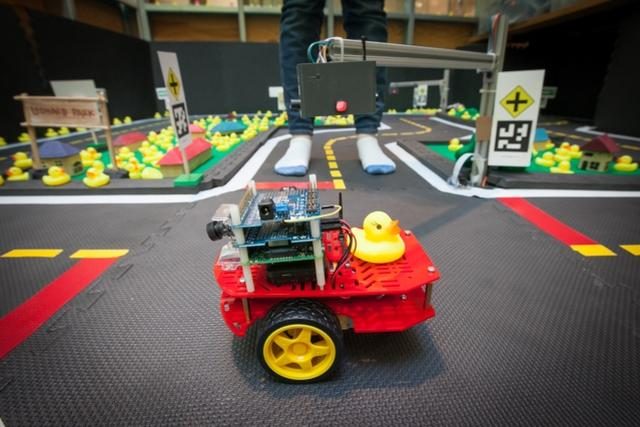
MIT Duckietown
Image used with permission by copyright holder

To bring us closer to the driverless future, 50 “Duckiebots” wander the colorful foam streets of Duckietown, using a single onboard camera to track road markings, monitor their fellow Duckiebots, and even read street signs. It’s not quite the real thing — there are no worn lane markings or inclement weather to deal with — but according to Andrea Censi, an MIT researcher who also leads the class, that isn’t really the goal.

“We thought about key problems like integration and co-design,” said Censi. “How do we make sure that systems developed separately will work together? How do we design systems that maximize performance while sharing resources? It’s a delicate balancing act in weighing the relative importance of different infrastructure elements.”

If you’re looking to build a Duckiebot, Doggiebot, or G.I. Joe action-figurebot for yourself, there is good news — the robo-taxi platform and the attached teaching materials are free and open-source. That means someday soon, you could have your very own autonomous community in your basement, albeit a small one. To stay up to date on all the happenings in Duckietown, check out the team’s Facebook page.

Andrew Hard
Andrew first started writing in middle school and hasn't put the pen down since. Whether it's technology, music, sports, or…
Cambrige experts find utterly simple fix for longer lasting EV batteries. Just put some pressure on it.
Scientists found a way to make EV batteries last longer without reinventing the battery
EV Charging

EV battery breakthroughs typically involve new chemistry, exotic materials, or faster charging/higher capacity. But a new study reveals that you can skip all the fancy stuff and go with a very simple solution, Researchers from the University of Cambridge found that putting the battery under the right amount of pressure actually helps.

The study was about how physical pressure affects lithium-ion battery life, which found that keeping cells under constant pressure could double their lifespan. The work was published in Nature Energy, and the team says the improvement came without changing the active materials, electrolyte, or basic battery chemistry.

Read more
BMW reveals redesigned X5 with petrol, hybrid, EV, and hydrogen options
BMW couldn't decide on a powertrain, so it launched all of them
BMW X5

BMW has pulled the wraps off the fifth-generation X5, giving one of its best-selling luxury SUVs its biggest overhaul yet. The new model brings a fresh Neue Klasse-inspired design, a completely redesigned interior, and the broadest choice of powertrains the X5 has ever offered. Alongside petrol, diesel, and plug-in hybrid versions, BMW has introduced the first fully electric iX5, while confirming that a hydrogen-powered X5 will join the lineup at a later stage.

More powertrain choices, more technology, and a fresh design

Read more
Tesla has a battery theft problem
Even Tesla's batteries can't wait to hit the road
Tesla cars at Superchargers

Tesla is facing an unusual security problem in the US, and it is happening before many of its batteries even make it onto the road. According to an investigation by WIRED, multiple truckloads of Tesla batteries have allegedly been stolen directly from the company's Nevada Gigafactory, highlighting a growing wave of organised cargo theft targeting high-value technology shipments.

Cargo theft is becoming a serious problem for Tesla

Read more