  1. Home
  2. Phones
  3. Android
  4. Mobile
  5. Photography
  6. News

Patent reveals Galaxy Note 7 could have an integrated iris scanner

Add as a preferred source on Google

Samsung’s Galaxy Note 7 is believed to be just around the corner. One of the biggest features rumored to be launched alongside the phone is a new iris-scanning technology that will allow you to securely unlock your phone by scanning your eyes.

Reports show Samsung has been working on an iris scanner since at least 2014. But a new patent lends credence to the rumor that we could be seeing this technology sooner rather than later. According to the patent, the iris recognition system will rely on three individual lenses, a dedicated lighting device, and an image processing system.

Recommended Videos

The system would rely on two narrow-angle lenses for capturing the individual eyes of the user. These would be used alongside a wide-angle lens to capture the entire face of the user. Together, these images would be used to capture and verify the identity of the person attempting to unlock the device.
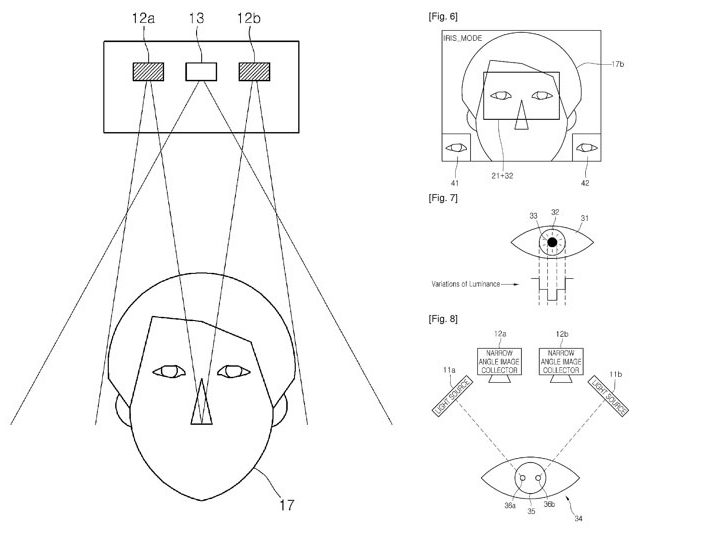
Samsung Iris Scanner 3
Illustrations detailing the multiple camera setup expected to be used in the upcoming Galaxy Note 7 Image used with permission by copyright holder

Besides the lenses, one of the key elements in the patent is a built-in infrared light, which will shine on the eye of the person attempting to unlock the phone. This would provide a more accurate image than using ambient light and wouldn’t blind the user as an LED light would.

For such a technology to be commercially successful, Samsung would need to balance security with convenience. Fingerprint scanners are extremely quick and although iris scanners would be more difficult to fool, the latency of such a system could prove to be a downfall. In addition, the individual components in an iris-scanning system will likely cost more than a fingerprint scanner, inevitably raising production costs.

Another trade-off that could be seen in this patent is the need for a rather large unit on the front side of the phone it’s being implemented into. As phone manufacturers continue to shrink the bezel on devices, this could reverse that trend.

We’ll see soon enough whether or not this will actually make its way into the Galaxy Note 7. What are your thoughts? Would you be willing to trade a little convenience and screen real estate for added security? Or is a fingerprint scanner good enough for you?

Gannon Burgett
Former Editor
Instagram could soon let you watch Reels while offline with automatic downloads
A new leak suggests Instagram is working on automatic downloads for Reels, which could let you continue your binge even without an internet connection.
Instagram and YouTube

Instagram could soon let users continue their Reels binge even when they're offline. A new leak suggests the app is working on automatic downloads for short-form videos, a move that would bring it closer to YouTube, which already allows offline viewing of Shorts.

What is Instagram working on?

Read more
Android 17 will let apps get the best out of your phone’s camera chops
A new vendor-defined extension system could bring advanced camera features like Super Resolution to your favorite third-party apps.
Android 17 logo.

Android 17 is shaping up to be quite an important update, especially if you care about camera quality across apps. Google is introducing a new way for phone makers to extend their custom camera features system-wide, which could finally close the gap between stock camera apps and third-party ones.

How is Android changing camera access for apps?

Read more
Google is preparing a priority charging feature for phones for rush scenarios
A hidden Android 17 feature appears built for quick top-ups, while keeping calls and texts flowing.
Electronics, Mobile Phone, Phone

Google is working on a priority charging feature designed for moments when you need power quickly. The option, uncovered in Android 17 beta code by Android Authority, focuses on boosting usable battery in a short window without shutting down core phone functions.

Instead of pushing higher charging speeds, the system shifts power toward the battery by dialing back background activity. Calls and texts still come through, but less critical processes pause so more energy goes into charging.

Read more