

“$30K is a lot for a hybrid that blends in more than stands out, so it’s a good thing the performance is worth the price.”
- Power trio of engine, turbo and electric motor combines for unexpected driving fun
- Electric-only mode a huge gas saver on short urban trips
- High-quality fit and finish
- Tech interface is simple to master
- Electric-only range is too short (when will it ever not be?)
- Style blends in
- Really needs a tachometer
- Hefty price tag
“Why you can trust Digital Trends – We have a 20-year history of testing, reviewing, and rating products, services and apps to help you make a sound buying decision. Find out more about how we test and score products.“
I pity the automotive engineers and designers tasked with making a hybrid.
The whole process seems ripe for corruption by competing forces. There’s the hybrid group, pushing for more efficiency, utility and ever more space for their batteries. And then there’s the motorhead group, wanting more horsepower, more transmission speeds and more performance, all of which usually equals less efficiency. Fight!
After driving the 2013 Volkswagen Jetta Hybrid SEL, I’d like to meet the project managers at Volkswagen and find out what they put in both camps’ coffee, because the car that came out of the gates is a highly functional combination of both ideals, even if it costs a smidge over $30,000 as driven.
Our test Jetta Hybrid SEL arrived wearing an HOA-approved tan-ish paint scheme with a cream-colored “V-Tex” leatherette (their word) interior. Boring, but also nicely boring, and quite comfortable. The VW and Hybrid badges are set off with a water-blue backing, lest you forget you’re driving a car that scored 10 out of 10 on the gubmint’s fuel economy (42/48/45) and smog report cards. A packet of grow-your-own Endangered Sea Monkeys is not included.
Tech you can use
Settle into the driver’s seat and the usual buttonage for cruise control, audio and voice recognition systems is close at hand through VW’s dual four-way steering wheel pads, which still take a little bit of getting used to. A responsive central touchscreen sporting large icons and flanked by six large “hard” buttons covering the major car systems (media, phone, navi, hybrid status, etc) made the in-car tech system one of the easiest to use that I’ve so far experienced.
Drilling down into menus was intuitive, and I never once cracked the manual. Connecting my iPhone 5 took less than a minute and I never had to mess with it again upon re-entry in the Jetta – it was always ready to go. The small central screen between the gauges was an effective reference tool for the car’s power systems, phone data, what the media player was up to, and other factoids.

Under the central touch screen were the usual environmental controls, and ahead of the shifter is a simple E-Mode button for electric-only propulsion.
Even the no-name stereo, which included a CD player, is a solid performer, with a lot of volume before distortion surfaces and only lacking just a bit on low-end bass response. Overall, the simplified tech interface was one of the most unobtrusive and easy-to-control systems I’ve come across as of late.
Hybrid go power
Under the hood, a wee 1.4-liter inline-four happily ticks away, backed by a turbocharger and a 29hp electric motor buried in the drivetrain. The battery pack lives behind and under the rear seats, and only soaks up a modicum of trunk space. Outside of the badging, it looks like just any other sharply-styled Jetta, ready to carry you and three others in care-free, high-mileage comfort along with light luggage for the weekend.
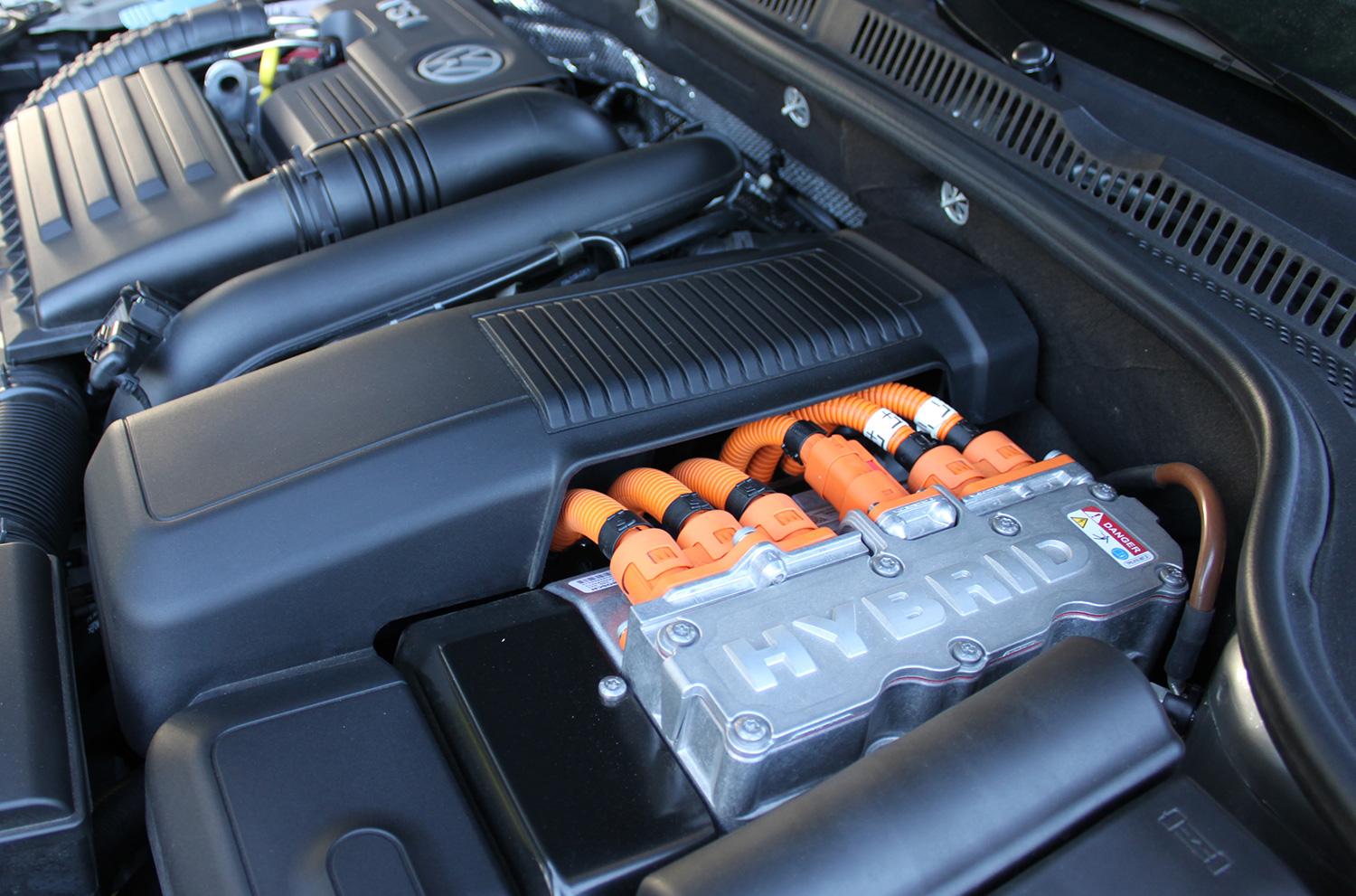
But the placid appearance evaporates when you snap the Tiptronic shifter to Sport Mode and squish the gas pedal towards the tanly-carpeted floorboards. The car scoots forward with unexpected acceleration as the engine, turbo and electric motor combine for 170 horsepower and 184 feet-pounds of twist. It’s no Porsche, but it does seem as though someone stole some 918 speed secrets during the VW group’s holiday party.
Thirty large is a lot for a hybrid that blends in more than stands out, so it’s a good thing it came loaded with just about everything…
On an infamous stretch of Oregon backroad that torture-tests handling first and power a distant second, the Jetta’s GLI-sourced rear suspension kept the car on its line despite the 500-pound elephant of a battery riding over the rear axles. Coming back into town on Highway 26, now clogged with traffic after a rare sunny weekend, I left the powertrain in Drive and pedaled lightly, the Jetta seamlessly switched between engine mode, electric mode, recharge mode and combinations thereof as I blasted Led Zeppelin’s new live CD on the capable stereo.
It’s a gas not buying gas
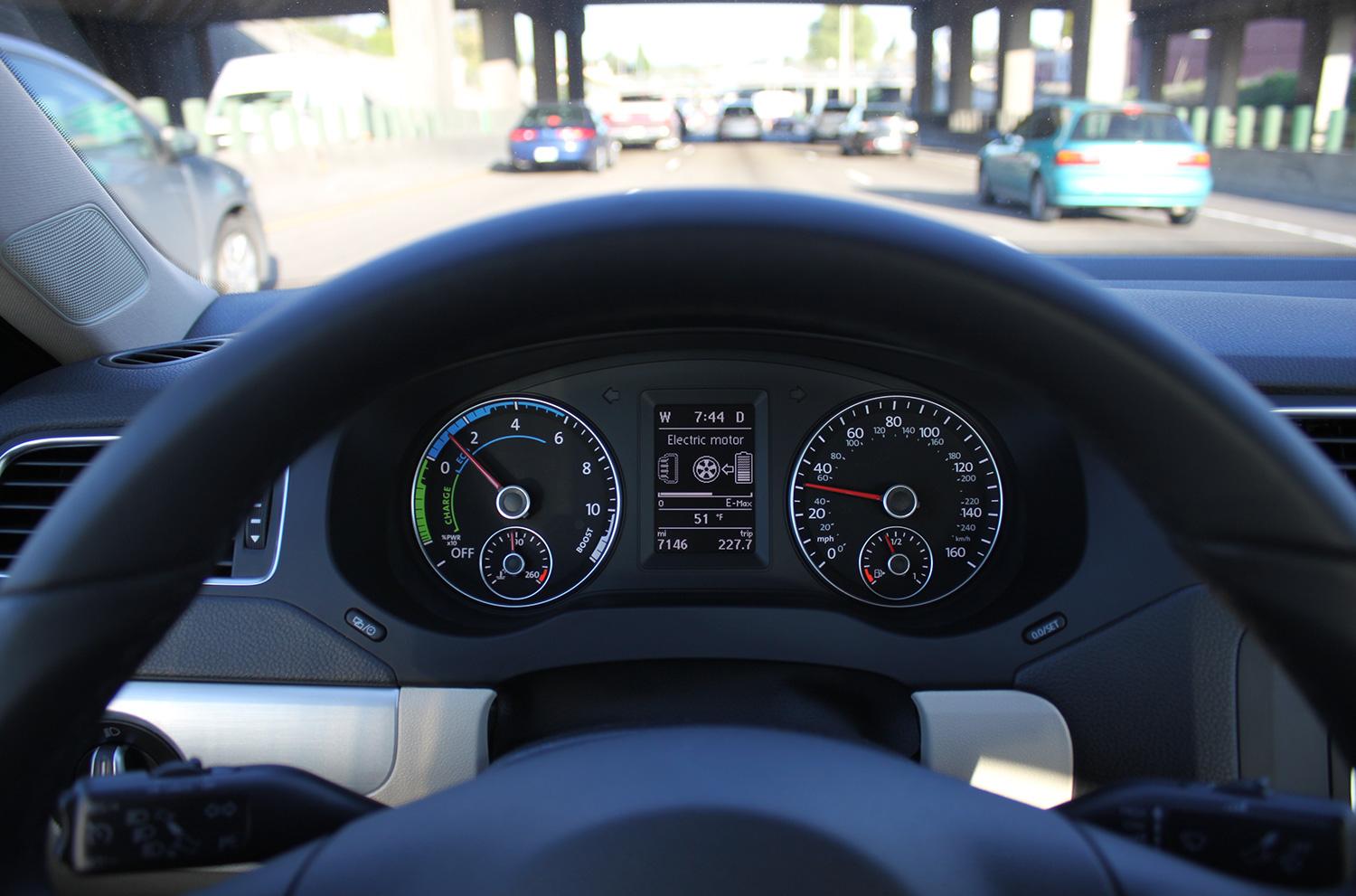
Back in town, a light foot on the go pedal and pushing the E-Max button drops the Jetta into electric-only mode, which is good for up to about 40 mph, and in my experience, at least six miles of gas-free driving. “E-Max” loads more of the driving duties onto the electric motor, and I’m lucky enough that those six miles cover my commute to work at Digital Trends. The small central screen in the instrument cluster sports monochrome 8-bit graphics, but that’s not a knock – it was easy to read quickly. It keeps you informed of numerous stats points, but the most useful was the one showing where the car was getting power from, along with how much more you could push the electric motor before the gas engine kicked in to take over.
The large analog gauge to the left, where a tachometer should be, doesn’t actually function as a tachometer – a major oversight for a car with a willing engine and a sport-shifting Tiptronic gearbox. Instead it shows how economical your driving habits are on a scale of 1 to 10 (higher is worse), and shows regenerative braking status. Mostly, it just makes you feel guilty as the needle swings towards “10” on the energy useage scale while you’re out railing the Jetta through the twisties. Tach mode, please.
On the greener end of the spectrum, it became an addicting game to see if I could use the gauge and data screen to roll the whole distance to work on electrons alone. If not for an uphill section of freeway right at the end that the little electric motor just could not summit, I was almost able to do it several times during the morning rush hour when congested freeway traffic kept speeds at 40mph or less. Still, using less than a shotglass worth of gas to drive to work in such a nice machine made me feel better. I finally understand why owners of Chevy Volts and plug-in hybrids love to play this game: It’s a worthy challenge, and it’s fun to screw Big Oil out of as many ducats as possible. A 40hp electric motor would likely get me all the way to work.
Another benefit of battery-powered motorvation: smoothness and quiet. It’s not like the little gas-sipper under the hood is buzzy or loud, but once you pilot a car in EV mode down a smooth road for a while with no stereo on, the lack of vibration, low sound level and general calm of the experience is fairly extraordinary. When the gas engine jumps back into the mix, you know it. I can see why Tesla owners gush about driving their cars.
Eventually, I believe cars designed with a lot of urban driving in mind will work on electrical power for the most part, and people will love driving them for the ethereal, near-silent (and gas-free) driving experience. Of course, we’ll all get used to it eventually, and 20 years from now when we climb into a then-ancient 2014 EarthRaper GT that runs on gas only, we’ll boggle at the crudeness and inefficiency of the internal combustion engine and wonder why we worshipped it for so long.
It’s the whole package, and then there’s the price
Thirty large is a lot for a hybrid that blends in more than it stands out, so it’s a good thing the Jetta Hybrid came loaded with just about everything, including navigation, a backup camera, sunroof, LED tail lights, dual climate controls, heated seats and the usual spread of airbags and warning systems. However, the me-too looks are quickly forgotten as the car screams up hills and through corners, or glides silently along in town.
It would be great if the Jetta Hybrid qualified for $7,500 worth of love from the Feds (and possibly more from state/local governments) due to it’s gas-avoidance technology, but since it doesn’t “plug in” to charge up, it sadly doesn’t. If it did, $22,500 or so for the Jetta when all is said and done would be a great deal. However, Uncle Sam does grant tax credits for buying hybrids, check your local governmental website for more information.
It’s going to take a lot of E-Max driving to make $30,000 feel like a smoking deal. Good thing the Jetta Hybrid scores high in smiles and miles per gallon. Next year add a cord, VW?
Highs
- Power trio of engine, turbo and electric motor combines for unexpected driving fun
- Electric-only mode a huge gas saver on short urban trips
- High-quality fit and finish
- Tech interface is simple to master
Lows
- Electric-only range is too short (when will it ever not be?)
- Style blends in
- Really needs a tachometer
- Hefty price tag


