“We didn’t know what we were missing from the EV market until Jaguar introduced its I-Pace”
- All the curves we’ve been missing from EVs thus far
- Butterfly-inducing acceleration and handling
- Stylish, upscale interior
- Plush ride within a silent cabin
- A higher level of regen braking facilitates one-pedal driving
- Saps its battery quicker than desired
- No network of 100+kW fast charging stations means longer wait times
“Why you can trust Digital Trends – We have a 20-year history of testing, reviewing, and rating products, services and apps to help you make a sound buying decision. Find out more about how we test and score products.“
An electric storm is brewin’, and though we’ve heard reports of landfall here and there, we’ll see the brunt arrive next year. Electric vehicles will descend from the heavens, claiming cities and suburbs in silent force. What we’ve seen from Nissan, Chevrolet, and even Tesla is nothing compared to the impending onslaught of alternative energy transport.
And, like the biblical flood, this storm will be cleansing. Humanity’s polluting ways will change; the earth will rejoice; children will play in the streets once more (if they can pry themselves away from their screens).
Perhaps, in time, the societal shift caused by broadly available electric vehicles will be that dramatic, but in the short term, EVs will remain a luxury for those with access to charging infrastructure and funds for higher-than-average new car prices. It’s curious, then, that premium brands weren’t the first to scale all-electric cars. BMW chipped in with its i3, but that was more stylish than premium. Tesla bridged the gap, but its version of luxury wasn’t yet to the standard of most affluent shoppers.
Very soon, Audi, Mercedes-Benz, BMW (again), and Porsche will offer EV models, but it’s Jaguar that leaps first. At $70,495 (including destination), and with 234 miles of range, the 2019 Jaguar I-Pace directly challenges Tesla’s Model X 75D SUV ($84,000). Provided the right amenities and execution, the I-Pace will both divert Model X customers and disadvantage future rivals.
The 2019 Jaguar I-Pace won our award for the best products of the year. Make sure and check out all our other selections for Best Products of 2018.
The right tech, the wrong way
The I-Pace is loaded with convenience and safety technologies in a layout that’s more familiar than Tesla’s tablet-dominated interface. Unfortunately, a confusing menu structure and slow processing speeds can make the Jag’s tech frustrating, or worse — distracting.


Every I-Pace ships with a digital driver display, 10.0-inch touchscreen infotainment, 5.5-inch accessory monitor, Apple CarPlay, Android Auto, Wi-Fi hotspot, Bluetooth, and a Meridian sound system. Jaguar’s TouchPro Duo interface shows off crisp graphics and rich colors, but constantly bogs between inputs. Sifting through the vehicle, navigation, and other settings is a bit of a chore as well. The lower display is much less complicated and offers neat shortcuts for HVAC and media controls, but excessive glare makes it difficult to read the screen. We anticipate Jaguar’s over-the-air updates will improve layouts and hasten response times, but early I-Pace customers may have to put up with usability flaws in the interim.
Sifting through the vehicle, navigation, and other settings is a bit of a chore.
The driver display and optional head-up unit are better executions. Useful information like posted speed limits and route guidance are shown prominently, and reconfiguring the screen is made easy with steering wheel controls.
Standard driver assistance technologies include automatic emergency braking, rear cross-traffic alerts, lane-keeping assist, a backup camera, front and rear parking sensors, traffic sign recognition and parking assist. Optional is an adaptive cruise control system, blind spot monitoring, 360-degree camera, and high-speed emergency braking.
Plenty of pace
Contemporary EVs have several performance advantages over their gas-powered brethren, and Jaguar turns each of these into weapons. It starts with the platform, which stretches the I-Pace’s 90 kWh battery pack across the floor. This gives the vehicle an ultra-low center of gravity and disperses weight evenly front and rear (50:50). Without the burdens of an engine and transmission, Jaguar was also able to push the wheels to the absolute ends of the body, improving cornering stability.
Two electric motors — one powering each axle — apply 394 horsepower and 512 pound-feet of torque to all four wheels. Peak torque develops in just 250 milliseconds and scoots the I-Pace to 60 mph in just 4.5 seconds. Top speed, meanwhile, is a modest 124 mph (so keep the drag races to a quarter mile). While the I-Pace is showing off its sports car rivaling thrust, it’s also whispering turbine music through the cabin speakers. We dig the subtle whir while straining our neck muscles, but those who prefer silence can engage the I-Pace’s active noise cancelling.
While the I-Pace is showing off its sports car rivaling thrust, it’s also whispering turbine music through the cabin speakers.
We expected to love its straight-line speed, but didn’t anticipate the I-Pace’s driving engagement. Trigger dynamic mode (part of the optional adaptive dynamics system) and the EV sharpens throttle response, increases steering effort, and stiffens the air suspension. Lugging 4,800 pounds through corners is a big ask, but the I-Pace stays flat and fluid. Steering feel is predictably muted, but the I-Pace goes right where you point it without hesitation. The higher of two levels of regenerative braking mimics the aggressive engine braking of a motorcycle, letting us operate almost exclusively with the accelerator pedal and turning a boring commute into a game of liftoff guesswork. We’ll just come out and say it: the I-Pace is a blast to drive.
There is a drawback to all that feline friskiness, however: anything less than conservative cruising drains the I-Pace’s battery in a hurry. Nothing is a bigger buzzkill than watching an EV’s active range estimator drop 80 miles as soon as you tap into its performance. And, when you arrive at an anxiety-inducing figure like 50 miles of remaining travel, there won’t be a 120 kW Tesla supercharger at your disposal.
Instead, the I-Pace will bring up a list of nearby commercial fast chargers – most of which are 50 kW units – for you to choose. Once you find an available unit (the I-Pace doesn’t yet show whether chargers are occupied), set aside 1.5 hours to recoup 80 percent capacity. If you are blessed with access to a 100-kW stall, you’ll only need 40 minutes to hit the same mark. Charging to 80 percent from a 220V home outlet requires 10 hours.
An elegant EV
We’d been looking at the Tesla Model X’s amorphous figure for so long we’d started to think it normal or even comely. Then Jaguar came along and shattered the spell.
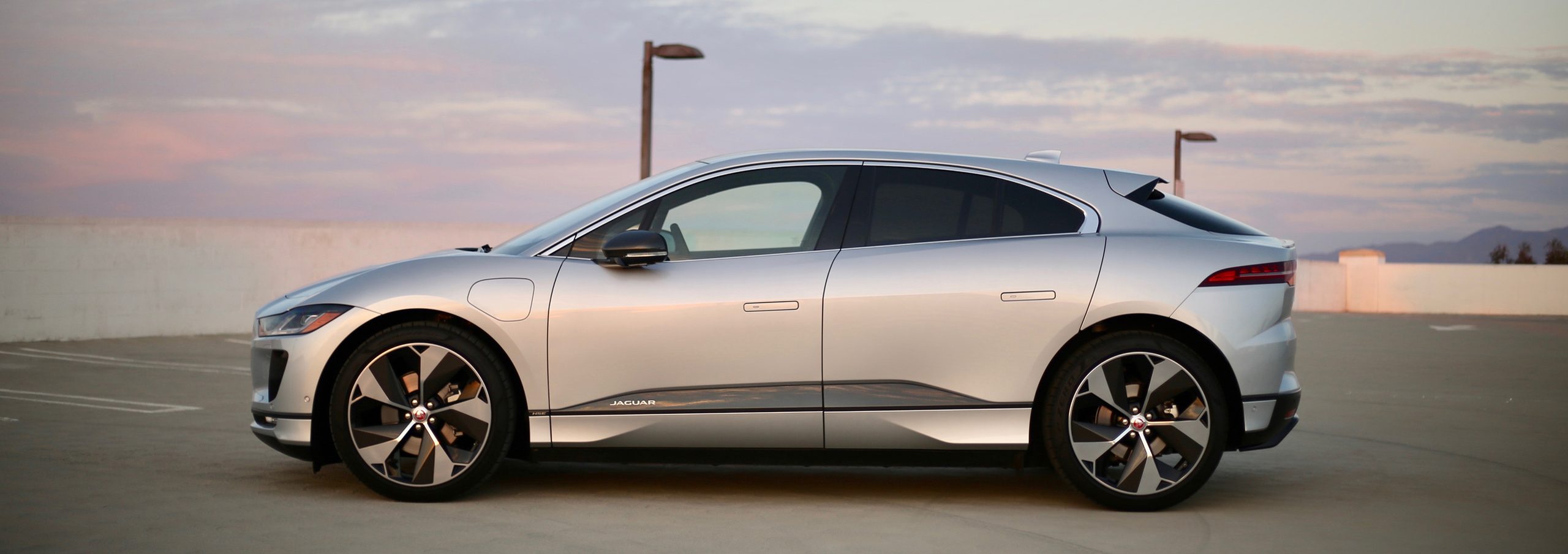
Though shorter and stubbier than the Model X, the I-Pace is more elegant and provocative. Sharp LED light signatures at the front and rear pair with curvy haunches and an aggressive roofline. Framed by a pair of air inlets, Jaguar’s corporate grill helps cool the car’s heat exchangers. Standard 18-inch wheels can be upsized to 20- or 22-inch styles, decreasing ride comfort as they grow.


We’re on the fence about the I-Pace’s sliced, chunky bottom as a contrast to the smooth curves comprising all other panels. Viewed separately, the caboose is cool (it also contributes to a slippery 0.29 drag coefficient), but a 360-degree tour gets confusing. We’re also skeptical of Jaguar’s claim that the rear window angle makes a wiper unnecessary; it seems like an ideal spot for snow buildup.
Inside, Jaguar continues to sell us. A choice of leather or premium textile and microfiber suede covers the seats and door panels. Brushed metals mingle with piano black trim to etch a stylized, upscale aesthetic. Some may still prefer Tesla’s minimalist layout, but the Jag feels like a genuine luxury experience. A massive panoramic glass roof invites a fresh ambiance, with tinting to cut down brightness. Thanks to a flat floor and smart packaging, there’s plenty of legroom for rear passengers, though headroom for the middle rider is reduced. Cargo space is excellent as well, with 25.3 cubic feet available behind the second row, and 51 cubes with the seats folded.
Peace of mind
Jaguar covers its owners for five years or 60,000 miles and includes scheduled maintenance for the entire term.
Jaguar’s warranty coverage is generous by all measures. While Mercedes-Benz, Porsche, and Tesla only offer four years or 50,000 miles of limited protection (without free scheduled maintenance), Jaguar covers its owners for five years or 60,000 miles and includes scheduled maintenance for the entire term. The batteries in the I-Pace are covered for eight years or 100,000 miles. Any dip below 70 percent capacity will prompt a replacement from the manufacturer. Tesla offers the same powertrain protection, but without mileage restrictions.
Tesla and the rest
We can debate whether the I-Pace is an SUV, a hatchback, or something in between, but it doesn’t change the car’s main rival: Tesla’s Model X 75D. With effectively the same range as the base Model X, the I-Pace is several hundred pounds lighter, almost a half-second quicker to 60 mph, more handsome, and over $10K cheaper to start. Standard features and cargo capacity favor the Model X, but the biggest argument for Tesla is its supercharger network.
This time next year, Audi’s e-Tron and Mercedes-Benz’s EQC will have also entered the fray, so it’s worth noting their specs. The e-Tron will be about a second slower to 60 mph than the I-Pace, should hit 240 miles of range, and will start at $75,795. Mercedes-Benz’s GLC-based offering will be about as quick as the Model X, is estimated to offer 200 miles of range, and will be priced from around $80,000.
How DT would configure this car
Our chosen I-Pace EV 400 would come in HSE trim ($11,000) with 20-inch five-spoke wheels, premium LED headlights with signature DRLs, a gesture-controlled tailgate, auto-dimming and power folding side mirrors, Windsor leather sport seats, a 15-speaker Meridian sound system, and all available driver assistance features. Standalone add-ons would include a head-up display ($970), cabin air ionization ($100), adaptive dynamics damping ($700), and adaptive surface response ($150). Painted in caesium blue ($575) with a premium textile/microfiber suede interior, our customized I-Pace would retail for $83,990 including destination.
Our Take
We didn’t know what we were missing from the EV market until Jaguar introduced its I-Pace. While offering the same range and technological sophistication as Tesla’s Model X 75D, the I-Pace brings forth style and athleticism beyond the scope of current players. And when the EV storm does hit, Jaguar will weather it from a shelter of customers and buzz.
Should you get one?
Until there’s a more affordable, beautiful, and dynamic offering, the I-Pace is our pick among premium EVs.