20 years ago, a hybrid was a Toyota Prius – end of story. Over the past two decades, hybrid tech has spread all across the automotive spectrum, and it has taken on many different forms. One of the newest is the Bosch 48-volt hybrid system, which presents a different kind of hybrid theory, one that brings the industry one step closer to meeting the stringent emissions regulations looming on the horizon.
A 48-volt hybrid system presents numerous advantages over other types of gasoline-electric powertrains. Notably, it’s cheaper than a full hybrid system like the one used in the Prius, and it’s much easier to integrate into an existing drivetrain, even one not designed with electrification in mind. The downsides are that it adds cost and weight to a non-hybrid car.
Bosch’s system is compatible with virtually every type of car on the market today.
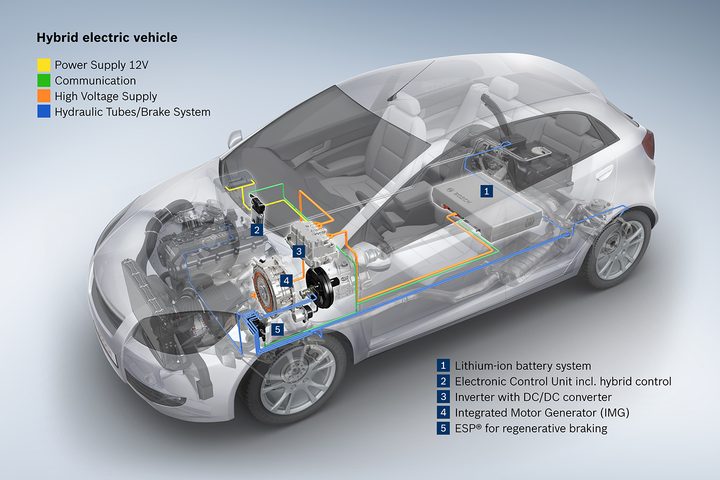
Its main component is an engine-driven motor-generator which replaces the alternator (if you’re in need of a refresher, the alternator is the cylindrical part that keeps your car’s battery topped up). In Bosch’s system, the motor-generator converts the kinetic energy generated during braking into electricity, and feeds it into a compact 48-volt lithium-ion battery pack. It also powers the conventional 12-volt system via a voltage converter. The result is lower fuel consumption, increased acceleration, and dramatic increases in overall efficiency.
The motor-generator is a little bit bigger than a conventional alternator, a Bosch engineer told us, but major packaging modifications are only required in extreme cases. The location of the battery pack – which weighs about 15 pounds – varies from car to car. It can be shoe-horned under the rear seat, hidden under the trunk floor, or mounted elsewhere. Highly modular, Bosch’s system is compatible with virtually every type of car on the market today.
Behind the wheel
We experienced the 48-volt technology on Bosch’s private test track in the heart of Germany. Our tester was a Volkswagen Golf-based prototype that looked fully stock save for stickers that denoted its experimental nature. Inside, a full-size Sony tablet attached to the dashboard provided information about how the four-cylinder and the electric motor were splitting powering duties. Of course, the software displayed on the tablet will be neatly integrated into the car’s dash-mounted touch screen when the technology reaches production.
As we pull away from our parking spot, the only indication that we’re driving a 48-volt prototype and not a standard Golf TSI is that there is virtually no turbo lag. The engineer riding shotgun tells us that’s because the electric motor gives the four-cylinder extra kick at lower engine speeds. As we approach the first roundabout, we notice the regenerative braking isn’t as strong as we expected it to be; it’s not stop-you-dead-in-your-tracks aggressive like in a plug-in hybrid or in an electric vehicle.
We negotiate a few more roundabouts to appreciate the low-rpm boost before merging onto the faster part of the test track. Much to our surprise, the engine shut itself off at about 50 mph. Did it just die? Should we hit the big red “STOP” button on the center console and run? Nope, the coasting function simply kicked in.
The Golf is completely silent as it whisks along a downhill stretch of the track.
Charged with enough electricity, the 48-volt battery pack can power volt-devouring accessories such as the air conditioning, the heater, the electric power steering, and the engine’s cooling fan(s). There’s no need for the four-cylinder to continuously spin the alternator in order to generate electricity. Bosch took advantage of this by developing a coasting function that shuts the engine off when the driver’s foot is off the gas pedal, allowing the car to coast freely.
The Golf is completely silent as it whisks along a downhill stretch of the track. Better yet, it consumes absolutely no fuel and emits no emissions whatsoever. When the track flattens out, a simple tap of the gas pedal is all it takes to swiftly and smoothly fire the 1.4-liter TSI engine back to life. The tablet keeps track of the coasting distances, and what percentage of the trip was spent coasting. It’s neat if you’re into numbers and graphs, but even if you aren’t, the fuel savings will surely put a smile on your face.
While the coasting function is a hyper-miler’s wildest dream come true, the 48-volt system isn’t only about going easy on the ozone layer. When saving fuel isn’t the order of the day, the motor-generator teams up with the four-cylinder to provide an acceleration boost.

As we mentioned above, the improvement is most present at low engine speeds, when the turbocharger hasn’t spooled up yet and the engine relies solely on its puny, regulations-mandated displacement to move 3,000 lbs of metal. We imagine the effect is also perceptible when passing, though we didn’t get to try the technology on public roads. Out on a race track, an augmented e-boost effect could certainly help a car get back up to speed quickly after a sharp corner.
The battery pack is too small to power the car on its own at anything faster than a crawl. Bosch is also developing what it calls a 48-volt strong hybrid system capable of running on electricity alone at up to approximately 50 mph, but we’re told the technology is a little bit more expensive than the mild hybrid setup we tried out. Consequently, it’s better suited to bigger and spendier cars.
What’s next?
The brand-new Audi A8 will be available with a 48-volt hybrid system as soon as it goes on sale, but a mass market vehicle it is not. Bosch predicts the technology will trickle down to more affordable cars by the end of next year, and it will become downright common before the turn of the decade. Technology like the mild hybrid system has the potential to save the internal combustion engine from an untimely death.
The 48-volt system goes beyond saving fuel. Our cars are becoming increasingly high-tech with each model year, and the various sensors, cameras, radars, and redundant systems baked into semi-autonomous machines suck up a lot of electricity. The 48-volt hybrid system is a cost-efficient and straight-forward solution to keeping tomorrow’s cars juiced up as they drive themselves down the nation’s roads.