
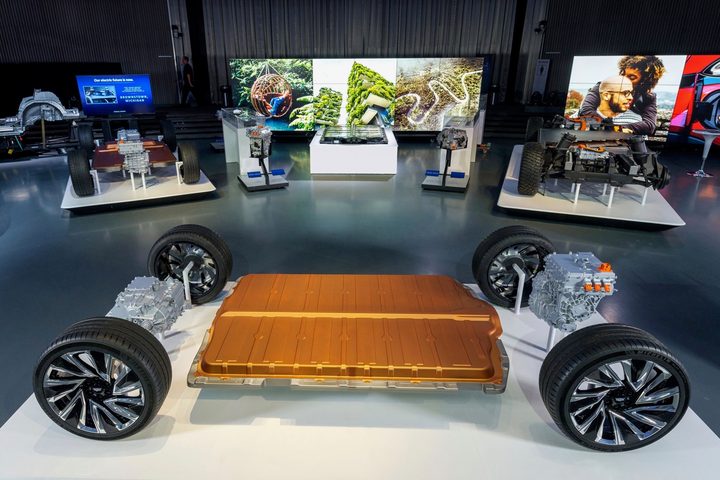
Electric cars are slowly, but surely becoming commonplace, and they introduce a whole new generation of specifications that are worth caring about. Range is an obvious one — but there’s another metric that has a major impact on the overall experience of owning an electric car: voltage.
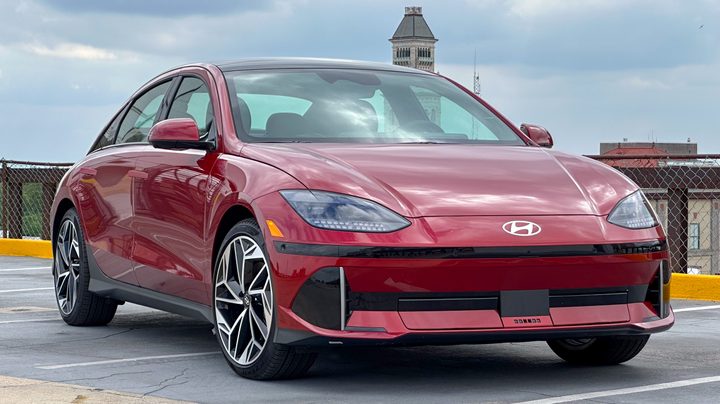
You’ll often see the voltage of an electric car’s battery pack touted in advertising. Hyundai, for instance, is proud of the 800 -volt battery in cars like the EV6 — that’s double the voltage of the 400V battery in the Tesla Model Y.
But what does that actually mean? Here’s everything you need to know.
Electricity 101
When you plug a charger into your electric car, electricity flows from the charger to your car’s battery. You can measure this flow in watts, volts, and amps, which each represent a different aspect of what’s going on. But the concept of voltage is relatively easy to understand.
Think of electricity like water, and voltage like water pressure. The voltage in this situation is the amount of pressure that’s applied in the pipes. More pressure pushes the water through the pipes quicker. The higher the voltage in a charging setup, the more energy that’s pushed through using less current.

The water analogy keeps going. Amps (or current) in this situation are equivalent to the size of the pipe. If you wanted to move a ton of water, you could either crank up the pressure, or make the pipe bigger. Electricity works the same way. Charging speed mostly boils down to voltage and current. With higher voltage, less current is required — and with lower voltage, higher current is required.
This is where watts come in, as these are an expression of overall power: To calculate watts, you simply multiply the voltage of a system by the amperage. So take 120 volts at 1 amp, for example, and you have 120 watts. That number represents a snapshot of power being transferred at any given moment, but your EV’s battery is measured in watt hours — that’s how we measure capacity. A kilowatt hour (kWh) refers to the power that can be supplied in the span of one hour. If your car has a 100kWh battery, it’s able to supply 100kW (100,000 watts) of electricity for an hour.
What higher voltage means
Head spinning? Don’t worry, learning all the new terms is over. Bottom line: To charge faster, more voltage or more current is required. Increasing the current, however, leads to more energy loss and heat — which makes actually charging faster more difficult. Thus, the better way to actually charge faster is by increasing the pressure inside that pump — with a higher voltage.
The fact that a higher current introduces more heat and energy loss means that higher-voltage cars can preserve power better too, by reducing energy consumption. High-voltage batteries can not only deliver more power, but more of that power will actually be used by the motor. And, because less energy is lost as heat, the battery is better preserved.
So why don’t all EVs use high-voltage systems?
Challenges of raising the voltage
Actually implementing a higher-voltage system means that car manufacturers have to redesign the circuits and components inside of a car to ensure that the systems are safe and reliable in a higher-voltage environment.
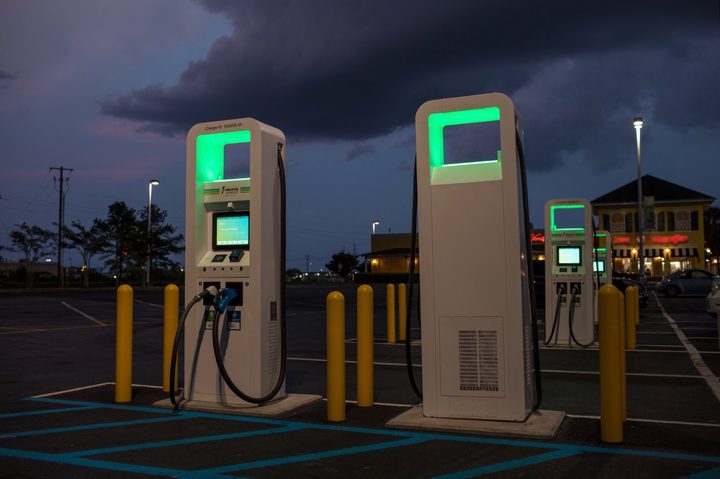
That in and of itself can be expensive. But on top of redesigning the electrical system of a car, the components that make up that system tend to be more expensive, too. So not surprisingly, the answer to why every car doesn’t use an 800V battery is simple: money.
Which cars are 800V already?
In today’s world, a higher-voltage system essentially means an 800V system — though it’s possible we’ll go even higher down the line. Lucid, which holds records for both range and charging speed, already uses 900V battery packs.
Some of the most notable 800V cars are the Kia EV6, Hyundai Ioniq 5, and Hyundai Ioniq 6, which not only make use of higher-voltage systems, but also come at a reasonable price — for EVs anyway. These cars can charge at 350kW, which is the fastest EV charging speed that’s widely available right now.
Other car companies that have adopted higher-voltage systems include the likes of Porsche and Audi, and they also offer cars that can make use of the full 350kW charging speed.
More are likely on the way. The Kia EV9, arriving very soon, offers an 800V architecture, however, Kia has announced that some of its upcoming lower-cost cars will make use of 400V architectures instead. Hopefully, 400V EVs become a thing of the past over the next five years or so.
But … my car charges at 350kW and is 400V
Then you must have something like the Hummer EV then. There are some cars that run on a 400V architecture, but can still make use of the maximum 350kW charging speed available, a charging speed that would usually be reserved for 800V cars.

In the case of the Hummer EV, that’s acheived through the use of a dual-layer battery, in which each layer is able to charge semi-independently.
There haven’t been too many other cars that make use of tricks like this, and ultimately, it’s likely that manufacturers will switch away from these kinds of tools in favor of full 800V architectures, at least over time.
There are clear advantages to 800V cars, however ,it may be some time before everyone makes use of them. Hopefully, that will happen sooner rather than later — especially given the fact that higher EV charging speeds are so important.


