
When sizing up options for your next car, you may be figuring out whether to get an electric vehicle, only to discover there are a bunch of variations to consider — not just hybrids, but plug-in hybrids, extended-range electric vehicles, and fuel cell electric vehicles are just some of the other categories. The depths of EV jargon run so deep that we wrote an entire EV glossary, but for now let’s zero in on the difference between electric vehicles, hybrids, and plug-in hybrids. These options blend old tech and new tech in a way that’s often practical, cheaper than an EV, and still more efficient than an old-school gasoline car.
What is an electric vehicle?
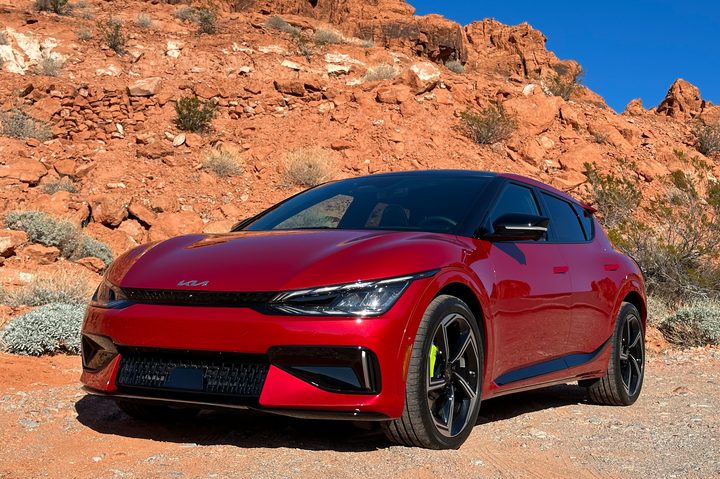
An electric vehicle skips the internal combustion engine found in most traditional cars in favor of an electric motor. This allows EVs to operate without needing gasoline. Instead, they’re powered by an electric battery that will need to be charged regularly, either at your home or at a charging station like a Tesla Supercharger. The Ford Mach-E, Kia EV6, and Rivian R1S are all popular examples of modern EVs.
The electric motor works by way of a rotating magnetic field. Inside the motor, three electromagnets surround a free-floating rotor, which spins based on which magnet is attracting it most. That rotor in turn produces power to the wheels of the car and pushes it forward and backward. Regenerative braking reverses the relationship and turns motion into electricity. While you’re slowing to a stop, the force of the turning wheels spins the rotor and generates a charge via the electromagnets in the motor, which in turn goes up into the battery for storage. If you’re curious, you can dig into the nuts and bolts of how an electric vehicle works.
What’s the difference between a hybrid and a plug-in hybrid?
In short, a hybrid primarily relies on gas with an electric backup, while a plug-in hybrid relies on electric power with a gas backup.
All the energy a hybrid uses derives from gasoline — you never plug it in. It just converts some of that energy to electricity to use it more efficiently. A typical hybrid electric vehicle (HEV) charges its batteries through regenerative braking. So when you apply brakes, an HEV uses the forward momentum to charge the battery, collecting energy that would otherwise be lost in a traditional car. That electricity can be used to run the hybrid at low speeds, like in a parking lot, or to help it accelerate. The Toyota Prius remains the most iconic hybrid, but they now come in all shapes and sizes, like the Kia Sportage Hybrid.
By contrast, a plug-in hybrid electric vehicle (PHEV) can also be charged via an electrical outlet, and generally relies on that charge for day-to-day-use. PHEVs generally have a much more generous electric-only range than HEVs — the modern Rav4 Prime is good for 42 miles before the engine kicks in. There are a few ways the internal combustion engine (ICE) and the electric motor can be arranged in relationship to one another.
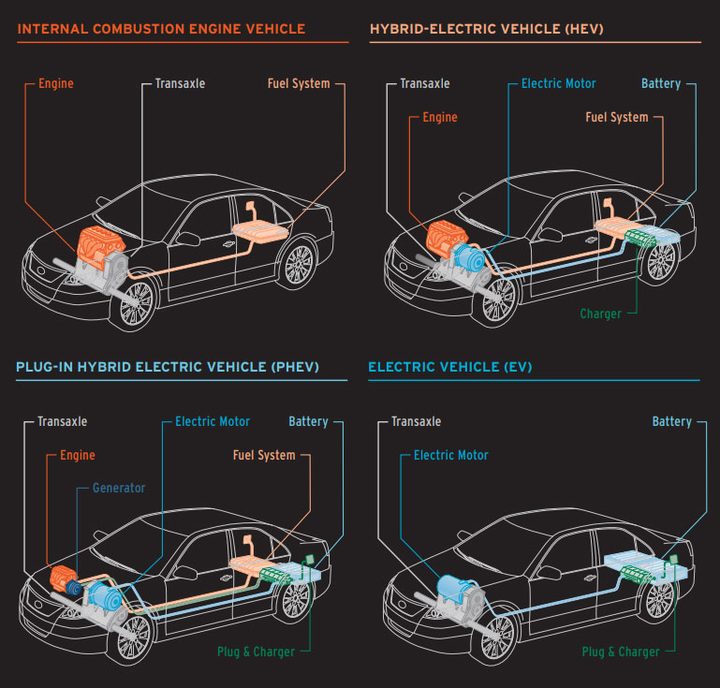
When a hybrid has a series drivetrain, the engine charges the battery pack. The battery pack then delivers power to the electric motor, which in turn moves the wheels. This typically results in small, efficient gas engines and larger batteries. This is a good setup for urban driving where there’s a lot of stopping. More battery means more capacity for storing regenerative braking power, plus you can enjoy quick startup once the light turns green with more abundant electric power.
In parallel, both the electric motor and ICE can move the wheels. The onboard computer figures out which kind of power is used, and when. So if you need instant torque, the electric motor is likely to be tapped, but if you’re on a long stretch of highway, the gas engine will likely do the work.
Series-parallel hybrids take things one step further by using both gas and electric power simultaneously. Typically, this will look like electric power used at lower speeds to get things started quickly, with gas power then added in to reach higher speeds. This is a more complicated (and therefore more expensive) layout than the other two hybrid systems.
Though EVs are becoming more popular, both hybrids and plug-in hybrids are still great picks for many consumers, especially those with range anxiety. Some PHEV buyers even prefer them to full EVs. If you’re still confused about the difference, be sure to check out our rundown of the difference between electric and electrified vehicles.


