

What a difference 10 months can make. In January, Honda unveiled closer-to-production versions of its first mass-market EVs at CES 2025. But as the year has dragged on, the reality of the Trump Administration’s anti-EV policies has set in, making the Japanese automaker more cautious. Even as Honda continues to develop EV tech and move these new models — dubbed the 0 Series — to production, uncertainty about the future was the thread running through remarks by Honda CEO Toshihiro Mibe shortly after the 2025 Japan Mobility Show.
Speaking to Digital Trends and other North American media at Honda’s global headquarters in Tokyo, Mibe discussed plans for more electric models and new battery tech, but emphasized that Honda does not view the current political environment as the right one for a full-speed EV push.
“With the IRA [Inflation Reduction Act] tax subsidies now gone, with the Trump Administration in place, we have sensed that EV growth has been moved back out by maybe five years or so, out into the further future,” Mibe said, speaking through a translator. “So the timing for doing anything will be difficult.”
The 0 Series is still on track, with a larger model coming later
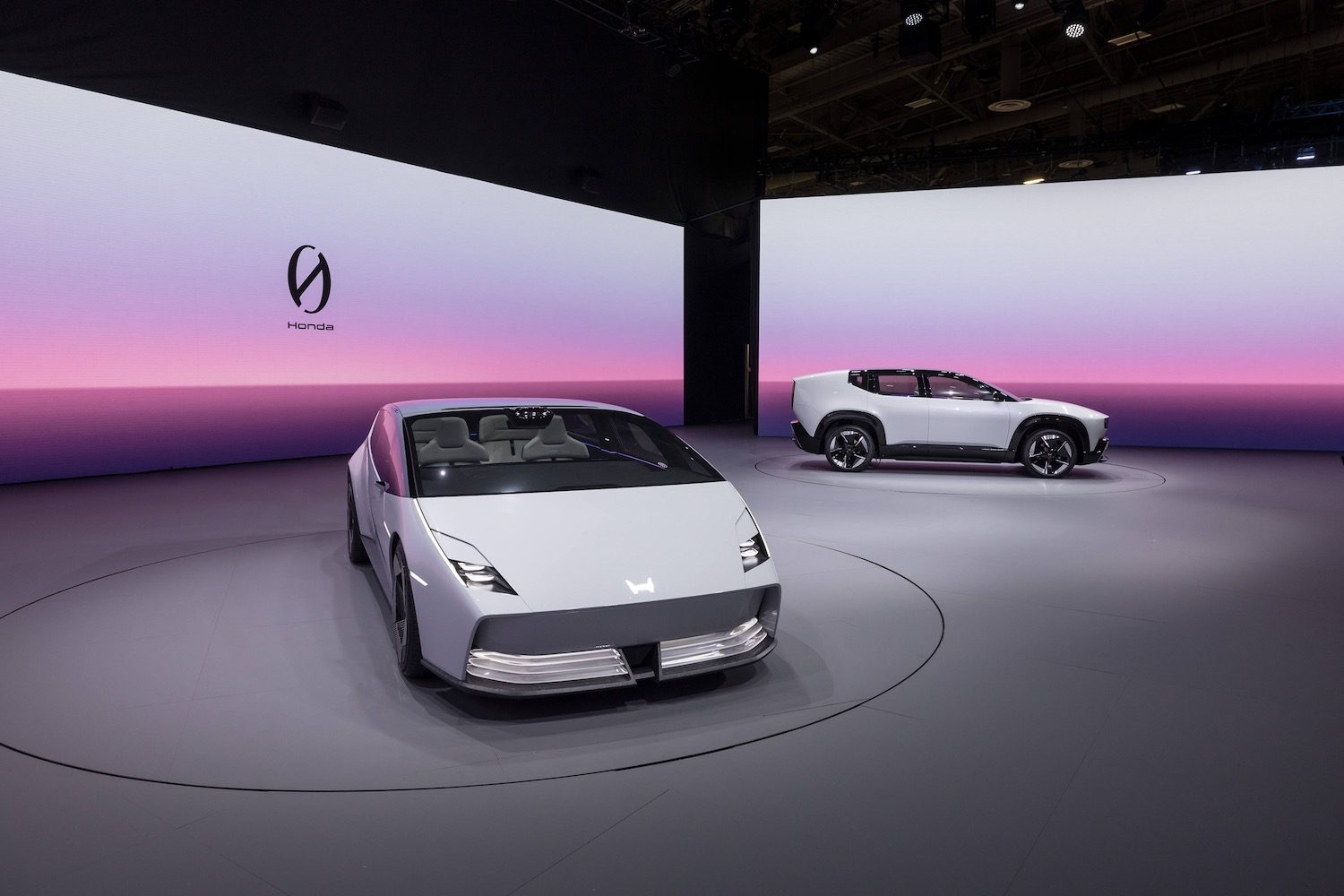
Honda announced the 0 Series at CES 2024 and unveiled what it calls “prototypes” of the first two models — an SUV and a super-sleek sedan — at CES 2025. Since that time, Honda pushed back the launches a few months, with the SUV now slated to enter production in Ohio at some point in 2026 (likely the second half of the year, when the Acura RSX for Honda’s luxury brand will also launch, along with the Afeela 1 from the Sony Honda Mobility joint venture) and the sedan following in 2027.
Mibe confirmed that Honda still expects to launch the 0 Series “according to our current plan,” but “probably initially the volume will be less than we had envisaged earlier.” Honda will likely keep “0 Series” in the names of the production models, “but we really haven’t made any official decision on the names,” he added. Honda will stick with just two 0 Series models for North America at first, but does plan to expand the lineup eventually, potentially with a larger EV in keeping with Americans’ attraction to big cars.
“We would like to come up with different platforms for EVs like large, medium, and small, and then would want to come up with a full kind of product range,” Mibe said. “However, it won’t be soon that we come up with a larger EV. Let’s say 2030 and later, which period we consider as where the wider adoption will be able to happen. At that time we will be coming up with a larger EV to be launched in North America.”
Solid-state battery development is continuing

Honda hasn’t provided much detail on the battery chemistry and format for the 0 Series, but Mibe suggested that the automaker could offer “affordable-level batteries and [a] high-performance one, too.” The CEO also confirmed that Honda is continuing development of solid-state batteries, which replace the typical liquid electrolyte with a solid material. Researchers see potential for increased energy density compared to conventional batteries, allowing for smaller battery packs without a range penalty. Honda is one of numerous automakers and startups working on this technology, but it’s unlikely to benefit production cars in the near term.
“Solid-state battery development is going quite well. We have already established a pilot production line, and we hope that sometime by 2030 or so we will be able to launch the product with that technology in the market,” Mibe said, noting that cost is a major hurdle, and that weak EV demand in North America isn’t exactly making a strong case for the cash outlay involved.
“In order to make that into the market we need to have the volume of the cars which can carry all that, otherwise it would not justify the investment,” he said. “So we would like to monitor the situation in the North American market.”
Honda is working on electric sports cars, hopes F1 tech can help

When most new-car shoppers think “Honda,” dependable ordinary cars like the Civic, Accord, and CR-V come to mind. But car enthusiasts know that there’s another side to Honda, one that’s created epic sports cars like the S2000 and Acura NSX, plus well-stocked trophy cabinets from over 60 years of racing exploits. Honda would like to continue that legacy in the EV era, Mibe said.
“We do have research on EV-based sports cars, and we have many prototypes already made internally,” he said. “But given this slowing-down environment of electrification in the market, it is kind of hard to decide when we would make them available to the market.”
For now, Honda hopes fans will make the connection between EV tech and its Formula One racing program. Honda will continue in F1 in 2026 as the powertrain supplier for Aston Martin. F1 uses hybrid powertrains known as “power units” that, beginning with the 2026 season, will derive half their power from an internal-combustion engine and half from electricity.
“In order to win in the races, we must have good EV technology in this power unit,” Mibe said. “We hope that we can find the right timing to launch sports-type EV cars, but the superiority of Honda EV power unit can be demonstrated in Formula One races.”
But an affordable EV is not a priority for North America

Honda unveiled a third 0 Series EV at the 2025 Japan Mobility Show, but it’s not coming to North America. The 0 Series Alpha is a smaller SUV intended for Japan and other Asian markets. It’s based on a downsized version of the architecture from the other 0 Series models, and is likely to be cheaper as well. But even with growing demand for affordable EVs, and refreshed models like the 2026 Nissan Leaf and 2027 Chevrolet Bolt EV, Mibe doesn’t think the time is right for the 0 Series Alpha — or any other affordable model — in North America.
“We are aware that there is a need to provide affordable EVs for the North American market,” Mibe said. But with Trump Administration policies expected to slow EV adoption, “you think about whether do we have to come up with this affordable EV right away, and we get the feeling ‘not really.’”
Mibe also said the 0 Series Alpha is “a tad too small” for the U.S., but that Honda will still “consider coming up with EVs under $30,000 as well,” likely for launch sometime in the 2030s. In addition to an unpredictable EV market, battery cost remains an obstacle, Mibe added.
“Unless the battery cost is significantly lowered, the total cost of the EV cannot be reduced significantly. That’s the reality.”
Meanwhile, Honda is hedging its bets with hybrids and carbon-capture tech

The CEO reiterated that Honda is committed to achieving carbon neutrality by 2050, which the automaker anticipates will require all-EV sales by 2040 due to the long lifecycles of new cars. But in the run up to that, the automaker will look to maximize hybrid sales and investigate other ways to keep internal-combustion engines in production with a minimal emissions penalty.
“For the immediate future, we will try to base the business in North America on hybrid vehicles,” Mibe said. Honda is already reviving the Prelude sports coupe as a hybrid, and will roll out updated hybrid powertrains in 2027, including one for the larger SUVs Americans love. However, the 0 Series won’t get hybrid powertrains, as they’re built around an EV-specific architecture, Mibe clarified. The hybrid-centric strategy will likely continue through at least the end of the decade as Honda waits to see which direction the political winds blow in the United States.
“Until 2030, hybrid vehicles will continue to increase,” Mibe said. “But what happens or what we do after that will really depend on what the U.S. administration’s regulations might do surrounding the environmental impact.”
Hybrids have lower emissions, but they still have tailpipes, so as Honda delays its EV pivot in the U.S., it’s also putting its 2050 carbon-neutrality goal in jeopardy. Mibe posited one scenario in which EV sales ramp up more steeply at a later date to make up for lost time, but also noted that Honda is researching carbon-capture technology, using carbon nanotube material to draw carbon from the air.
Honda isn’t the only automaker thinking along these lines — Mazda displayed a prototype system just a few feet from Honda’s booth at the 2025 Japan Mobility Show — but such technology would require new infrastructure to handle the captured carbon. And the need to use it will depend on how seriously governments and voters take the threat of climate change, Mibe emphasized.
“As long as humankind will not abandon efforts for global warming prevention we have to keep up the responsibility on the business side as well. That is how we devise our long-term strategies, toward that end.”