
Earlier this year, the Passport returned to Honda’s lineup after a long hiatus, but the real story with the new crossover is how different it is from the vehicles that wore the nameplate before it.
Previous versions of the Passport were tough, body-on-frame SUVs, but for 2019 the vehicle gets unibody construction that is much closer to passenger cars or minivans than it is to anything resembling an off-roader. Honda bills the new Passport as an adventure-ready crossover with some real off-road credibility. It certainly looks the business, but is it any good when the pavement ends? The answer is yes, mostly — but not for the reasons you think.
The Passport’s real trickery comes in how it uses technology to get the most out of the modest adventure-ready upgrades it got over the family-hauling Pilot SUV. Extra ride height and a shortened rear end certainly help it clear obstacles and make hill climbing easier for the Passport than its larger sibling, but those changes are only skin-deep without the clever electronics working behind the scenes to control them. No one will mistake the Honda for a dedicated rock crawling rig, but the vehicle’s capabilities far exceed the vast majority of buyers’ ability or willingness to use them.

I spent a week with the Passport earlier this year just after its official release but had a second opportunity to drive the vehicle when Honda invited me to Yosemite National Park earlier this month. We spent two days on the curvy roads in and around the Park, and were even able to sneak off for a few runs down hidden dirt roads in the area. These two experiences have shown me how the Passport uses technology to become a surprisingly capable vehicle that is able to hit a “sweet spot” of ruggedness and comfort.
Torque Vectoring
Torque vectoring is a fancy way of saying that an all-wheel drive vehicle can send power between individual wheels that need more grip. Honda’s got an even fancier title for the capability, calling it I-VTM4, short for “Intelligent Variable Torque Management.” We’ll just call it all-wheel drive to keep things simple. Where some all-wheel drive systems use braking to slow one or both rear wheels to increase the effectiveness of the others, Honda’s i-VTM4 system uses electro-hydraulically actuated clutches at each rear wheel to regulate the amount of power reaching each wheel.
The Passport’s all-wheel drive system is able to send as much as 70 percent of the power to its rear wheels and can shift that power completely between either rear wheel to maximize traction. That sounds complicated on paper, but in the real world it translates to a much more capable off-road vehicle and one that handles much more confidently on the road. The result is that, for better or worse, Passport drivers can get themselves into (and out of) much hairier situations than they could with a standard all-wheel drive system.
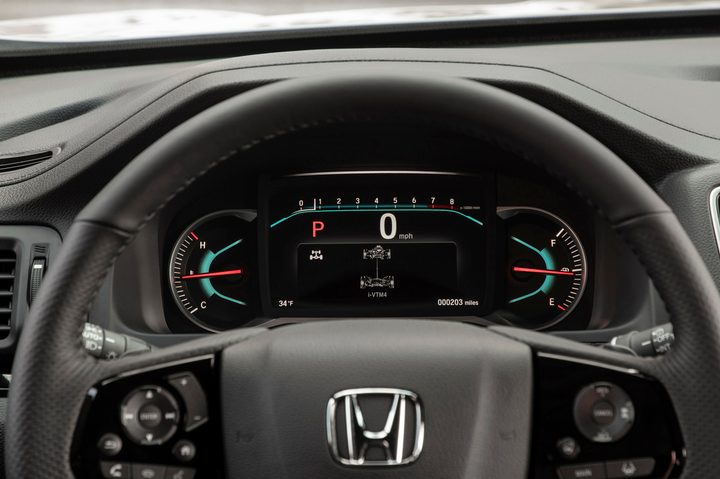
Even with this capability, most Passports will spend the vast majority of their lives on pavement. The i-VTM4 system works on the road to improve handling on curvy roads by moving power to the wheels that need to grip most and get the vehicle out of the corner. In poor weather conditions, the independent rear wheel power delivery helps keep the Passport planted and on the road.

Drive Modes
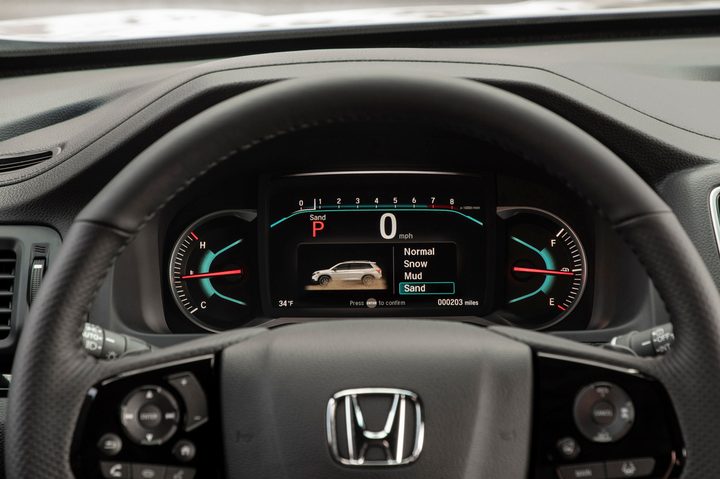
Where sports cars use selectable drive modes to shift between economy, road, and track situations, the Passport’s drive settings use Normal, Snow, Mud, and Sand modes to maximize traction on those road conditions. Modes can be selected with a button in the Honda’s center console and each selection gets its own animation in the digital gauge cluster.
Depending on the mode selected, the system remaps throttle response, transmission shift patterns, and torque distribution through i-VTM4. The result is a noticeable difference in the way the Passport feels and drives in everyday situations, and there’s usable traction when conditions are actually snowy, muddy, or sandy. On the loose dirt trails in the Yosemite area, Sand mode added more torque where it was needed and gave us the ability to navigate quickly and easily without worrying about slipping into a ditch or getting stuck. In my early drive of the Passport during a late-season New England snowstorm, Snow mode softened the throttle inputs and made it easy to get started, even when heading up a steep incline.
Safety Systems
Every Passport comes with Honda Sensing Safety tech, which includes collision mitigation braking, lane departure warnings, forward collision warnings, lane keep assist, road departure mitigation, and adaptive cruise control. These systems are in place to make the vehicle safer, but in real world driving it’s what they don’t do that contributes most to the Passport’s impressive driving experience. The advanced safety systems don’t interfere with everyday driving and aren’t over-the-top in their alerts when they do need to step in. Notifications for various systems are not frightening as they are in a few other vehicles, and the only time that alerts showed up unexpectedly were a few false alarms from the forward collision warning system. On the very curvy roads heading into Yosemite, the system appeared to read oncoming vehicles as a threat because of the extreme angles of the road.
It’d be hard to recommend the Passport to someone shopping for a hardcore off-roading rig, but for most people the Honda can take them much farther off the beaten path than they’ll ever want to go. The ability to move from being a comfortable on-road cruiser to being a capable trail vehicle is one of the Passport’s most notable assets, and make it a great adventure vehicle that is comfortable while still handling some pretty serious conditions.


