
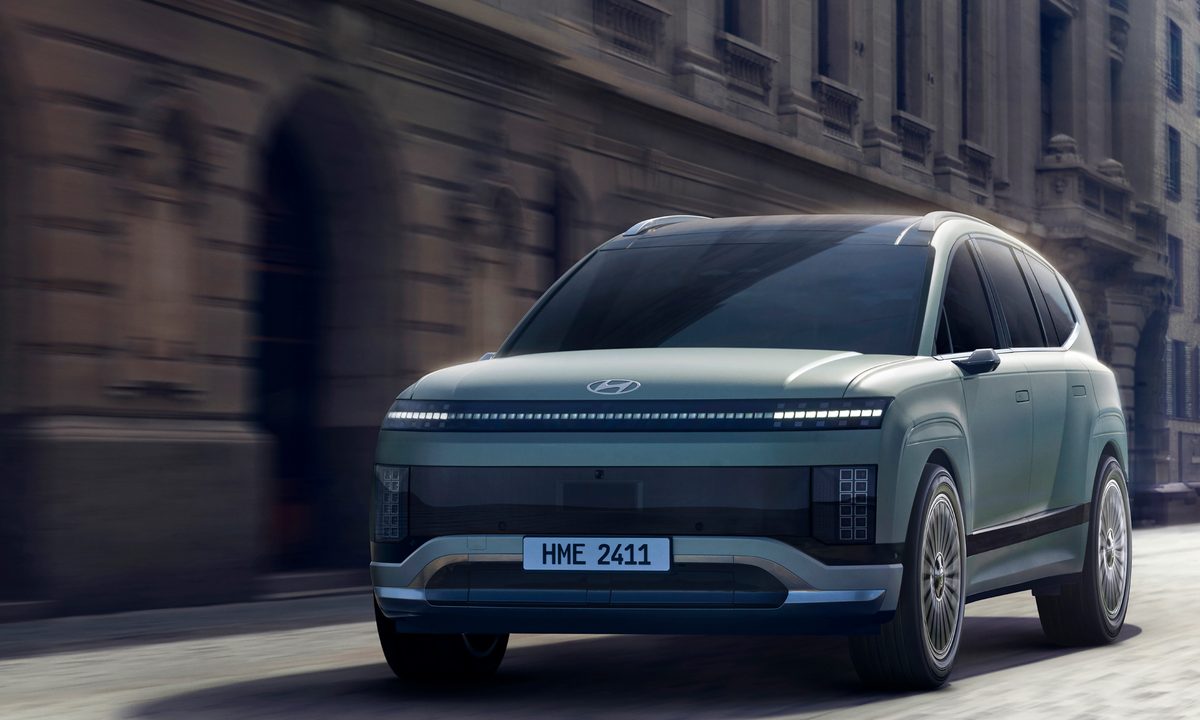
The Kia EV9 was a huge hit, proving that an electric SUV at a relatively affordable price is something that plenty of people want. Now, Hyundai is finally trying its hand at the same concept with the Hyundai Ioniq 9. The company has been teasing the Ioniq 9 for some time now, but finally, we have a much better look at it, along with some specifications for what it will offer under the hood.
The Ioniq 9 is based on Hyundai’s Concept Seven electric SUV, but it’s different from that vehicle in many ways. It incorporates elements from the much-loved Ioniq 5, but in a larger body. Essentially, it’s the electric SUV that you’ve been wanting from Hyundai.
Curious about the Ioniq 9 and whether it could be your next car? Here’s everything we know about the Hyundai Ioniq 9 so far.
Hyundai Ioniq 9 design
Hyundai finally showed off the Ioniq 9 at the LA Auto Show this week, which is a much closer-to-production version of the vehicle that was originally shown in 2021. In many ways, it looks a lot like that car that was shown off a few years ago, but a little more polished and a lot less concept-oriented.

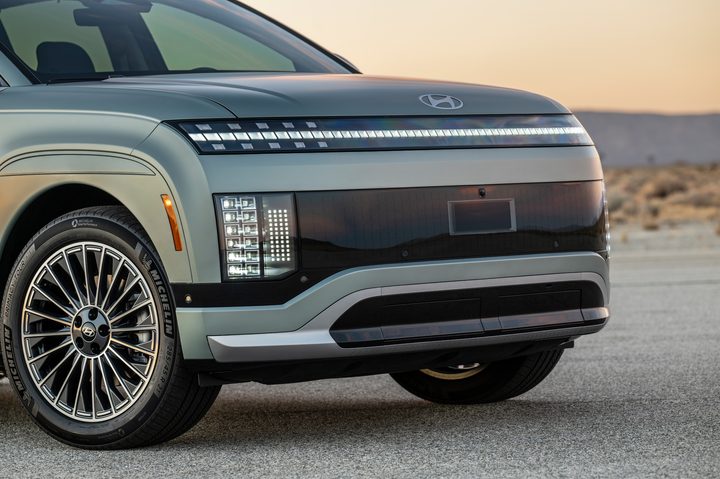
The exterior of the vehicle is large and curved, somewhat unlike some other SUVs that are a little more angular. It has a tall sloping roofline that terminates at the rear of the vehicle, which itself then juts down toward the bottom. It also incorporates many design elements from other Ioniq vehicles, like the pixel lights that stretch along the front of the car in a light bar and down along the two sides at the rear of the vehicle with the tail lights. That rear design is quite different from the concept version of the vehicle, which had an almost completely glass rear encircled in pixel lights.
Hyundai Ioniq 9 interior and tech
The interior of the original “Concept Seven” was designed around the philosophy of a living space on wheels — and in that version of the vehicle the seats could rotate to face each other. The close-to-production Ioniq 9 does away with many of those interior design elements and instead offers a more traditional interior. But the legacy of the living room on wheels concept does live on a little. For example, if you buy the six-seat layout, the second-row seats can turn around to face the rear, making for a slightly more social layout. These seats can only be moved while the vehicle is stationary, but it’s currently unclear if the car will be able to drive when the seats area already facing the rear. And, there’s a new so-called “Universal Island” that sits between the driver and front passenger, which is basically a storage console that slides backward or forward by 7.5 inches, allowing it to be used by the second-row passengers too.

Trunk space is impressive too, with the vehicle offering 21.9 cubic feet of space with the third-row seats up and an impressive 46.7 cubic feet with the third-row seats folded down flat. And, there’s a 1.8-cubic-foot front trunk in the all-wheel drive models, which is increased to 3.1 cubic feet on the rear-wheel drive models.
The Ioniq 9’s interior is still very spacious, too. There are three rows of seating, with options for either six or seven seats depending on how you configure the second row, whether it be a bench seat or two captain’s chairs. At the front of the vehicle, there is a dual display setup similar to that in vehicles like the Ioniq 5, with one screen for infotainment and the other for instrument monitoring. Like other modern Hyundai vehicles, the Ioniq 9 will support CarPlay and Android Auto through a wireless connection.
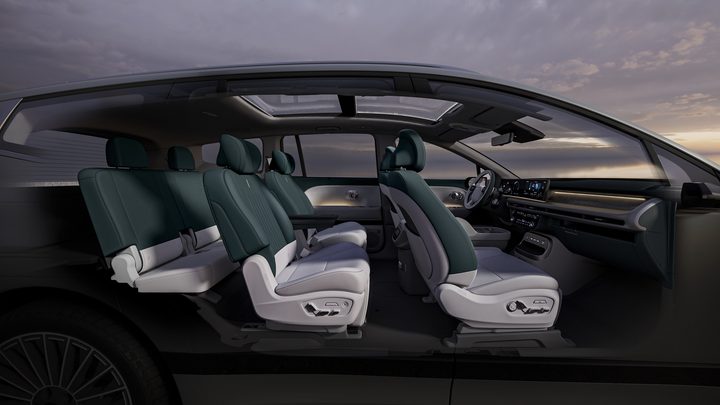
The Ioniq 9 also incorporates plenty of dedicated controls for climate, including a knob that controls temperature. Over the past year or so, we’ve been seeing plenty of manufacturers walk back from putting everything into the display, and I love that this is happening as it makes vehicles safer and easier to use. You’ll also find three USB-C ports for charging, wireless charging pads for phones, and other USB-C ports dotted around the cabin for the passengers.
The Ioniq 9 will receive over-the-air software updates, and has a new app store that Hyundai calls “Features on Demand.” This store will offer personalization features for the Ioniq 9, like special lighting patterns in the dashboard, although you have to pay for them. It’s nice that at this point it seems as though Hyundai is only really selling optional aesthetic upgrades, and not hiding hardware (like heated seating) behind a paywall.

Other tech features, some of which are optional, include things like the camera-based blind spot monitoring system that’s currently available on the Ioniq 5, Forward Collision Assist features.
Hyundai Ioniq 9 performance
The Ioniq 9 will come in two versions: a Long Range model (available in RWD or AWD) and a Performance model (only available in AWD). The entry-level Long Range RWD model offers a single 214 horsepower motor on the rear wheels and will be able to accelerate from 0 to 60 mph in a relatively slow 8.4 seconds. The Long Range AWD model adds a second 94-hp motor to the front, keeping the same motor on the rear, and steps up acceleration to 60 mph to 6.2 seconds.

The performance model uses that same 214-hp motor but puts them on both the front and the rear axles, and Hyundai says it’ll be able to get from 0 to 60 mph in 4.9 seconds, which is pretty quick for such a large vehicle.
These acceleration numbers aren’t necessarily ultra-quick, but keep in mind that these aren’t built to be racing vehicles. They’re built for families who need a little more space.
Hyundai Ioniq 9 range and charging
As mentioned, there are two versions of the Ioniq 9: a Long Range version and a Performance version. As the name suggests, the long-range version will offer better range, while the performance version will offer better performance. Currently, it seems as though all versions of the Ioniq 9 will have a 110.3kWh battery.
That said, we don’t have exact range figures for the vehicle just yet. Hyundai has, however, given us some hints as to what to expect, claiming that all variants of the Ioniq 9 will have at least 300 miles of range. That’s pretty helpful and means that you don’t have to sacrifice range just because you want the cheaper base model. Of course, it’s entirely possible that at a later point Hyundai will release an even cheaper version of the vehicle that has a smaller battery and costs less, but at least at launch, that doesn’t seem to be the plan.

The vehicle will charge quickly as well. It will use the same eGMP platform as other Hyundai Motor Group electric vehicles, and will support an 800-volt architecture that will enable a charging speed of up to 350kW, at charging stations that support it. And, it’ll come with the North American Charging Standard (NACS) port popularized by Tesla — so it’ll be able to charge at a Tesla Supercharger. Doing so may be slightly tricky though, as the charging port is on the passenger side rear, which means that at older superchargers, Ioniq 9 drivers may have to take up two spots so that the charging cord can reach the port. Newer Superchargers have longer charging cords that may be able to reach without the need to take up two spots, but we’ll have to wait and see.
Hyundai Ioniq 9 price and release date
One of the few things that we still don’t know about the Ioniq 9, beyond specific range numbers, is how much it’ll cost. That said, we don’t necessarily expect the pricing to be all that different from the Kia EV9, which starts at a little over $56,000 and ranges up to over $80,000 depending on the options and the trim.
According to Hyundai, the Ioniq 9 will go on sale in Korea and the United States in the first half of 2025, before eventually rolling out to other markets. It’s expected that eventually the Ioniq 9 will be manufactured at Hyundai Motor Group’s new plant outside of Savannah, Georgia. However, it’s unclear if that will be the case for the initial batch or just at a later date.
Hyundai Ioniq 9 tax credit status
A major reason that Hyundai wanted to build the Ioniq 9 in North America was to ensure that it qualified for the Federal EV tax credit. This would allow customers to get the vehicle for a lower price — ultimately translating to higher sales for Hyundai. At this point, however, it’s unclear if the vehicle will end up qualifying. To be clear, if the EV tax credit remains the same as it is now, then when it is manufactured in Georgia, it will almost certainly qualify for the credit. However, the incoming Trump administration is reportedly planning on eliminating the EV tax credit completely.
We’ll have to wait and see what the status of the Federal EV tax credit is when the vehicle launches in the U.S.


