Volkswagen is expanding its electric lineup even further. The company was relatively early to EVs with the ID.4, and since then, it has launched a series of additional models in various regions. Now, Volkswagen is prepping the launch of the new ID.7, an electric sedan that could rival the likes of the Tesla Model 3.
The ID.7 has been announced, and we know plenty of details about the car, but it has yet to be officially released to the public. Here’s everything we know about the Volkswagen ID.7.
Volkswagen ID.7 design

While some car manufacturers are getting more creative with the designs of their EVs, Volkswagen is taking a slightly more reserved approach. The Volkswagen ID.7 doesn’t look bad by any means, but you probably wouldn’t be able to tell that it’s Volkswagen’s all-new electric sedan just by looking at it.
The ID.7 does still look modern, though. It has a light bar across the front, connected to the headlights, and another on the back that connects the taillights. The headlights are slim and stylish, and the car features curved glass along the top.
The interior of the car is modern-looking too. There’s a large 15-inch infotainment display coupled with a much smaller instrument display behind the steering wheel. We have yet to experience the car for ourselves, but the materials look premium and comfortable, and there appears to be plenty of storage.
Volkswagen ID.7 tech features

As mentioned, the Volkswagen ID.7 will offer a large 15-inch display for infotainment, and the car will support wireless CarPlay and Android Auto, so you’ll be able to stream content from your phone to your car relatively easily.
The car will offer a range of driver-assist features too. There’s a head-up display, which will show things like speed, driving warnings, and more, and there’s adaptive cruise control that can help make the car feel like it’s almost self-driving on the highway.
Volkswagen ID.7 price
Volkswagen has yet to release official pricing information for the ID.7, but we do have hints as to how much the car will cost. Volkswagen said the car will cost below 60,000 euros (nearly $65,000). However, it’s largely expected to start at around $50,000 ($54,164) and range up from there for better or more powerful powertrains.
We’ll have to wait and see exactly how much the ID.7 ends up costing, but hopefully, it’ll be priced to compete with cars like the Ford Mustang Mach-E and the Tesla Model 3.
Volkswagen ID.7 release date
There’s no official release date for the Volkswagen ID.7, but we do know that Volkswagen has started manufacturing the car, and that it’s expected to launch in the U.S. sometime in the second half of 2024, following a launch in Europe in China. It will launch as a 2025 model-year car.
Of course, it’ll go up against some tough competition when it is released. There’s the Tesla Model 3, for starters, but it’ll also go up against larger crossovers like the Mustang Mach-E, the Kia EV6, and the Hyundai Ioniq 5.
Volkswagen ID.7 models and colors
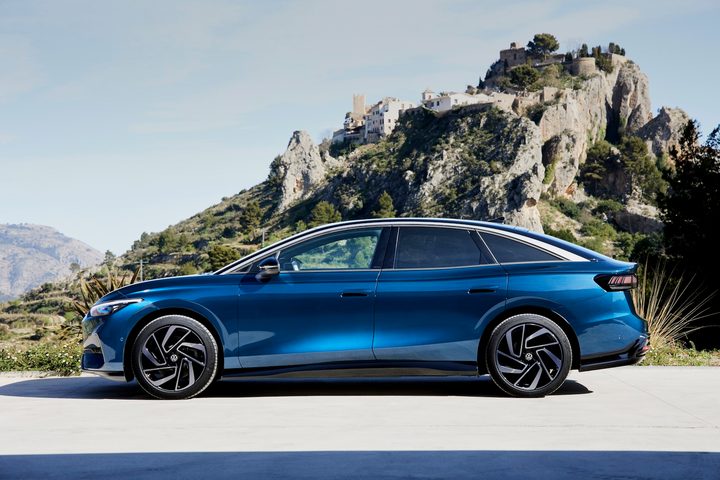
Like the Volkswagen ID.4, the ID.7 is expected to come in a few different trim levels. For starters, there will be the ID.7 base model, along with ID.7 Pro, Pro S, and Pro S Plus trims. The base model of the car will offer a single-motor configuration with 282 horsepower. Other variants, including a dual-motor, all-wheel drive variant, will be released at a later date. The main difference between these different trim levels will come down to performance and range.
We don’t know the exact colors that the ID.7 will come in just yet, but Volkswagen has been showing it off in a deep blue color, which looks great. It’s likely that the car will come in a similar color selection to the ID.4.
Volkswagen ID.7 charging speed and range
The differences between the trim levels largely come down to the range, and thankfully, the range on even the lower-end model looks to be pretty solid.
The battery pack in the ID.7 is the same 77 kilowatt-hour battery pack that was available in the ID.4, and it’s expected to deliver around 400 miles of range. A larger battery pack, which sits at 86kWh, will be released later on, and while we don’t know what kind of range to expect, it will likely offer a higher range option.
Charging speed is 170kW, which isn’t as fast as we would have hoped. Many cars offer a charging speed of up to 350kW, and a 170kW charging speed means the car will take around 30 minutes to charge. We’re hoping that other future EVs can push that speed a little.