
Tesla has enjoyed a years-long lead in the EV space, which has given it time to build an incredibly expansive charging network in the U.S. No matter where you’re driving, chances are you can get there using the Tesla Supercharger network, topping up your Tesla as you go. But what is a Tesla Supercharger? How do Superchargers compare with ordinary EV charging stations?
The short answer is that a Tesla Supercharger is a charger designed specifically for use with Tesla vehicles, and only Tesla vehicles. But things are also a little more complicated than that. Here’s the long answer.
Types of Tesla Supercharger
Tesla Superchargers aren’t all the same. There are three main types: V1, V2, and V3. As you might expect, V3 chargers are the most recent and most advanced type of charger, and they can charge at up to 250kW, though rumors indicate that they will support speeds of up to 324kW or faster through an update. Eventually, Tesla will begin building V4 Superchargers that will offer even faster speeds.
V1 and V2 Superchargers currently support charging speeds of up to 150kW — which is still quite fast and should charge a Tesla from 0% to 80% in less than 30 minutes. V1 and V2 Superchargers are still in operation, so you won’t always get the current maximum of 250kW with a V3 charger — but you still get fast charging in general.
Tesla Supercharger network
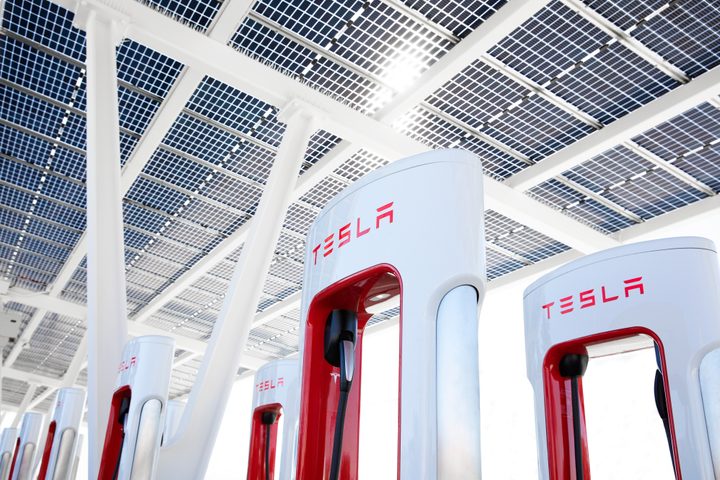
The Tesla Supercharger experience isn’t just about how fast they charge — it’s also about how often you can charge. Because Tesla has been at it for much longer than everyone else, the Tesla Supercharger network is huge — and Tesla owners can charge all over the country. According to the Tesla website, there are currently more than 40,000 Superchargers around the world, and there are many more to come.
The result? You can easily travel across the country on Tesla’s Supercharger network. It may require a little forward planning, but it’s possible — and it’s going to get easier and easier as time goes on. It’s also important to note the fact that Tesla users can use other charging networks — though it will require using an adapter to do so.
How much does it cost to use a Tesla Supercharger?
The cost of using a Tesla Supercharger varies based on a number of different factors, just like gasoline. Costs vary from location to location, day to day, and even hour to hour in some cases. Usage isn’t even metered uniformly: Some stations charge by the minute, some by the kilowatt-hour. In other words, it’s impossible to say exactly how much a Supercharger costs.
But generally speaking, a Tesla Supercharger costs around $0.25 per kW, according to Evannex, a maker of third-party Tesla accessories. That means that it should cost less than $20 to fully charge a Tesla, or less if you’re only partially charging it. The best EV charging apps can help give you an idea of the cost at any given station before you roll up.
Prior to 2016, Tesla offered free unlimited charging with some models, but it has since ended free Supercharging.
Can any car plug into a Tesla Supercharger?
No. Tesla cars can charge at most charging stations around the country with an adapter, but currently, no other car can charge at a Supercharger except in a few select areas where Tesla is testing allowing other cars to charge at Tesla stations. It’s possible Tesla will open its stations more in the future, but we’ll have to wait and see if and when that happens. Non-Tesla cars can’t even plug in at the station. That’s because Tesla cars use their own charging connector, and while the connector is no longer propriety, no non-Tesla cars have it yet. Non-Tesla EVs currently mostly use the CCS plug, which has risen to become the standard in the U.S. For more information on EV infrastructure, check out our comprehensive EV glossary.


