

“Apple brings a page from the MacBook to the desktop with its Magic Trackpad: an excellent - if still dubiously necessary - mouse replacement.”
- Gorgeous, well-built design
- Easy installation
- Intuitive software
- Works as well as Apple’s class-leading MacBook trackpads
- Rechargeable batteries not included
- Not as precise as a mouse
“Why you can trust Digital Trends – We have a 20-year history of testing, reviewing, and rating products, services and apps to help you make a sound buying decision. Find out more about how we test and score products.“
 Introduction
Apple has moved one step closer to banishing the button. After making significant inroads with touch-based input on the iPod Touch, iPhone, iPad and MacBook, Apple brings swipes to the desktop with the Magic Trackpad. While it basically amounts to the trackpad pried from a MacBook, blown up and made wireless, Apple’s past notebook expertise makes it one of the best in its class… for the narrow class of desktop owners who see the need to replace the mouse at all.
Features and Design

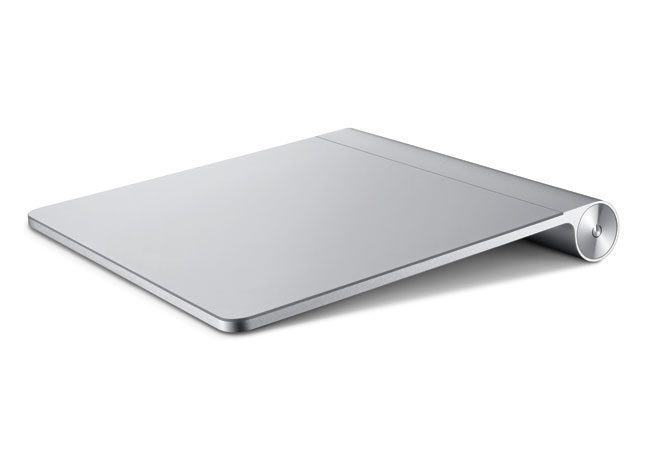
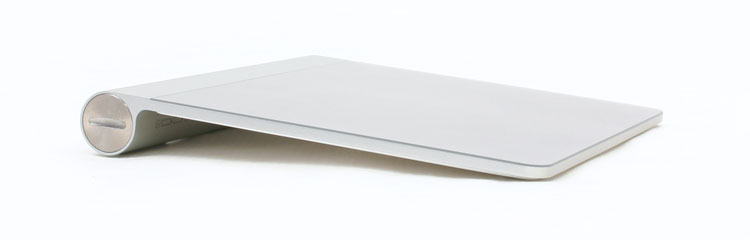
As an obvious accessory to the Apple’s Wireless Keyboard, the Magic Trackpad follows its design cues to a tee with frosted aluminum construction, a curled-over tube boosting it up in the rear, and clean lines all around. On the right edge, a power button turns the trackpad on and off, while a screw-on cap on the other edge, like the butt of a flashlight, lets you swap out the AA batteries nestled inside. A discrete light up top blinks to let you know it’s on.
The Magic Trackpad comes equipped with ordinary alkalines, but Apple also sells a charger and six NiMH rechargeables for $29.
Build quality, as you would come to expect from Apple, is top notch. You could probably use the Magic Trackpad as pastry scraper then turn around and mouse on it just fine.
Setup
Installation for the Magic Trackpad takes less than a minute – if you don’t count the time you’ll spend downloading Apple’s surprisingly hefty 70MB drivers. After installation, just tap the power button to put the Trackpad into pairing mode and your Mac will see it through the default Bluetooth setup wizard.
The Magic Trackpad does require Snow Leopard (Mac OS X 1.6.4) to function, but Boot Camp users, fear not: Apple makes both 32-bit and 64-bit Windows drivers for it as well. No need to swap mice when you swap operating systems.
Testing and Usage

Anyone who has used one of the latest generation MacBooks will feel right at home on the Magic TrackPad, since it functions absolutely identically. Pressing down delivers a firm click from the button-like rubber feet, and a number of multi-finger gestures make advanced features within OS X easier to access. A four-finger swipe to the side, for instance, brings up the application switcher, and doing the same motion up and down brings up Expose.
Like the trackpad on a MacBook, the Magic Trackpad offers a smooth, slippery surface that’s easy to glide a finger over without the sticking of a glossy pad or the drag of a dimpled pad. As far as we’re concerned, it’s as perfect as a trackpad can come, but that still doesn’t make it appropriate for precision mousing applications like gaming or Photoshop, and you’ll need to dial up sensitivity (and sacrifice some accuracy) if you expect to whip it from one corner of your 27-inch monitor to the other as quickly as you would with a mouse.
Apple’s software makes it a snap to make these adjustments, simply by going to the same “Trackpad” control under System Preferences that you would use on a MacBook. You can tweak tracking speed, double-click speed, scrolling speed, and even disable gestures you don’t want to accidentally activate.
Due to the raised design, placing the Trackpad in front of your keyboard interferes with typing, eliminating the familiar MacBook arrangement. However, it’s just as easy to use off to the side of your keyboard where a mouse would typically go.
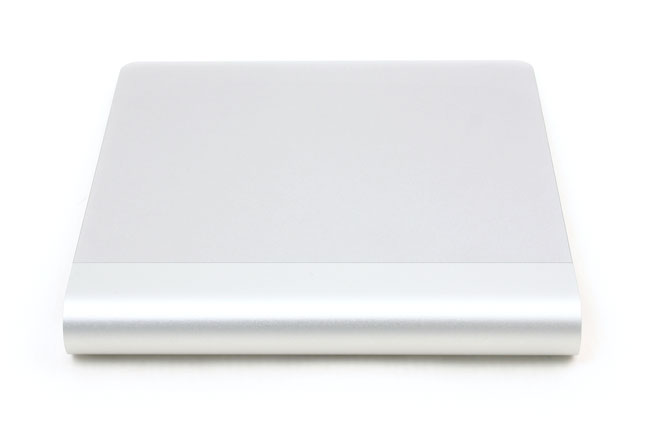 The 33-foot Bluetooth range conceivably makes the Trackpad a plausible home theater PC controller – and its dimensions are small enough to prop up on a couch arm or thigh in a bind – but without a keyboard, we can’t really see it functioning without software that presents an on-screen keyboard, like Boxee.
Conclusion
When Apple makes a mouse as foul as its Magic Mouse – and a trackpad as elegant as the one on the MacBook, it’s not surprising to see the Magic Trackpad emerge. And we have to give Apple credit: It’s probably the best replacement for a desktop mouse we’ve ever stumbled upon.
But who asked for a replacement to the mouse?
Carpal Tunnel suffers might find that the lack of clicking brings them relief. Students bound to tiny dorm room desks might find it works better than a mouse in tight quarters. MacBook devotees might simply miss their precious gestures. But given the step back in precision for gaming and Photoshop, you would really have to fit into one of these niches to consider replacing a perfectly workable mouse with a Magic Trackpad. (And by the way, software like xGestures can add gestures to a mouse, too.)
We’ll brush our skepticism over the need for the Magic Trackpad aside, and leave that for you to decide. Whether it belongs in a SkyMall catalog with orthopedic dog beds and laser parking systems or not, the Magic Trackpad does exactly what it says it does, and does it well.
Highs
- Gorgeous, well-built design
- Easy installation
- Intuitive software
- Works as well as Apple’s class-leading MacBook trackpads
Lows
- Rechargeable batteries not included
- Not as precise as a mouse


