
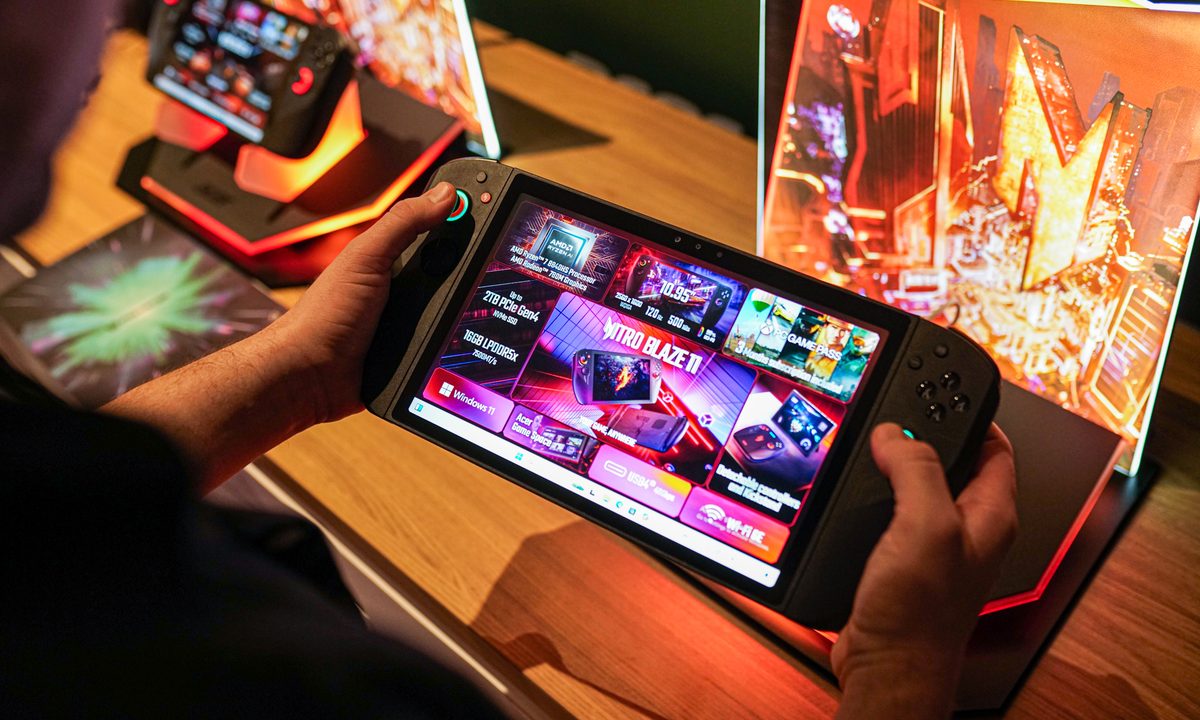
I mean, just look at that picture. That’s all you really need to see what I mean by calling an 11-inch handheld the craziest thing I’ve seen at CES 2025. There are always plenty of wacky concepts coming out of the Las Vegas Convention Center, but the Acer Nitro Blaze 11 takes the cake for not only being the largest handheld gaming PC I’ve seen but also being a real product that’s set to hit store shelves this year.
Outside of the screen size, the Nitro Blaze 11 is a fairly conventional handheld. It comes packed with an AMD Ryzen 7 8840HS chip, along with 16GB of LPDDR5X memory at 7,500MT/s and up to 2TB of storage. The Ryzen 7 8840HS is identical to the familiar Ryzen Z1 Extreme available in handhelds like the Asus ROG Ally, at least when it comes to core configuration, architecture, and clock speed. The main difference is that the Ryzen 7 8850HS is set to run at 28W in its default configuration while the Ryzen Z1 Extreme runs at 15W. Thankfully, the default power is something Acer can tweak.
The screen is really what’s interesting here, though. It’s a 10.95-inch WQXGA display, and it comes with specs identical to what’s available on the Lenovo Legion Go — outside of size. The resolution is 2,560 x 1,600, it comes with a 144Hz refresh rate, it’s a touchscreen, and Acer claims 500 nits of peak brightness. The Ryzen 7 8850HS isn’t powerful enough to run most games at this high of a resolution, though it works for lighter indie titles. Hopefully you’ll be able to easily scale down the resolution for more-demanding games.
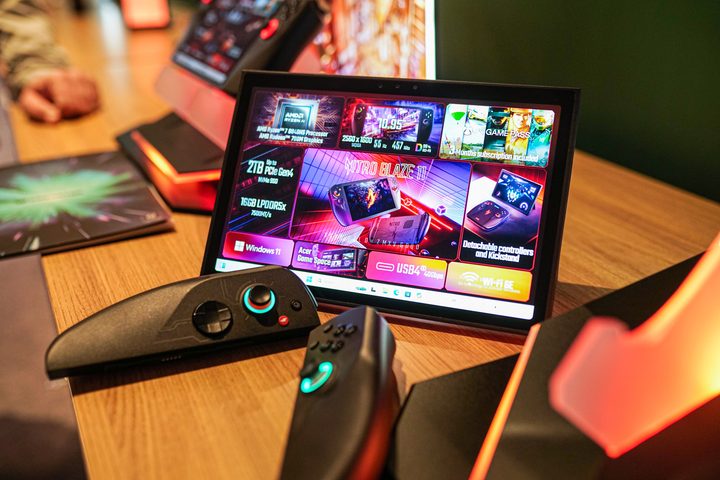
For connectivity, Acer includes dual USB-C ports — one that’s rated for USB 4 and another that sticks with USB 3.2 — and it includes Wi-Fi 6E and Bluetooth 5.3. It’s pretty much the standard affair that you’d expect out of a handheld gaming PC, just scaled up to an ungodly large size.
That sized is a bit of an issue, too. Playing on the handheld, I struggled to reach the triggers with my thumbs on the thumb sticks. You need to reposition quite a bit while playing games. The handheld is fairly heavy, too, clocking in over two pounds. It’s not unmanageable, though I don’t suspect I would be laying in bed playing on the Nitro Blaze 11 much.
Thankfully, it looks like Acer recognized how crazy the Nitro Blaze 11 is. It also has the Nitro Blaze 8 coming soon, which is identical to the 11-inch model from top to bottom. It even includes a 144Hz WQXGA display, just down at an 8.8-inch size. Both handhelds include a 55Whr battery, as well, which is a bit concerning for the 11-inch model. Some newer handhelds like the Asus ROG Ally X push all the way up to 80Whr.
Acer hasn’t revealed the pricing or release date for either handheld yet, but they should arrive this year. Hopefully I’ll be able to play around for a bit while I’m here in Las Vegas.


