
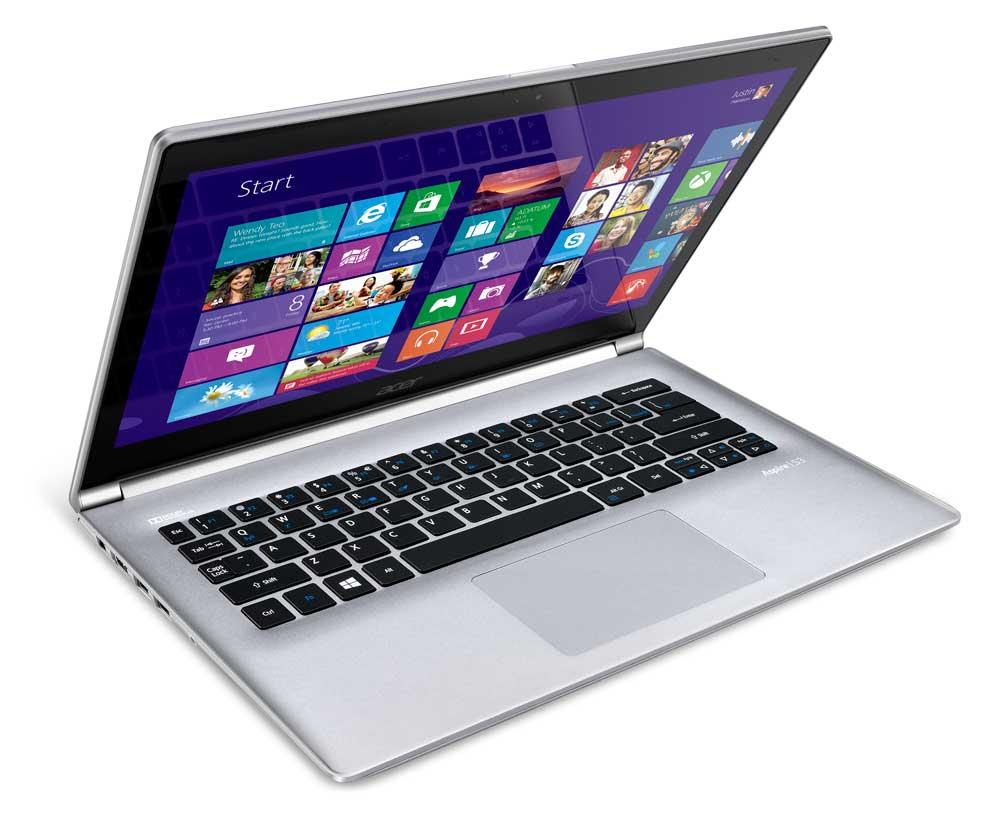
 Check out our full review of the Acer Aspire S7-392 ultrabook.
Building on the previous success of the Aspire S7 and the Aspire S3, Acer announced updated versions with fourth generation Intel Core processors, improved battery life, and WiDi today at Computex. While these new Ultrabooks are updates of previous models, there are significant changes, especially for the Aspire S3, which gets a new look and features that are more like its popular S7 sibling.
We first reviewed the Aspire S3 in late 2011, when it was one of the first Ultrabooks on the market (and still running Windows 7). A lot has changed since then and Acer has kept up with the changes by adding a 1920 x 1080 IPS touchscreen display that boasts viewing angles of up to 170 degrees. If that’s not enough of a view for you, the hinge on the new Aspire S3-392 opens to 180 degrees, essentially allowing you to open the notebook till it’s completely flat. Acer also says the new dual-torqued hinge design is wobble-free for a better touchscreen experience.


One our favorite features of the original Aspire S3 was the inclusion of a discrete graphics card. It’s still a rarity in Ultrabooks, so we’re happy to see that Acer has included an Nvidia GeForce GT735M card on the refreshed model. In addition to the graphics card and the Intel Haswell processor, the Aspire S3 has an option for 1TB hard disk drive. While we haven’t heard details on the inclusion of a solid-state drive, it’s safe to assume that there will be a hybrid option just like there was on the previous model.
The changes to the Aspire S3 aren’t only on the inside; the whole laptop has been redesigned to echo many of the design cues of the Aspire S7. Made of aluminum, the lid is then sprayed with glossy white paint to give it a reflective quality. There’s even an ambient light-sensing backlit keyboard.
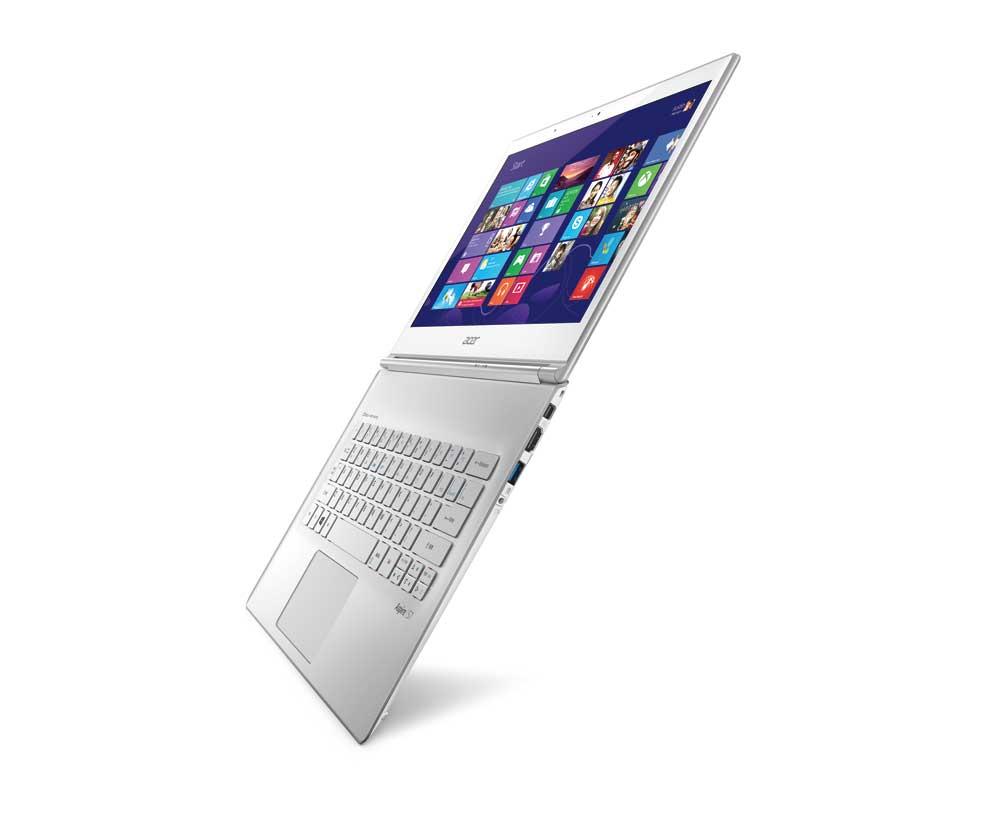
As for the Aspire S7, Acer’s updated it with several new features including Intel’s Wireless Display technology (WiDi) that allows users to wirelessly transmit video from their laptop to their HDTV. Of course, the new Aspire S7-392 is packing Intel’s new Haswell processor paired with an SSD and promises up to 7 hours of battery life – a 33 percent increase from the last model. In our review of the previous Aspire S7, we found the battery life to be below average, so we hope the model will show a marked improvement in our tests. Another complaint we had was the noisiness of the laptop’s fan. Acer fixed that this time around with its second generation Acer TwinAir cooling fan that brings the noise down to 31 decibels.
Like the Aspire S3, the Aspire S7 features a full HD IPS touchscreen display mounted on a hinge that rotates 180 degrees. The screen orientation can change with a hotkey combination so that images may be easily shared with a group.
On the outside, the Aspire S7 maintains its sleek, MacBook Air-esque looks, cutting a slim profile at just 0.5 inches thin and weighing 2.8 pounds.


We don’t have an exact release date, but Acer tells us it’ll be sometime in Q3 of this year. Pricing hasn’t been announced yet, but we expect to find out more soon.


