

We’ve known for months that Alan Wake 2 will be one of the most demanding games on PC, but new details show just how taxing the upcoming title from developer Remedy will actually be. According to a now-deleted tweet from a Remedy employee, somewhere around 23% of PC players won’t be able to play the game.
To be clear, the employee didn’t say that number explicitly. In response to the outcry over the Alan Wake 2 system requirements, the employee shared that only cards with mesh shaders are officially supported, meaning any Nvidia 10-series or AMD RX 5000-series GPUs or older aren’t officially supported.
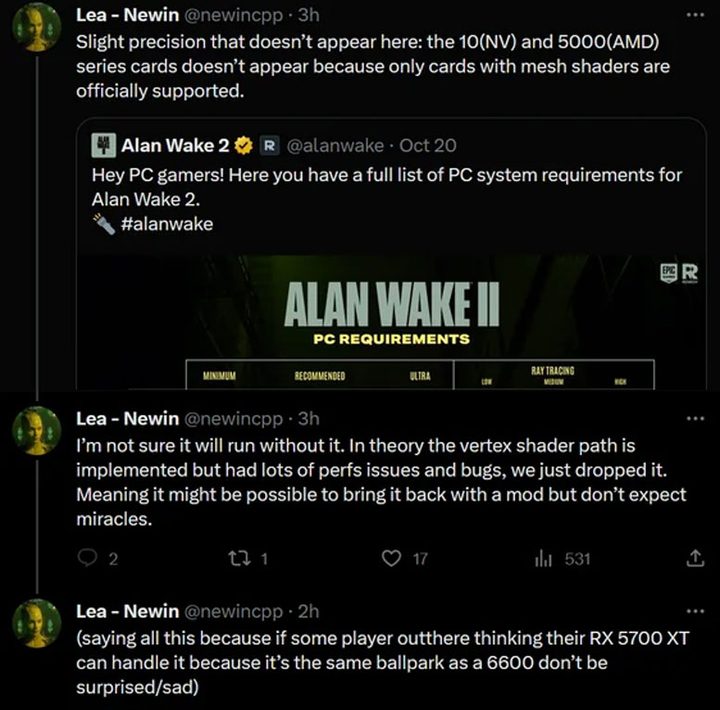
I did some quick math on Steam’s latest hardware survey, and that accounts for somewhere between 23% and 25% of participants, depending on if you count integrated graphics or not. The number is much larger if you include Nvidia’s GTX 16-series graphics cards, which support mesh shaders, but fall below the minimum requirements for Alan Wake 2.
The developer says that cards without mesh shader support will still run the game, but you’ll likely experience much lower performance. It points to the example of an RX 5700 XT and RX 6600 showing a large gap in Alan Wake 2 despite having similar performance otherwise. Strict mesh shader support, according to the developer, came up after the team experienced “lots of perfs issues and bugs” with a vertex shader path, leading the development team to officially drop support for it.
Based on the system requirements, it doesn’t look like PC gamers using these older cards wouldn’t be able to run the game anyway. You’ll need at least an RTX 2060 or RX 6600 to run the game at 1080p with the Low preset at 30 frames per second (fps), and that’s with Nvidia’s DLSS or AMD’s FSR 2 set to the Quality mode.
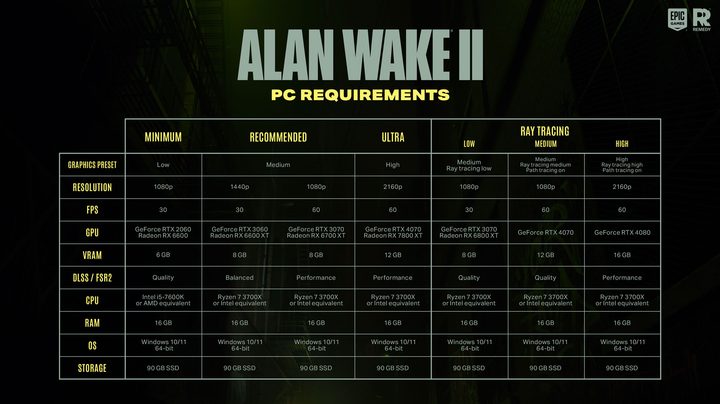
Upscaling has been another controversy surrounding Alan Wake 2, as it seems the game requires players to enable DLSS or FSR 2. That hasn’t been confirmed yet, but all of the tiers on the system requirements call for some form of upscaling, ranging from Quality to Performance modes.
There’s no doubt that Alan Wake 2 will be a tech showcase. The game will support Nvidia’s latest DLSS 3.5, including the Ray Reconstruction feature we saw in Cyberpunk 2077. It will also support path tracing, which is a far more demanding form of ray tracing that leads to realistic lighting conditions.
Alan Wake 2 launches on October 27, and we’ve had a chance to check out the game’s performance ourselves. Make sure to read our Alan Wake 2 PC performance breakdown.


