1. Home
  2. Computing
  3. News

AMD just launched a free tool all serious PC gamers should have

Add as a preferred source on Google
A screenshot of Frame Latency Meter running on top of a game render.
AMD

AMD has just unveiled Frame Latency Meter (FLM), an open-source Windows utility designed to measure the response time of games based on mouse movements. FLM measures the time it takes for a mouse movement to translate into a new frame on the screen, providing insights into system performance.

This tool is particularly aimed at advanced gamers, power users, and game developers who are keen on optimizing whole-system latency or reducing input lag. If you’re new to frame latency measurements, they are commonly used online to approximate input lag by measuring button-to-pixel latency.

Recommended Videos

This used to be done with a high-speed camera, a mouse, and an FPS game with a visible muzzle flash. The camera would capture the moment the mouse was clicked, and you would count the frames until the muzzle flash or other on-screen reaction appeared.
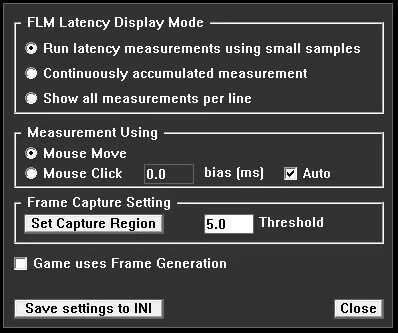
A screenshot of AMD's Frame Latency Meter software.
AMD

This utility does not require any special equipment and works with any AMD, Nvidia, or Intel GPU that supports DirectX 11 or newer. For capturing data, AMD GPUs use the Advanced Media Framework or AMF codec, while other GPUs use the DirectX Graphics Infrastructure or DXGI codec. FLM can generate detailed latency and effective frame-rate statistics, which can be exported to CSV files for further data analysis.

FLM measures latency by continuously capturing frames and comparing each one to the previous frame within a selected region. It then generates a mouse movement event using standard Windows functionality and waits for the frame contents to change. The time between the mouse movement and the detected frame change is recorded as the latency.

To achieve a cleaner value, 16 latency measurements are averaged per row, but more measurements can be averaged for greater precision. Since FLM doesn’t require muzzle flash to measure latency, it allows for quick, repeated measurements without concerns about running out of ammo, enabling the application to autonomously collect unlimited samples for higher accuracy.

The software also offers some level of customization, enabling users to measure latency based on mouse movements or clicks. Users can specify frame capture regions and even choose between small samples, continuous accumulation, or a constant meter for measurements. It also supports frame generation technology, although there’s no clarity on whether it is compatible with all games that support the latest FSR 3 or DLSS 3.

FLM is available as a free download for Windows 10 and 11 users via GPU Open or the official GitHub repository.

Kunal Khullar
Kunal Khullar is a computing writer at Digital Trends who contributes to various topics, including CPUs, GPUs, monitors, and…
Apple made Liquid Glass adjustable, which says plenty about Liquid Glass
The new slider is useful, welcome, and mildly hilarious after a year of Apple acting like transparent everything was the obvious future.
Text, Document, Business Card

Apple’s big glassy software future now comes with a way to make it less glassy. In iOS 27, users can adjust the translucency of the Liquid Glass effect, while macOS Golden Gate adds its own Liquid Glass controls under System Settings.

Liquid Glass is still alive across Apple’s platforms, still shimmering through menus and panels, still doing the elegant UI trick Apple clearly likes. The big visual bet has already earned a dimmer switch. After a year of treating translucency like the obvious next step, WWDC’s most revealing design update may be the one that lets people dial it back.

Read more
Windows 11 just fixed one of Search’s dumbest limitations, and you’ll wonder how you lived without it
One less character, one less annoyance every time you search your PC.
Person sitting and using a Windows Surface computer with Windows 11.

If you have ever typed two letters into the Windows 11 search box, paused, and watched nothing useful happen until you added more characters, you already know exactly why this Windows 11 update matters. 

Microsoft's June 2026 Patch Tuesday update, part of a release Windows Latest calls the biggest of the year (via Windows Latest), quietly fixes that. Windows Search can now find and prioritize files with as few as two characters, down from the old three-character minimum.

Read more
Brazil’s secret World Cup weapon taught the team when to ignore it
The data said he wasn't running enough. The footage said he was always in the “perfect tactical position.”
Soccer ball in net

Brazil has more World Cup titles than anyone, five of them to be precise, but after going through five straight tournaments without adding to that count, the team is leaning hard on data this time. 

Every player wears a sensor-packed "smart vest" tracking field position (via GPS), heart rate, and a stat called "player load," the same kind of numbers that your Whoop band or Apple Watch brags about, but tuned specifically for the sport.

Read more