
AMD’s next-gen graphics cards could adopt a new architecture leveraging a chiplet design, using a strategy that the company had implemented with its Ryzen processors. According to a patent filing with the United States Patent and Trademark Office in December 2020, AMD is looking at ways to use chiplets to give future Radeon GPUs an extra boost.
In the past, GPUs were kept on a single monolithic die because of implementation problems, like cross-firing, AMD stated in its filing.
“Accordingly, a GPU programming model that spreads sections of work on different threads is often inefficient because the parallelism is difficult to distribute across multiple different working groups and chiplets as it is difficult and expensive computational to synchronize the memory contents of shared resources throughout the entire system to provide a coherent view of the memory to applications,” AMD lamented. “Additionally, from a logical point of view, applications are written with the view that the system only has a single GPU. That is, even though a conventional GPU includes many GPU cores, applications are programmed as addressing a single device. So, it has been historically challenging to bring chiplet design methodology to GPU architectures.”
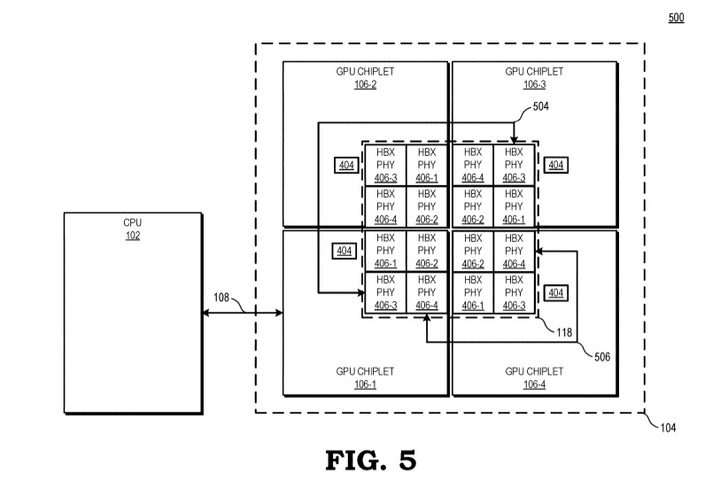
To solve that challenge, AMD is turning to high bandwidth passive crosslinks to couple GPU chiplets, which would allow the GPU to be communicably coupled to the processor. Processor coupling with the chiplets could allow AMD to expand its Smart Access Memory feature for Team Red gamers who also use a Ryzen processor. Here, the GPU chiplets would be arranged in an array such that each chiplet would be coupled with the first GPU through passive crosslink, Videocardz reported.

AMD claimed that its chiplet design breaks up the SoC into smaller functional groupings, called chiplets, that performs the functions of the cores of the SoC — or a GPU, in this case. Each chiplet would have its own last-level cache, or LLC, in a way that the caches are communicably coupled to other resources so that communication remains unified and coherent across the chiplets.
Potentially coming soon to RNDA 3
After having launched its RDNA 2 architecture — colloquially referred to as Big Navi or Navi 2x — on its most recent Radeon RX 6000 series graphics card, the new chiplet layout could be headed to AMD’s forthcoming RDNA 3 design. Though the company had mentioned RDNA 3 in previous roadmaps, it had not detailed specifics about the architecture or the performance boost we can expect nor has AMD claimed that RDNA 3 will move to a chiplet design.
For reference, when RDNA 2 debuted, AMD CEO Lisa Su stated improvements to the new architecture meant that the company’s top-of-the-line Radeon RX 6900 XT card got a 65% performance boost compared to the prior generation. The RX 6000 series in general performed 50% better than the prior first-gen RDNA design, which already delivered a 50% boost from the old GCN architecture. If AMD’s history of performance improvements is to be followed, we can expect similar performance uplifts as the company moves from RDNA 2 to RDNA 3.
And even though it’s unconfirmed, one way for AMD to boost performance is to move to a smaller 5nm process with fab partner TSMC. The company had referred to RDNA 3 as its “Advanced Node” when detailing its graphics roadmap in the past.
It should be noted that while the use of chiplets will give AMD a unique way to boost the performance of its GPUs, the company won’t be alone in pursuing this design. Tweaktown noted that rivals Intel and Nvidia are both working on bringing chiplet designs to their GPUs in the years ahead. Nvidia is expected to debut a similar architecture when it unveils its Hopper design.
So while we can look toward a boost in performance with the arrival of chiplets on RNDA 3, it will also be interesting to see what AMD does in the future to drive even greater gains. Unfortunately, for now, insiders speculate you’ll have a bit longer to wait — RDNA 3 isn’t expected to go into a Radeon card until late 2021 or 2022. This timeline could mean that RDNA 3-powered cards will go up against Nvidia’s next-gen Ada Lovelace GPUs.


