
AMD announced a new upscaling feature at CES 2022, Radeon Super Resolution (RSR), and it’s built on the company’s FidelityFX Super Resolution (FSR) upscaling feature. Instead of coming through supported games, though, it comes through AMD’s drivers, allowing it to work with virtually any game.
It’s interesting timing, coming just a couple of short months after Nvidia brought a very similar feature back into the limelight. I’m happy that RSR is here, but it’s the wrong move for AMD in the increasingly competitive space of upscaling.
Back and forth (and back again)

Nvidia revitalized Nvidia Image Scaling (NIS) in November 2021. The company has offered NIS for the past two years as a driver-level upscaling feature, but in response to the growing popularity of FSR, Nvidia released a version that developers could add directly to games.
AMD is doing the opposite. The company released FSR as an open-source platform, allowing developers to add upscaling tech to their games. RSR is the driver-level bit, opening the floodgates for upscaling in all games on AMD graphics cards.
It’s not a bad feature, but it’s not the right step for AMD. There’s little doubt in my mind that AMD released RSR as a way to combat NIS, forgetting that this whole upscaling battle is focused on Nvidia’s Deep Learning Super Sampling (DLSS).

FSR has and will continue to be a marketing play for AMD. From the jump, it was positioned as a competitor to DLSS, despite sharing little to no technical DNA with Nvidia’s upscaling feature. And RSR looks like the same thing, announced alongside AMD’s products in what is likely the biggest stage the company will present on for the whole year.
The back and forth between AMD and Nvidia is ultimately a good thing. But it can lead to situations like RSR, where one company is pushing a feature that itself isn’t pushing the market forward. RSR is good, but an update to FSR would be much better.
Where have the last six months gone?
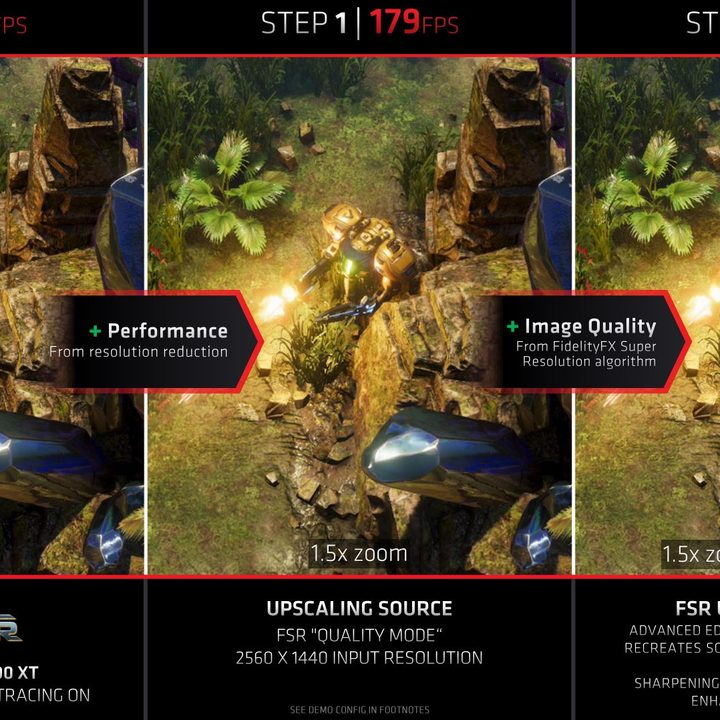
Six months have flown by. AMD released FSR on June 22, 2021. In that time, the company has added support for several dozen games, which is an impressive feat. But it doesn’t require much from AMD. FSR is open-source and available to developers free of charge.
It’s no secret that FSR needs some work when it comes to image quality, and AMD has been open that the current version is far from the last. Six months isn’t enough time for FSR 2.0, but it’s certainly enough time to hone the upscaling algorithm of FSR 1.0 to improve image quality.
I don’t want to mince words: We should have RSR. But it’s not a replacement for an enhanced version of FSR, and it’s not the right move for AMD against the upscaling monolith Nvidia has established.
The best feature of FSR is that it supports all graphics cards. RSR only supports AMD graphics cards through the driver, and although it’s a nice feature to have for AMD cards, it does very little to separate the feature set from the Nvidia competition.


