  1. Home
  2. Computing
  3. News

AMD Zen 6 chips could be here sooner than you think

Add as a preferred source on Google
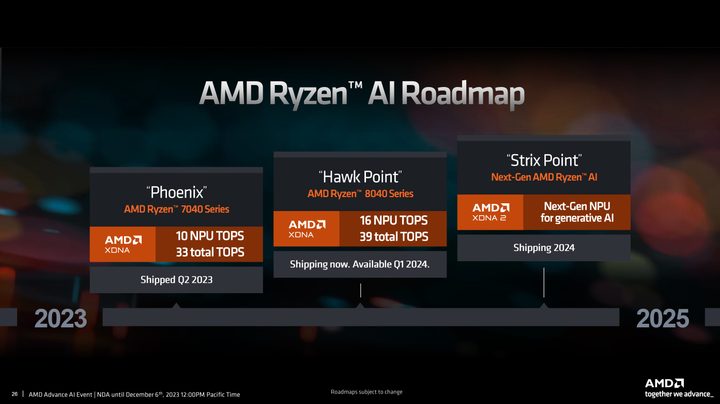
AMD's roadmap for Ryzen AI.
AMD

Last month at Computex, AMD announced its Zen 5-based desktop and mobile processors, set for launch later this month. Shortly after this announcement, details about their successor, code-named “Medusa,” have emerged. According to leaks, Medusa will be part of the Zen 6 lineup and is expected to be released in late 2025, contrary to earlier rumors of a 2026 launch.

Sources cited by YouTuber Moore’s Law Is Dead suggest AMD plans to finalize the Zen 6 architecture by Q2 2025, with production possibly beginning later that year. Another source confirmed Medusa as a Zen 6 product, potentially targeting both laptops and the desktop AM5 platform. Additionally, Strix Halo and Medusa Halo, based on Zen 5 and Zen 6 architectures, are expected to use TSMC’s N3E (enhanced 3nm process).

The Asus ROG Zephyrus G16 with the updated AMD Ryzen AI 9 HX CPU with key highlights at Computex 2024.
Jacob Roach / Digital Trends

AMD’s product naming conventions include “Ridge” for desktop products, “Point” for mobile parts, and “Halo” for extreme mobile variants. Under the Zen 5 architecture, Granite Ridge is for desktops, and Strix Point is for mobile. The Strix Halo product, however, has not yet officially appeared, likely due to TSMC’s 3nm process challenges.

Recommended Videos

Initially, AMD planned to launch Zen 5 on the 3nm node for both Strix Point and Strix Halo. However, issues with chiplets and TSMC’s delays forced AMD to stick to 4nm for Strix Point. Despite this, Strix Halo is expected to launch later this year with a 3nm design, aiming to compete with Intel’s Lunar Lake, featuring an improved neural processing unit (NPU).

Given Moore’s Law Is Dead’s track record with accurate leaks, these rumors hold some credibility, but should still be approached with caution.

New notebooks featuring AMD’s Ryzen 300 AI Strix Point processors are anticipated to start shipping later this month from major OEMs. Meanwhile, Ryzen 9000 desktop parts are also expected to hit shelves soon, with a leaked starting price of $310.

Kunal Khullar
Kunal Khullar is a computing writer at Digital Trends who contributes to various topics, including CPUs, GPUs, monitors, and…
Apple made Liquid Glass adjustable, which says plenty about Liquid Glass
The new slider is useful, welcome, and mildly hilarious after a year of Apple acting like transparent everything was the obvious future.
Text, Document, Business Card

Apple’s big glassy software future now comes with a way to make it less glassy. In iOS 27, users can adjust the translucency of the Liquid Glass effect, while macOS Golden Gate adds its own Liquid Glass controls under System Settings.

Liquid Glass is still alive across Apple’s platforms, still shimmering through menus and panels, still doing the elegant UI trick Apple clearly likes. The big visual bet has already earned a dimmer switch. After a year of treating translucency like the obvious next step, WWDC’s most revealing design update may be the one that lets people dial it back.

Read more
Windows 11 just fixed one of Search’s dumbest limitations, and you’ll wonder how you lived without it
One less character, one less annoyance every time you search your PC.
Person sitting and using a Windows Surface computer with Windows 11.

If you have ever typed two letters into the Windows 11 search box, paused, and watched nothing useful happen until you added more characters, you already know exactly why this Windows 11 update matters. 

Microsoft's June 2026 Patch Tuesday update, part of a release Windows Latest calls the biggest of the year (via Windows Latest), quietly fixes that. Windows Search can now find and prioritize files with as few as two characters, down from the old three-character minimum.

Read more
Brazil’s secret World Cup weapon taught the team when to ignore it
The data said he wasn't running enough. The footage said he was always in the “perfect tactical position.”
Soccer ball in net

Brazil has more World Cup titles than anyone, five of them to be precise, but after going through five straight tournaments without adding to that count, the team is leaning hard on data this time. 

Every player wears a sensor-packed "smart vest" tracking field position (via GPS), heart rate, and a stat called "player load," the same kind of numbers that your Whoop band or Apple Watch brags about, but tuned specifically for the sport.

Read more