

After a long wait, the future of AMD’s best graphics cards is finally here. The company just announced the RX 9000 series, comprised of two new GPUs: The RX 9070 XT and the RX 9070. Both are set to launch on March 6 at $599 and $549, respectively. If AMD lives up to the expectations performance-wise, these GPUs might be an absolute mainstream hit.
AMD’s focus throughout the presentation was the fact that gamers buy mainstream GPUs more often than behemoths along the lines of the RTX 5090. To that end, AMD cited its own research, saying that 85% of gamers buy GPUs that cost less than $700. At the same time, higher resolutions are slowly becoming mainstream, with more and more people buying 1440p and 4K monitors. The needs of gamers have gone up, now including solid performance in ray tracing, but keeping it affordable is important too.
At $599 and $549, both the RX 9070 XT and the non-XT counterpart will fall close to the RTX 5070 in terms of pricing. However, the RX 9070 XT is expected to perform on a similar level to the RTX 5070 Ti, which spells great news for AMD. The RTX 5070 Ti launched at $750, but it’s largely sold out and hardly available at MSRP right now.
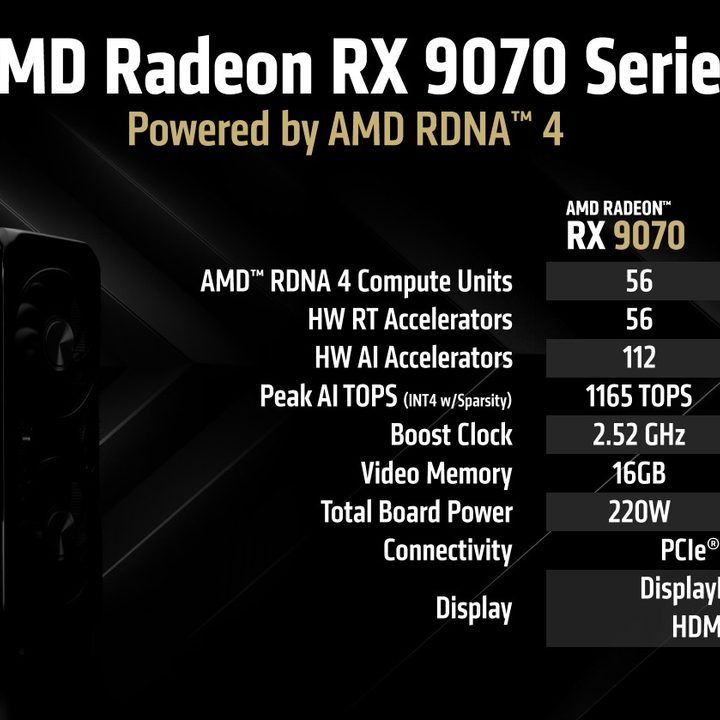
The specs of RDNA 4 have been leaked months ago, and it turns out that leakers got a lot of it right. The flagship RX 9070 XT serves up 64 compute units (CUs), 64 hardware ray tracing (HW RT) accelerators, and 128 AI accelerators. The boost clock nearly hits 3GHz, maxing out at 2.97GHz, which means that overclocked GPUs will definitely go past that threshold. The card comes with 16GB of VRAM across a 256-bit bus, and this memory configuration also applies to the RX 9070 non-XT. The flagship has a total board power (TBP) of 304 watts.
The RX 9070 cuts back on every spec, scaling down to 56 CUs and a maximum clock speed of 2.52GHz. On the other hand, the power consumption is also significantly lower, now at 220 watts.
Both GPUs will use GDDR6 memory. AMD chose to stick to GDDR6, clocked at 20Gbps, which it found to offer the best balance of performance and cost. Nvidia’s RTX 50-series already made the switch to GDDR7, having used GDDR6X in the previous generation, but AMD offsets for the loss of bandwidth by adding plenty of VRAM to its GPUs.
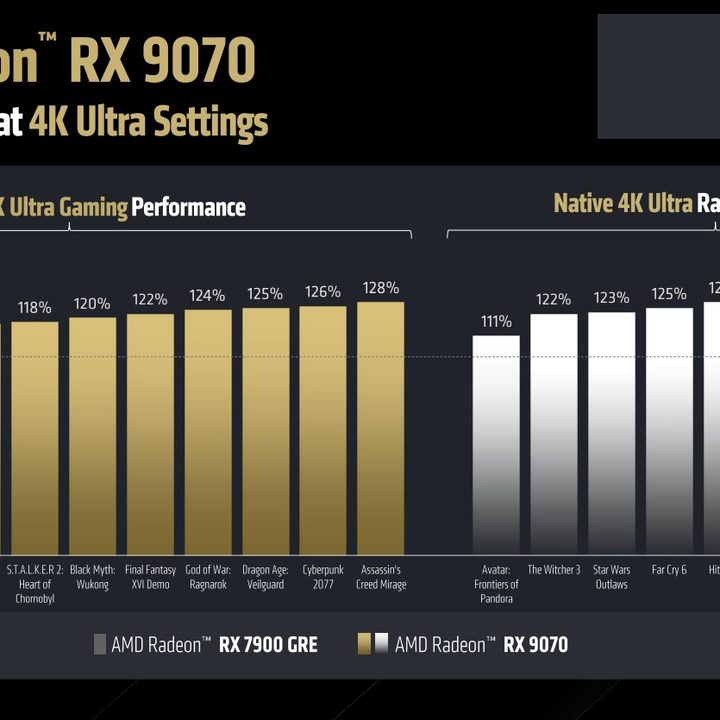
AMD revealed some benchmarks for both GPUs, and they seem pretty great. However, when comparing to Nvidia, it used an RTX 3090 as opposed to something from a current generation. AMD explained that this was because people who bought the RTX 30-series will be looking to upgrade now, but it would’ve been nice to see some scores for that.
Fortunately, AMD revealed that it expects the RX 9070 XT to be on par with Nvidia’s $750 RTX 5070 Ti or the last-gen RTX 4080. AMD promises up to 21% better performance-per-dollar than the RTX 5070 Ti, which is a great deal if the two cards really end up going head-to-head.
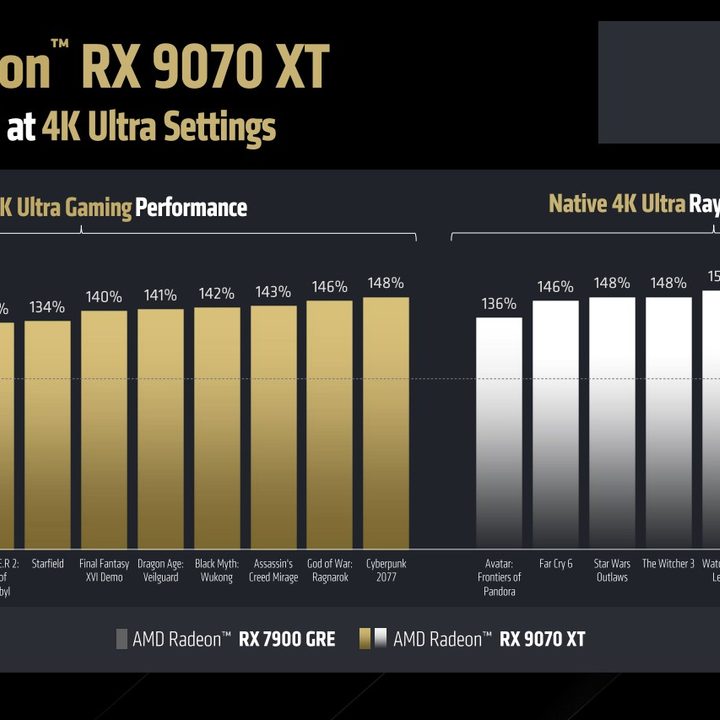
Regardless, the RX 9070 is said to offer up to 21% faster performance than the RX 7900 GRE at 4K, which is a sizeable uplift. Meanwhile, the RX 9070 XT will be up to 42% faster at 4K, while also showing solid ray tracing improvements.

With the new compute unit (CU) in RDNA 4, AMD was able to boost efficiency, clock speeds, and register allocation. The new graphics cards will come equipped with third-gen ray tracing accelerators, which will offer 2x ray tracing throughput per CU. Historically, AMD trailed behind Nvidia in ray tracing, but it’s certainly making improvements in that regard.
The new GPUs will also come with second-gen AI accelerators, which AMD promises will result in up to 8x faster AI performance when compared to RDNA 3. The die size is at about 350mm2, and the transistor count at around 44 billion. AMD also revealed that the GPU was built on a 4nm process. The RX 9000 series makes the switch to PCIe 5.0, and it also offers DisplayPort 2.1a and HDMI 2.1b support.
The company will not be making its own versions of the cards, also known as MBA (Made By AMD), but it says it’ll work closely with its partners to ensure availability, and more importantly, availability at MSRP.
Alongside the RX 9000 series, AMD also announced FSR 4, which will remain an RDNA 4-exclusive for the time being. AMD has previously said that it would like to open up FSR 4 to other cards, but it’s unclear when or if that might end up happening.


