
Long before Apple’s Vision Pro headset made its debut, there was rampant speculation that the company’s wider augmented reality (AR) efforts were part of a larger project toward building the then-mysterious device. Now, it seems that at least one of those technologies was built with Vision Pro in mind.
I recently interviewed Susan Prescott, Apple’s vice president of Worldwide Developer Relations, and Steve Sinclair, senior director of product marketing for Apple Vision Pro, to find out how the company courted developers while prepping the headset. In the course of that interview, Sinclair shed some light on how Vision Pro intertwined with the company’s ARKit developer framework.

Throughout my talk with Prescott and Sinclair, both made repeated references to ARKit, Apple’s framework for building AR experiences. Prescott said it was “foundational” for allowing people to build content for Vision Pro. When discussing how Apple adapted existing tools for its headset, Sinclair stated that “ARKit on iPhone and on iPadOS allowed us the opportunity to learn from developers and from ourselves on how best to implement these things on a platform like Vision Pro.”
Was ARKit specifically built with Vision Pro in mind, I asked, or did its development come about separately and subsequently?
“We’ll just say in conjunction” was Sinclair’s response.
Sinclair’s answer seems to imply that, at a minimum, Vision Pro was a consideration in the development of ARKit, if not the main driving force behind its creation.
ARKit’s secret purpose
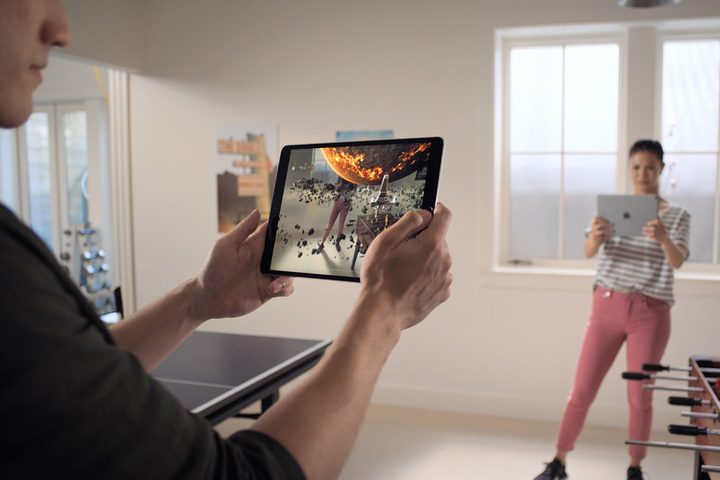
When Apple revealed ARKit as part of iOS 11 in 2017, it explained that the tool would allow developers to “build detailed and compelling virtual content on top of real-world scenes for interactive gaming, immersive shopping experiences, industrial design and more.” Looking back, that seems like a description ripe for Vision Pro as much as it does the iPhone or iPad.
We already know that Vision Pro has been in development since at least 2007, the date Apple provisionally applied for a very early headset patent. In the intervening 16 years, there have been many other technologies that Apple ostensibly made for different devices that could also have been created with Vision Pro in mind.
LiDAR, for instance, has been heavily promoted as a way to enjoy AR experiences using an iPhone or an iPad Pro, but it also features prominently in Vision Pro. Numerous patents registered over the years, from extending a Mac’s display into virtual space to in-air MacBook keyboards, could all have been disguised Vision Pro technologies.
That’s unsurprising given Apple’s famous tight-lipped reticence, and it’s interesting to see the suggestion that ARKit has always had a secret secondary purpose. What other seemingly innocuous techs could find their way into future Apple devices? Only time will tell.


