  1. Home
  2. Computing
  3. Legacy Archives

Can the ZXX typeface thwart and call attention to the NSA’s spying?

Add as a preferred source on Google
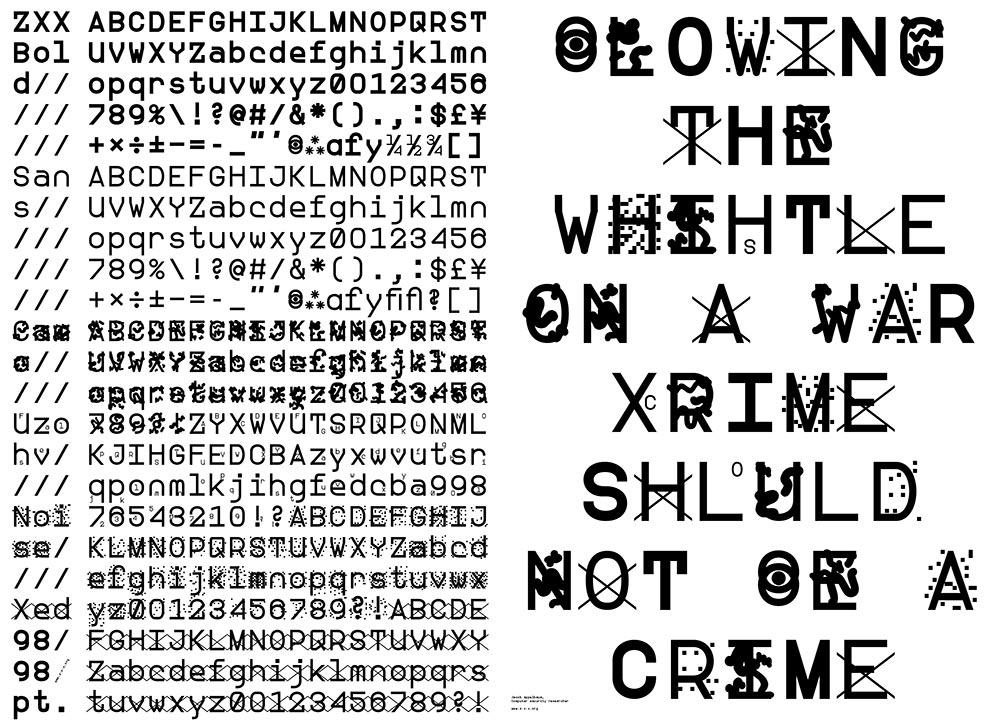
zxx-poster
Image used with permission by copyright holder

Thanks to recent events, we now know that the government is monitoring our emails about dinner plans and 40% off coupons. While – at least in the short term – there’s not a lot we can do about it, one designer has found a way to possibly make our transmissions a little less obvious. Sang Mun, a designer who spent two conscripted years in the Korean military and then worked for the U.S. National Security Agency, has developed a typeface with four font styles that are designed to confuse OCR (optical character recognition) scanners, but are still readable to the human eye. He calls the typeface ZXX. Not coincidentally, this is also the code given to books in the Library of Congress that contain no linguistic content. 

There are the standard Sans and Bold varieties of the font, then are four more, Camo, False, Noise, and Xed, that use different methods to confuse computers. Camo, as you might guess, cloaks the individual letters in camouflage with ink splotches and twisty vines around the characters. Noise uses a similar method and obscures the letters with extra digital dots of different sizes hanging out around the characters.  False reverses the standard alphabet and numerals to seemingly create a code of nonsense where Z equals A, and 0 equals 9. It’s easy enough to decipher though thanks to the very small placement of the correct letters within each character. Lastly, there’s Xed, which simply places an “X” on top of each letter. 

Recommended Videos

In the video below, Mun shows how an OCR program interprets his font styles and, interestingly enough, the style that elicited the most confused result from the program was Xed. The pattern of “X” in each word completely through off the character recognition program.

So how will these nifty fonts protect you from the prying computerized eyes of the NSA? They won’t. Nearly all of the data collected is already in digital form, so it’s as simple as “Select All” and changing the font to Times New Roman. Plus, as you can see, the fonts don’t fool the human eye. As soon as a real, live person looks at your Xed font email, the jig is up. The point of Mun’s project isn’t that it will protect you from the government’s prying eyes. The point is to use graphic design to raise awareness about surveillance and privacy. In Mun’s own words, “I believe that stripping humanity of its freedoms can never be justified as a natural evolution. It’s our duty to call out crimes against democracy.”

Want to try out ZXX for yourself? Download the typeface here

Image via Walker Art Center.

Meghan McDonough
Former Contributor
Meghan J. McDonough is a Chicago-based purveyor of consumer technology and music. She previously wrote for LAPTOP Magazine…
Microsoft is retiring the Together Mode in Teams in favor of something cleaner and simpler
Teams is retiring Together Mode for layouts people may actually use
Computer, Electronics, Laptop

Microsoft Teams is retiring one of its more recognizable meeting features, and it might be for the best. The company announced that Together Mode is going away in Teams as Microsoft is shooting towards a simpler set of meeting layouts.

To recall, Together Mode was introduced during the pandemic-era video call boom, placing participants inside shared virtual environments such as auditoriums or classrooms. It was a cute idea at the time, but it never became the everyday meeting view for most people.

Read more
Experts are worried that smarter AI gets, the dumber we might become
Experts say chatbots can help research, but leaning on them too hard risks outsourcing the work that builds intelligence
OpenAI CEO Sam Altman during the Uncapped podcast in June 2025.

AI can now answer questions so quickly that the search itself can feel optional. That convenience worries the Royal Observatory Greenwich, which has warned that instant AI answers can weaken the curiosity, scrutiny, and source-checking behind real knowledge.

The risk hides inside the usefulness. Chatbots can help people test ideas, move faster, and find new angles, but a finished response can also cut users off from the messy trail that makes learning stick. When that happens, information arrives without the struggle that turns it into judgment.

Read more
Miss the old PC days? This website lets you experience Wikipedia like it’s Windows XP
This XP-style Wikipedia explorer turns online research into a nostalgia trip, while showing how much browsing changes when search takes a back seat
File, Webpage, Person

Wikipedia has an unofficial new front door, and it looks like a desktop from a very specific era of family PCs, school labs, and chunky blue title bars.

Developer Sami Smith has built a browser-based Windows XP Wikipedia explorer that turns categories into folders and articles into documents. It’s playful, slightly inefficient, and more interesting than another AI search box bolted onto the web.

Read more