  1. Home
  2. Computing
  3. News

Character.AI just made talking to an avatar feel more real

Add as a preferred source on Google
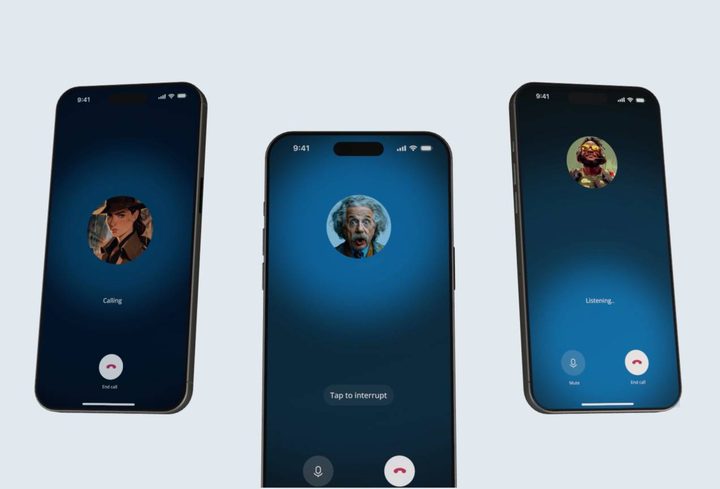
Three examples of Character Calls on phones.
Character.AI

Character.AI, the hugely popular digital avatar startup, announced Thursday that users will now be able to hold real-time conversations with one of the company’s multitude of AI agents by placing a free, fictionalized Character Call on the app.

The company has been building intelligent chatbots designed to engage users in interactive conversations since the company’s founding in 2021. Initially, users could only interact with these characters as one would any other chatbot like Gemini or Claude, doing so via text. That changed in March 2024, when the company unveiled Character Voice, a suite of free tools including a library of more than a million AI-generated vocals built both by the Character.ai team and its user community, which allowed users to speak with their selected avatars in one-on-one conversations.

Introducing Character Calls: Character.AI's latest Voice Feature

Thursday’s announcement streamlines the process of initiating a conversation. Using the Character.AI app, users simply place a call to their preferred avatar. While Character Voice was initially only available in English, avatars on Character Call can speak English, Spanish, Portuguese, Russian, Korean, Japanese, Chinese, “and many more” languages, according to the company. Character.AI envisions people using this feature for a variety of tasks (non-explicit, of course), from practicing a foreign language to getting their spiel down for an upcoming job interview to gaining confidence for a stressful social interaction — even adding an AI-generated party member to their next D&D campaign.

Recommended Videos

Unfortunately, we won’t likely see a return of the party lines that were popular in the 1970s, as the company recently removed its group chat room feature from the web-based version. There is, however, a simple workaround if you’d still like to try it for yourself.

Andrew Tarantola
Former Computing Writer
Andrew Tarantola is a journalist with more than a decade reporting on emerging technologies ranging from robotics and machine…
Claude’s Sonnet 5 is built to do more on its own and cost you less
Better than its predecessor, nearly as good as the flagship, and meaningfully cheaper than both.
Art, Floral Design, Graphics

Every major AI lab is racing to prove its models can work autonomously with minimal hand-holding; we’re now seeing pricing emerge as the next battleground. 

Anthropic just fired its latest shot, Claude Sonnet 5, a model the company says performs nearly as well as its flagship Opus 4.8 at a fraction of the cost.

Read more
Apple Creator Studio adds AI tools across Final Cut Pro, Logic Pro and Pixelmator Pro
Final Cut Pro gets AI captions, Auto Mask and better Pixelmator Pro workflows in Creator Studio update
Computer Hardware, Electronics, Hardware

Apple has introduced a major update to Apple Creator Studio, adding new AI features, deeper Pixelmator Pro integration, and workflow upgrades across Final Cut Pro, Logic Pro, Keynote, Pages, Numbers, Motion, Compressor, Freeform, and Final Cut Camera.

The update makes Creator Studio more useful across Mac, iPad, and iPhone, especially for people who move between video editing, image editing, presentations, documents, spreadsheets, and music production.

Read more
AI browsers like Perplexity Comet can be tricked into spilling your password through BioShocking exploit
Six AI browsers were found leaking saved passwords and many of them haven't fixed it yet.
MacBook Air in hand, Comet browser loaded—let’s see what Perplexity’s AI can really do

Security researchers just found a strange way to trick AI browsers into handing over your passwords. They managed to trick AI browser agents into exposing sensitive data like saved passwords, session cookies, and private tokens by disguising the theft as part of a harmless "game."

The technique is called BioShocking, named after the popular video game BioShock, where a brainwashed character is manipulated into believing a false reality. Once an AI browser falls for the same trick, it stops following its own safety rules entirely.

Read more