
OpenAI unveiled its new ChatGPT Pro subscription tier during the company’s inaugural “12 Days of OpenAI” live-stream event. At a cost of $200 per month, the Pro tier costs 10 times as much as a standard, single-user Plus account.
In this guide, we’ll discuss how much the various ChatGPT subscription tiers cost, as well as what features and benefits you receive at each level — all to help you decide which, if any, paid tier is right for you.
Pricing
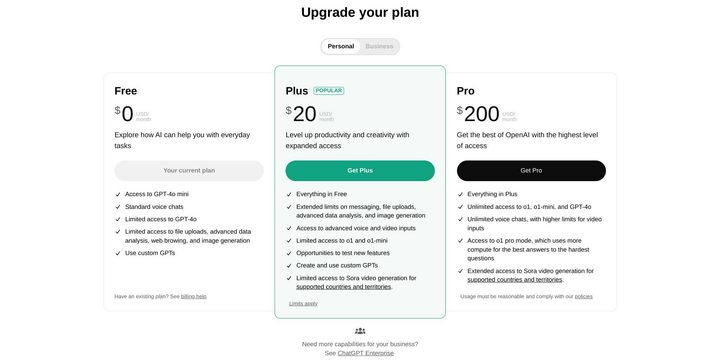
A ChatGPT Plus subscription will run you $20 per month, which is bang on average for the industry. Google Gemini, Microsoft Copilot, Anthropic Claude, and Perplexity all cost that amount as well. A Pro subscription, on the other hand, costs a whopping $200 per month. As such, the Plus tier is generally geared toward individual users who are looking for improved performance over what’s available at the free tier, while the Pro tier is more for power users and businesses that require continual access to OpenAI’s models and inference services.
OpenAI also offers a $25-$30 (depending on how it’s billed) Teams plan, which grants small businesses Plus-tier access to multiple employees. Enterprise tier is a step above that and is used for large-scale corporate licensing, while the Edu tier is used by schools, colleges, and other educational institutions to license the chatbot to their student bodies.
What you get with a Plus subscription
The Plus tier offers users access to a wide variety of OpenAI’s model lineup, including GPT-4o mini, which is the default version used by the ChatGPT chatbot, as well as increased usage limits for GPT-4o over the free tier including for file uploads, advanced data analysis, and image generation.
This tier also enables you to not only employ but create custom GPTs, as well as access both the standard and Advanced Voice Mode features. You will also have limited access to OpenAI’s new o1 and o1 mini reasoning models (similar to how free tier users only have limited access to GPT-4o.)
What you get with a Pro subscription
The Pro tier offers unlimited access to every model and feature that OpenAI offers. You’ll have free rein of the GPT-4 and o1 family of models, and unlimited access to Advanced Voice Mode’s various features and functions.
What’s more, you’ll be able to use Pro Mode, which dedicates additional compute resources to your queries in order to generate the most complete and accurate response it can.
Who needs to shell out $20, much less $200, a month for a chatbot?
For most casual users, sure, the free tier of ChatGPT is more than enough for their needs. However if you use the chatbot frequently as part of your daily workflow, need unlimited access to image and GPT generation, or want to leverage the platform’s advanced analytical tools, paying $20 a month for a Plus subscription makes sense (and can be deducted from your taxes if you work for yourself).
So why on Earth would someone drop $200 for Pro? According to OpenAI, there are plenty of people who stand to benefit from drinking directly from the company’s generative AI fire hose. “ChatGPT Pro provides a way for researchers, engineers, and other individuals who use research-grade intelligence daily to accelerate their productivity and be at the cutting edge of advancements in AI,” OpenAI wrote in its announcement post for the subscription tier. So if you need ChatGPT to help you unravel the mysteries of the cosmos, and you need it to do it right flippin’ now, the Pro tier is your best bet.
But are you using the best AI chatbot? Here’s how ChatGPT and Google Gemini measure up.


