
  1. Home
  2. Computing
  3. Emerging Tech
  4. News

Chrome is testing an Ask Gemini button that follows your text highlights around the web

Highlight text, get Gemini. Google is making sure you never have to look for AI in Chrome again.

Add as a preferred source on Google
Google Chrome with Gemini
Google Chrome

Google is quietly testing something in Chrome Canary that I think will either become one of the browser’s most useful or its most irritating additions ever. 

It depends on how often you highlight text to copy it without wanting an AI to jump in.
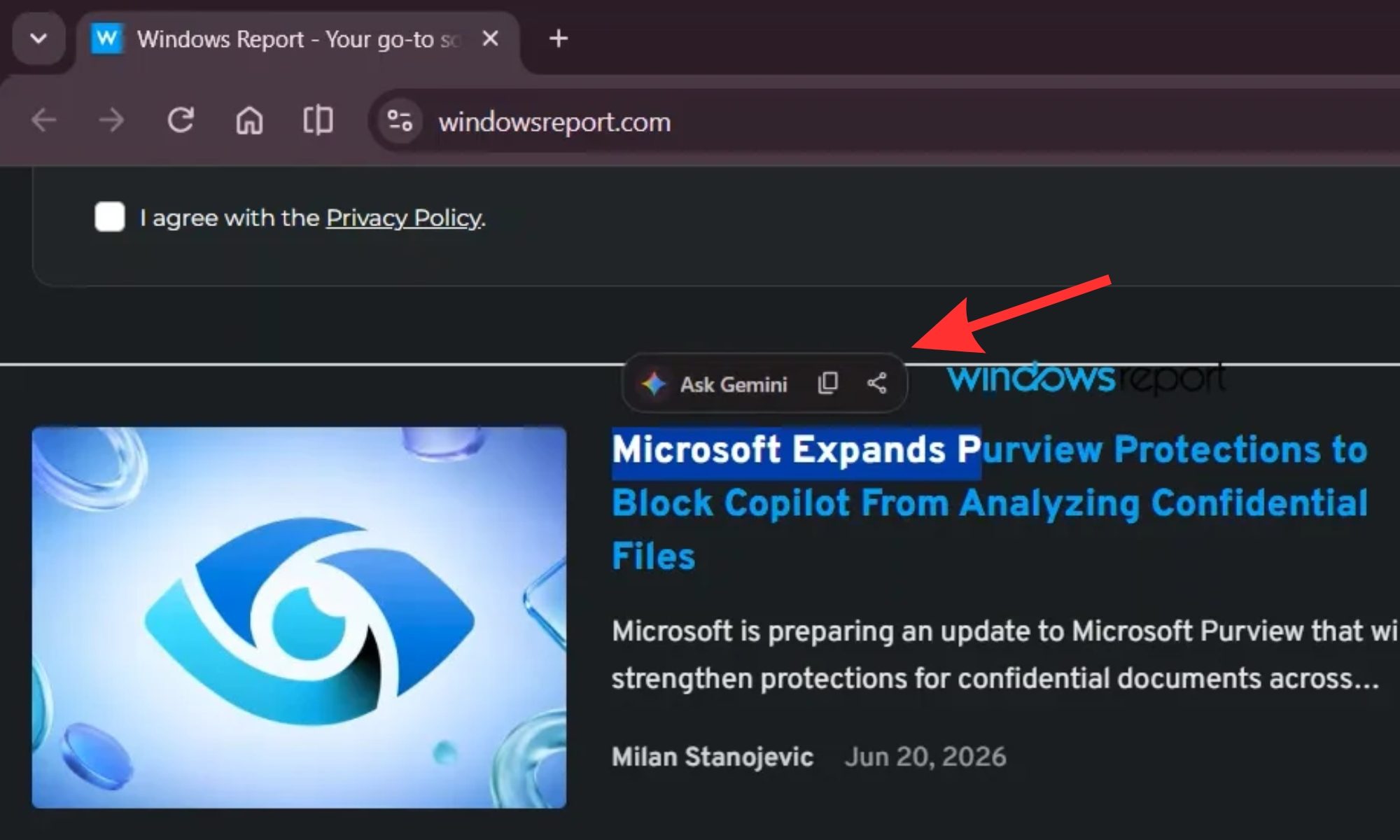
So what exactly is Chrome testing?

The feature is a floating toolbar or pop-up that appears above any text you select on a webpage, similar to the menu that appears on Android phones. However, on the web, it offers four options: Ask Gemini, Copy, Share, and a three-dot menu. 

Recommended Videos

Clicking Ask Gemini opens the Gemini side panel with your selected text as a prompt, ready for follow-up questions without switching tabs or manually copying the text to a tab with Gemini already open.

The three-dot menu tucks away two options: “Hide for this site,” which suppresses the toolbar on sites where you don’t want it showing up, and “Settings,” which opens Chrome’s general content settings page rather than anything specific to the AI assistant. That last part is clearly unfinished.
Does this mean Gemini is about to be everywhere in Chrome?

Google has been steadily adding Gemini entry points in Chrome, including the @gemini address bar shortcut and a pinnable AI Mode toolbar button, which is also currently in testing. So, yes, it appears the company wants Gemini to be an omnipresent AI layer.

The text selection toolbar takes that logic further: instead of you going to find Gemini, Gemini finds you every time you select something. Google hasn’t announced this feature publicly. It’s still in Chrome Canary, and there’s no guarantee it ever makes it to the stable release (via Windows Report). 

This news comes after Google added an “Ask Gemini” shortcut directly to the right-click menu, something I noticed a couple of weeks ago. So, it’s not like interacting with Gemini has been a hassle or requires a lot of effort.

However, the new feature puts “Ask Gemini” front and center, so you can jump into Gemini without opening another menu first.


Shikhar Mehrotra
For more than five years, Shikhar has consistently simplified developments in the field of consumer tech and presented them…
Dell Pro Max 18 Plus review: I tested this giant in an AI startup lab and it refused to sweat
A massive laptop that wants to sit on your desk, churn data, and make your desktop feel bad.
Dell Pro Max 18 Plus laptop.

View at Dell

I test laptops for a living, and have grown a bad habit out of it. The moment a top-tier machine lands on my desk, I immediately try to push it until I find the cracks. The render that stalls, the fan curve that gives up, or the throttling wall that turns a specs sheet into mere marketing fiction. I went into the Dell Pro Max 18 Plus fully expecting to find that hurdle. Instead, I spent two weeks watching an 18-inch slab absorb everything I threw at it and keep asking for more. It even surprised the engineers at an AI lab who pitted it against their trusty training desktop.

Read more
Intel Core 3 test shows it could give Windows laptops a fighting chance again MacBook Neo
Fresh PassMark scores suggest Wildcat Lake is closing the gap with Apple's A18 Pro.
Intel Core Series 3 Processors Featured

Apple's MacBook Neo has shaken up the budget laptop market with its $599 price tag and surprisingly capable A18 Pro chip. But if fresh benchmark numbers are anything to go by, Intel may finally have a worthy response. The company's upcoming Core 3 304 processor has surfaced on PassMark, and the results suggest that entry-level Windows laptops could soon be much more competitive.

Intel's Core 3 304 is closing the gap with Apple's A18 Pro

Read more
Hackers leak facial recognition records tied to millions of Madison Square Garden visitors
Facial Recognition Composite

Madison Square Garden has spent years using facial recognition technology to monitor who enters its venues. Now, that same surveillance system is at the center of what could become one of the year's most troubling privacy breaches.

The cybercrime group ShinyHunters has published a massive cache of data allegedly stolen from Madison Square Garden Entertainment after the company missed a ransom deadline. According to reports, the leak includes facial recognition records, customer information, internal security assessments, and other sensitive data tied to millions of visitors. While large-scale breaches have become depressingly common, this one feels different. Most data leaks involve passwords, email addresses, or financial information. This breach reportedly includes something far more personal: information connected to how people were monitored and identified in physical spaces.

Read more