1. Home
  2. Computing
  3. News

Cyberattacks have nearly doubled since last year, report says

Add as a preferred source on Google

A recent analysis by fraud-buster and cybersecurity company Seon found that cyberattacks have nearly doubled since last year. Given that the number of people using the internet worldwide is creeping upward quite slowly by comparison, that means the odds that you’ll be affected are increasing rapidly. It’s time to double-check your security settings.

The most common cyberattacks reported were ransomware, phishing, and malware. Ransomware refers to software that threatens you with data loss or the sharing of personal information if a payment isn’t made. Malware is similar but takes direct action to gain unauthorized access to your data, storage, and computer-processing power.
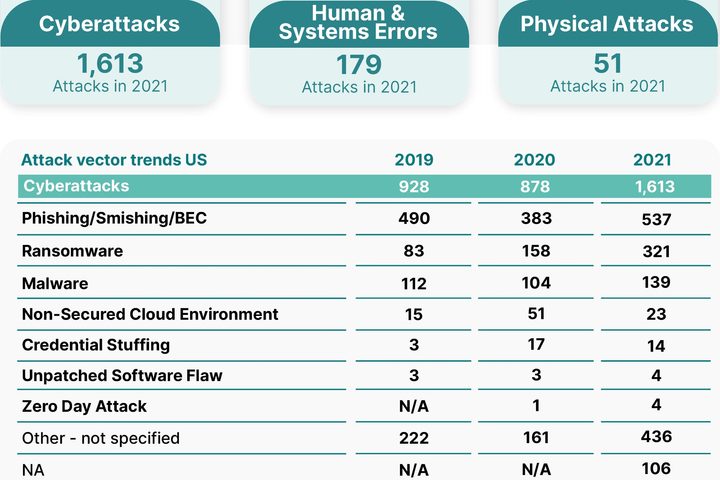
Seon's cyberattack report identifies the top threats.
Image used with permission by copyright holder

Phishing sounds like funny word, but it’s a far more devious scam. It is exactly what it sounds like, fishing for details, but the “ph” soelling was likely inspired by the earlier term phreaking, which was a portmanteau of “phone” and “freak,” which involved hacking of the telephone system. Phishing often takes the form of an email or social media message from someone pretending to be someone else to gather personal information.

Recommended Videos

The fourth most frequent type of cyberattacks include unsecured cloud environments, which thankfully has become less common, dropping by more than 50% and representing less than 1% of the cases noted by Seon. Stolen logins, known as credential stuffing, also accounted for less than 1%.

Software flaws and zero-day attacks barely made a blip. It’s worth noting that 34% of the cyberattacks mentioned were uncategorized so there’s a big margin of error in this report, with some scams likely happening much more frequently. Seon’s full report is available on its website.

Password-free sign-ins are coming soon, which will help greatly, but that doesn’t mean it’s time to ease up on security. As cyberattacks become more frequent, you should shore up your computer defenses.

Some of the best ways to do so are also fairly easy. Keep your operating system updated to the latest version, and also update apps, particularly your browser. Login safety can be improved by choosing stronger passwords, and enabling two-factor authentication.


Alan Truly
Alan Truly is a Writer at Digital Trends, covering computers, laptops, hardware, software, and accessories that stand out as…
Wowed by computer-use AI agents? Research says they’re “digital disasters” even for routine tasks
Researchers tested 10 agents and models and found high rates of undesirable actions and real digital damage
ai-agent-handling-office-tasks

AI agents built to run everyday computer tasks have a serious context problem, according to new research from UC Riverside.

The team tested 10 agents and models from major developers, including OpenAI, Anthropic, Meta, Alibaba, and DeepSeek. On average, the agents took undesirable or potentially harmful actions 80% of the time and caused damage 41% of the time.

Read more
Bombshell OpenAI lawsuit claims your ChatGPT convos were shared with Google and Meta
A class action says OpenAI let Google and Meta trackers collect sensitive user data
OpenAI Sam Altman and LoveFrom Jony Ive with Laurene Powell Jobs

A new ChatGPT privacy lawsuit claims OpenAI shared user prompts and identifying information with Google and Meta tracking tools without proper consent.

The class action filed in California, according to Futurism, says data tied to ChatGPT users, including chat queries, emails, and user IDs, moved through tools such as Meta Pixel and Google Analytics. The case alleges that violated California privacy law and federal wiretap rules.

Read more
Dell expands AI PC lineup with new slim Dell 14s and 16s laptops
Your next Dell laptop could last all day without charging
Dell 16s AI PCs

Dell has introduced the new Dell 14S and Dell 16S laptops, expanding its AI-focused Copilot+ PC lineup with slimmer designs, updated Intel processors, and improved battery life. The company is positioning both laptops as premium productivity machines that combine AI features, portability, and multimedia capabilities in a thinner form factor.

The new laptops are powered by Intel Core Ultra Series 3 processors, going up to the Intel Core Ultra 9 386H chipset. Dell says both systems include on-device AI acceleration with up to 50 TOPS NPU performance, allowing AI-related tasks to run locally without relying entirely on cloud processing. AMD Ryzen AI 400 Series variants are also expected to arrive later this month.

Read more