  1. Home
  2. Computing
  3. News

This Wi-Fi security flaw could let drones track devices through walls

Add as a preferred source on Google

A research team from the University of Waterloo has attached a device to a drone that can use vulnerabilities in Wi-Fi networks to see through walls.

Imagine intruders being able to track people by the devices they have on them or find weak spots in their homes. This alarming possibility has been proven by a device called Wi-Peep, which is essentially $20 of easily-purchasable hardware, an off-the-shelf quadcopter, and the work of Dr. Ali Abedi and his team at the University of Waterloo.
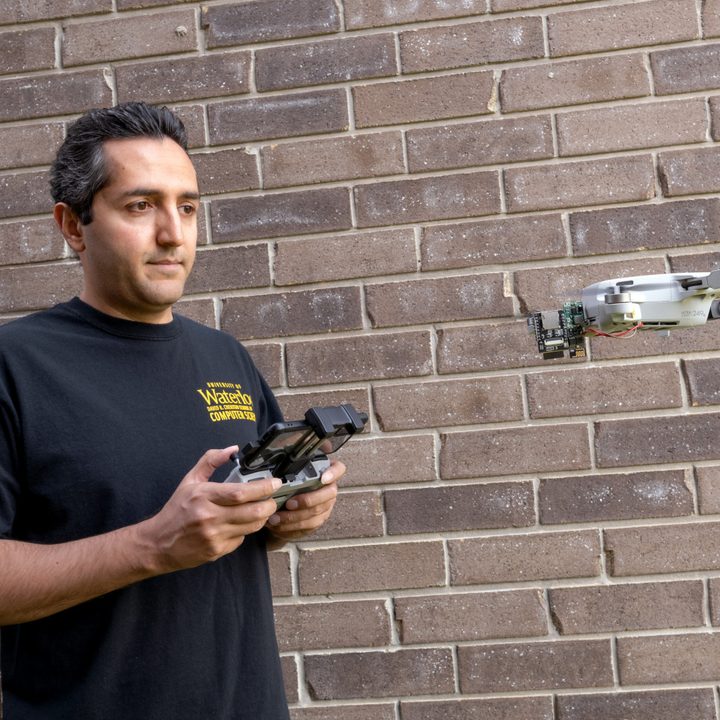
Professor Ali Abedi flying Wi-Peep standing against brick wall.
Image used with permission by copyright holder

The way Wi-Peep works is quite simple — it flies right up to a building, then starts exploiting the inhabitant’s Wi-Fi network (through what many call the Polite Wi-Fi loophole), and locates all Wi-Fi-connected devices inside in seconds. Wi-Peep is thus able to identify the location of individual devices down to 1 meter (3.3 feet) by sending several message packets to each device and measuring the response time on each. Apparently, this method also works with password-protected networks, because devices will still ping a response to any contact attempts by Wi-Peep.

Recommended Videos

It is therefore not hard to conceive how this (or similar) setup could be used for nefarious reasons. Dr. Abedi, who’s an adjunct professor of computer science at the university explains that “one could track the movements of security guards inside a bank by following the location of their phones or smartwatches. Likewise, a thief could identify the location and type of smart devices in a home, including security cameras, laptops, and smart TVs, to find a good candidate for a break-in. In addition, the device’s operation via drone means that it can be used quickly and remotely without much chance of the user being detected.”

Wi-Fi vulnerabilities have been exploited in the past, but what sets Wi-Peep apart from bulkier, more complex counterparts is its low cost, ease of assembly, and portability. Of course, it requires someone with the right expertise to create, but Abedi and his team have shown that it can be done.

Abedi is hoping that this revelation can create change for the next generation of Wi-Fi protocols. Meanwhile, he urges Wi-Fi chip manufacturers to have randomized device response times, which can throw off what Wi-Peep is currently able to do.

Aaron Leong
Former Computing Writer
Aaron enjoys all manner of tech - from mobile (phones/smartwear), audio (headphones/earbuds), computing (gaming/Chromebooks)…
AMD’s Radeon RX 9070 GRE has strong 1440p claims, but $549 may be a hard sell
Radeon RX 9070 GRE goes global after China debut
AMD Radeon RX 9070 GRE front view

The Radeon RX 9070 GRE has now launched globally at Computex 2026. AMD first introduced the RDNA 4-based GPU in China in May 2025, so this is a wider rollout rather than a brand-new graphics card.

It will be available from board partners starting June 2, in reference and overclocked versions, with a suggested retail price of $549.

Read more
Windows 11 is finally addressing key annoyances with the universal Search system
Partial terms now surface compound file names anywhere they appear, not just at the start.
Windows 11 Laptop

If you have ever typed a file name into Windows Search but stopped midway because you only remembered part of it, Microsoft has something for you. 

In its latest Windows 11 Insider Preview build, Microsoft has added a focused but genuinely useful improvement to the way Windows Search finds your files. It is one of those fixes that makes me wonder why it took so long. 

Read more
It’s not just you. Research says people don’t like overtly friendly AI chatbots
AI saying “hope you’re having an amazing day!” Is apparently too much
AI Chatbots

For years, tech companies have tried making AI assistants sound warmer, friendlier, and more emotionally human. But new research suggests that approach may actually backfire more often than companies expect. A recent study highlighted by Tech Xplore found that people generally prefer AI chatbots whose personalities mirror their own communication style rather than assistants that act excessively cheerful or overly friendly all the time.

According to the findings by the Northeastern researchers challenge one of the biggest assumptions driving modern AI development is that making chatbots more emotionally expressive automatically improves user experience.

Read more