  1. Home
  2. Computing
  3. News

Engineers take drastic action to prove humanoid robot is real

It walked so naturally that some people thought there was a human inside.

Add as a preferred source on Google
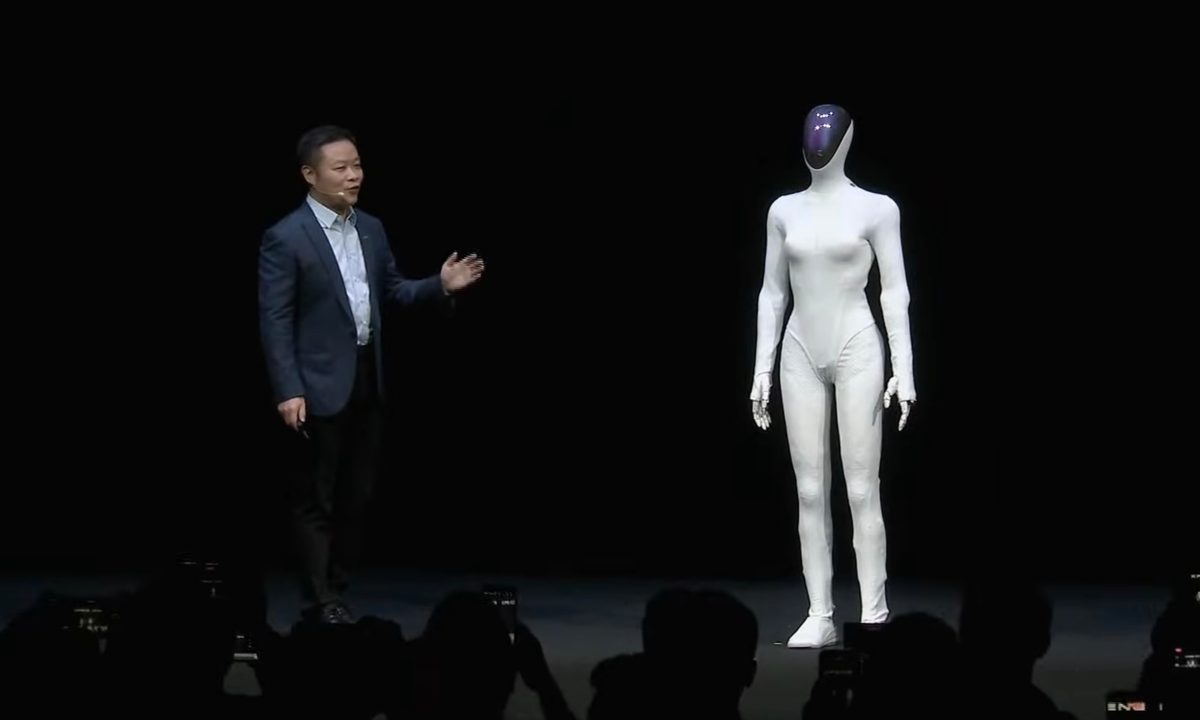
XPeng's CEO beside the company's Iron humanoid robot.
XPeng's CEO beside the company's Iron humanoid robot. XPeng

XPeng held a special event at its headquarters in Guangzhou, China, this week, showcasing its transformation from an electric vehicle maker to something much more ambitious involving humanoid robots, robotaxis, and flying cars — all powered by its advanced AI model and proprietary chips. 

Highlighting its new focus on integrating AI with real-world mobility and robotics, the company unveiled the latest version of its humanoid robot, called Iron. 

And that’s where things got interesting.

Recommended Videos

Iron’s ability to walk just like a human had many in the audience, as well as those watching a livestream of the event at home, wondering if it was actually a human inside. After all, many of you will recall that when Tesla chief Elon Musk unveiled the automaker’s Optimus robot in 2021, it was actually someone wearing a tight-fitting bodysuit.

And so, keen to dispel any rumors that XPeng was trying to pull a fast one in the style of Tesla, CEO He Xiaopeng brought Iron back onto the stage to show that Iron was indeed a humanoid robot and not a person in a bodysuit. 

They did this by getting an engineer to carefully cut away the fabric and padding materials surrounding Iron’s left leg, eventually revealing a robotic leg.

Once again, with its metal innards exposed, Iron walked across the stage in a very human-like way. It’s an extraordinary sight, and anyone with a nervous disposition may shudder at the spectacle of the bipedal bot strolling along in such a realistic way.

XPENG’s next-gen IRON robot effectively crossed the uncanny valley, leading many to believe it was a human in a suit.

In a follow-up event to prove it was a robot, He Xiaopeng had its leg skin cut open in front of a live audience. The robot then walked off the stage. pic.twitter.com/CNF5loZyaf

— The Humanoid Hub (@TheHumanoidHub) November 6, 2025

XPeng is competing with a slew of other makers of humanoid robots, which could eventually be deployed in the workplace and even in home settings.

According to XPeng, Iron could one day find itself helping visitors in museums, car showrooms, shopping centers, and of course XPeng’s own retail stores. Placement in factories for inspection roles is also on the cards. 

The company says it’s targeting mass production of Iron by the end of next year.

Trevor Mogg
Contributing Editor
Not so many moons ago, Trevor moved from one tea-loving island nation that drives on the left (Britain) to another (Japan)…
Faceless creators are becoming collateral damage in YouTube’s AI cleanup
Faceless creators built real YouTube audiences but the algorithm is now working against them
YouTube

YouTube has an AI slop problem, and its crackdown is catching legitimate creators in the crossfire. Faceless channels, where no human host ever appears on screen, have existed for years and are not inherently AI-generated.

Many are run by solo creators who simply prefer to stay anonymous. The problem is that AI tools made it easy to flood the platform with low-effort faceless content at scale, and YouTube's algorithm is now penalizing the format as a whole.

Read more
A network of X accounts is boosting AI nudify tools, raising hell for victims
Researchers say coordinated X accounts are helping AI nudify apps evade moderation and reach more users.
how-to-remove-nudes-deepfake-non-consensual-images

A network of X accounts is pushing AI nudify apps into more feeds, giving abuse-prone tools another route to users while victims fight to contain the fallout.

In a Wall Street Journal report, Graphika senior researcher Matthew Patane said some nudify services are promoted through coordinated social accounts that reuse similar wording. One network included 45,000 X accounts, with posts leaning on indirect phrasing and censored visuals to avoid moderation.

Read more
This new Mac app takes your screen hostage until you drink water
Hydration Hostage sits in your menu bar and blocks your screen on a schedule, only unlocking after your camera confirms you took a sip.
Hydration Hostage featured

A new Mac app is betting that the reason your hydration reminders fail is that they are too easy to ignore. Apps like Loook take a gentle approach, nudging you to hydrate alongside reminders for posture and eye breaks. Hydration Hostage takes the opposite stance. Built by a solo developer, the app sits in your menu bar and takes over your screen on a predefined schedule until the camera confirms you actually drank water.

How it works

Read more