  1. Home
  2. Computing
  3. News

Google wants to push quantum computing mainstream with ‘Bristlecone’ chip

Add as a preferred source on Google
Google Bristlecone Quantum
Image used with permission by copyright holder

Google’s Quantum artificial intelligence lab recently revealed a new quantum processor that may pave the way for quantum computing to go mainstream. The new chip features 72 qubits according to Google and offers a compelling proof-of-concept for future, large-scale quantum computers.

“Our strategy is to explore near-term applications using systems that are forward compatible to a large-scale universal error-corrected quantum computer,” Google’s announcement reads.

Recommended Videos

All right, quantum computing is complicated, bizarre, and tough to explain but Google’s new Bristlecone chip is important for a few reasons. First of which, it’s designed to address one of the key problems facing quantum computing today: Error correction. Because traditional chips, like the one in your phone or your computer, or any other electronic device, all use Boolean logic — simple yes or no, on or off operations — error correction is fairly easy to implement. All of these traditional processors use redundancy to check for errors. Just copy a single bit of data three times, if one changes due to an error, your processor can just check the other two bits and make the correction.
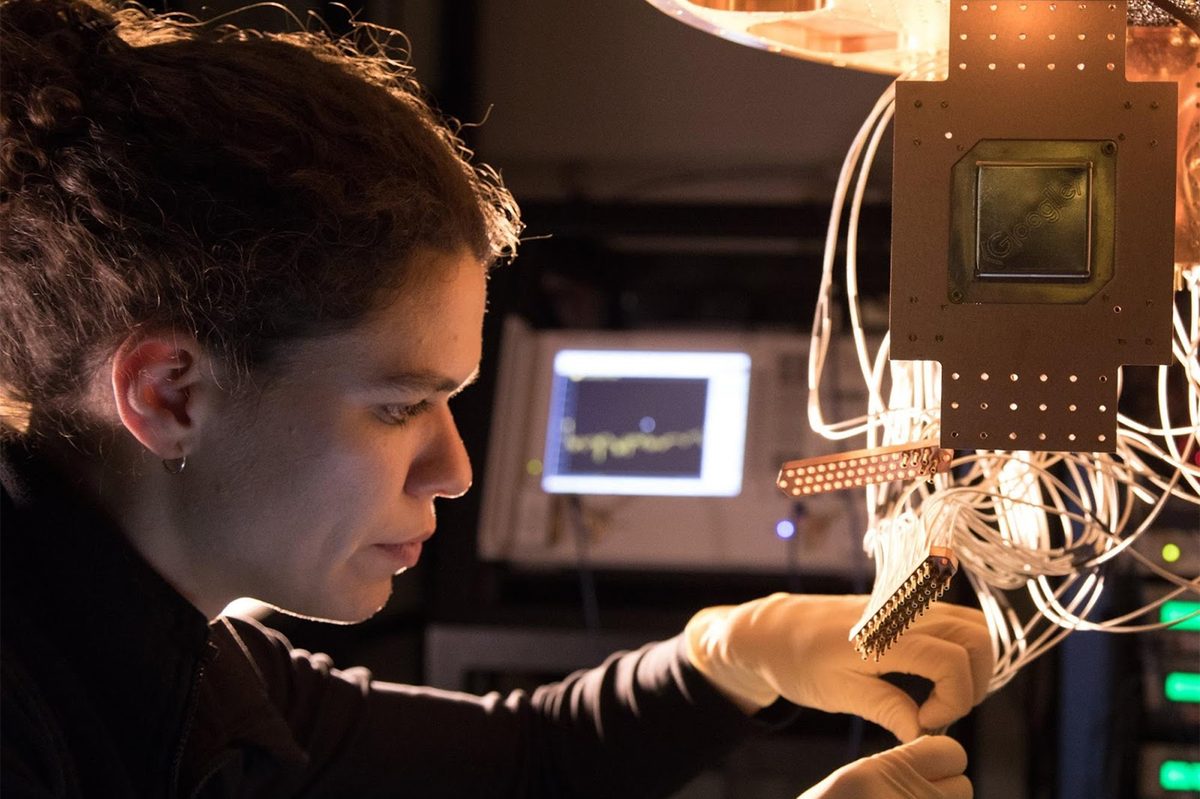
Bristlecone quantum computing chip
Image used with permission by copyright holder

That is an oversimplification but that is essentially how error correction works on regular processors. Now quantum processors use a different kind of logic which makes traditional error correction tricky. Instead of each bit having two potential states — on or off — a quantum bit or qubit has three. It can be on, off, or both, and you’ll only know which one it is once you look at it. This makes error-correction a huge problem for quantum computers. How can you tell if a bit of data is correct if looking at it might change its state?

“We chose a device of this size to be able to demonstrate quantum supremacy in the future, investigate first and second order error-correction using the surface code, and to facilitate quantum algorithm development on actual hardware,” Google’s announcement said.

Chips like Bristlecone aim to solve that problem by offering a testbed for quantum error correction on a chip with enough qubits to potentially achieve quantum supremacy — that is just a term for the first time a quantum computer can actually outperform a traditional supercomputer on a well-known computer science problem. According to Google, this new chip could be the one that does it — or at least some future version of Bristlecone.

Jaina Grey
Former Digital Trends Contributor
Jaina Grey is a Seattle-based journalist with over a decade of experience covering technology, coffee, gaming, and AI. Her…
Google’s new desktop mode makes one thing clear: Samsung DeX was onto something
Android 16 finally brings a real desktop mode to Pixel phones, but Google’s long-awaited move mostly proves Samsung spent years getting the hard parts right
File, Webpage, Person

I’ve been waiting for Android to take desktop mode seriously for years. Back in 2019, I bought a OnePlus 7 Pro and wasted an embarrassing amount of time trying to brute-force its half-baked desktop mode into something useful.

The idea made perfect sense to me even then. Phones were already absurdly powerful, and the thought of carrying one real computer in my pocket felt less like science fiction and more like delayed common sense.

Read more
Anthropic launches Claude design to simplify visual creation with AI
Finally, AI that designs your slides so you don’t have to
Claude

Anthropic has introduced a new AI-powered design tool called Claude Design, aimed at helping users create visual content such as prototypes, presentations, and marketing assets through simple conversational inputs. The product, developed under Anthropic Labs, is currently available in research preview for paid Claude subscribers and is being rolled out gradually.

Claude Design is powered by the company’s latest vision model, Claude Opus 4.7, and is positioned as a tool that bridges the gap between technical design expertise and everyday creative needs.

Read more
AI triggered a RAMmageddon so bad that Apple looks like the sensible choice
Laptop prices got so stupid in 2026, that Apple turned into the value king.
Student using MacBook Neo in classroom.

I really didn't want to believe it, but here we are. Apple is now looking like the sensible laptop brand. Not the cool underdog. Not the affordable alternative. Apple, in 2026. The reason is not that the company suddenly became generous, but rather the rest of the competition has suddenly become so deranged that a MacBook lineup starting at $599 feels weirdly grounded.

Apple's MacBook Neo starts at $599, while Microsoft's own 13-inch Surface Laptop now starts at $1,199 after this month's price hikes. This isn't a small gap that you can ignore. Meanwhile, Apple's MacBook Air with M5 starts at $1,099 with 16GB of memory and 512GB of storage, which looks like one of the few premium laptops still priced by human beings.

Read more