  1. Home
  2. Computing
  3. News

Google pulls the plug on Project Mariner, the AI agent that browsed the web like a human

The autonomous browser agent Google introduced at I/O 2025 is now more. Its technology is being absorbed into the Gemini API and Gemini Agent.

Add as a preferred source on Google
Diagram, Business Card, Paper
Google Labs

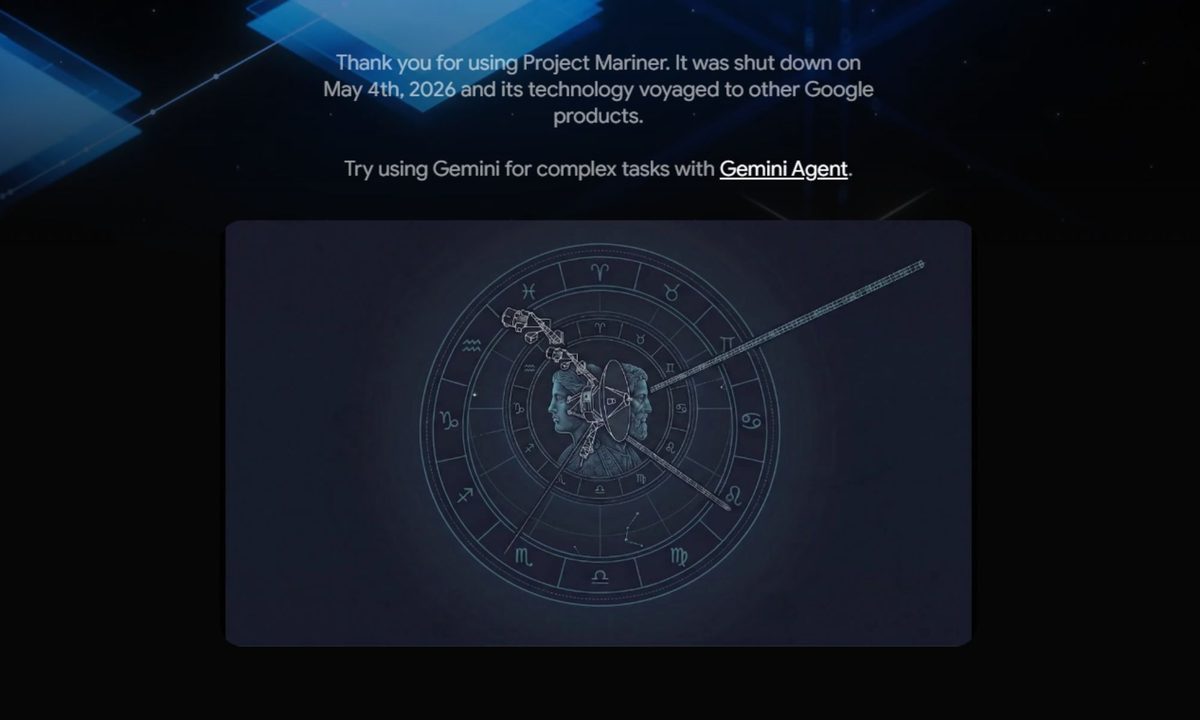
Google has shut down Project Mariner, the autonomous web browsing agent it debuted at I/O last year. The tool, which could navigate Chrome, fill out forms, search listings, and book travel by taking screenshots and visually recognizing page elements, is no longer available. Its landing page now shows a notice with the shutdown date listed as May 4, 2026.

A browser agent that saw what you saw

Project Mariner was Google DeepMind’s attempt to build an AI agent that interacted with websites the way a person would. Rather than reading page data directly, it processed screenshots in real time to identify buttons, text fields, and links, then clicked and typed on a user’s behalf. That approach lets it handle multi-step tasks across sites without requiring any special integration from the website.

NEW: Google quietly shut down Project Mariner yesterday, the web-browsing AI agent it highlighted onstage last year at Google IO.

I reported for WIRED, nearly 2 months ago, that Google had moved staffers off the Project Mariner team as it responded to OpenClaw-style agents. pic.twitter.com/WMBago74vr

— Max Zeff (@ZeffMax) May 6, 2026

The tradeoff was performance. Visual processing at that scale demands significant compute, and the method was prone to errors, such as selecting the wrong option on a page. The agent also raised privacy concerns, since it required continuous access to whatever was visible in a user’s browser at any given moment.

Recommended Videos

Signs of trouble first surfaced in March, when Wired reported Google had begun reassigning staffers away from the Project Mariner team, a signal the project was losing internal support months before the shutdown became public.

Mariner’s tech isn’t going away

Google says Mariner’s technology “voyaged to other Google products.” Its core features will reportedly be absorbed into the Gemini API and the new Gemini Agent rather than being discontinued outright.

The shutdown tracks with a wider shift in how the industry is building agentic AI. Tools that operate at the file and code level, rather than the visual browser level, have become the dominant model. They are faster, cheaper to run, and more capable of handling complex, multi-step tasks. Mariner’s screenshot-based approach, while novel at launch, was competing against an architecture that had effectively moved past it.

Pranob Mehrotra
Pranob is a seasoned tech journalist with over eight years of experience covering consumer technology. His work has been…
Google responds to Chrome’s silent Gemini Nano install, stops short of addressing consent
Chrome's GM says on-device AI is central to the browser's security strategy, but did not explain why deleting it triggers an automatic re-download.
Google Chrome with Gemini

Google Chrome VP and GM Parisa Tabriz has responded to criticism over Chrome's practice of silently downloading a 4GB AI model onto users' devices, saying on-device AI is central to the browser's security and developer strategy.

What triggered the backlash

Read more
Anthropic just taught Claude to dream between tasks, and it makes agents meaningfully smarter
Dreaming turns Claude from an AI that forgets everything the moment a session ends into one that quietly gets better at its job every time it's not actively working.
Claude Dreaming featured image.

Anthropic just gave Claude something that sounds like a perfect science fiction plot: the ability to dream. The company has announced three upgrades to Claude Managed Agents: Dreaming, Outcomes, and Multiagent Orchestration. 

While I agree that the Dreaming clearly has the most evocative name, it’s also the one with the most practical implications for developers building AI agents that can handle complex, long-running work. 

Read more
Samsung patent shows a laptop with a clever touch-sensitive palmrest for shortcuts
This new Samsung laptop patent wants to rewire your typing habits
The screen of the Galaxy Book4 Ultra.

Samsung has been known to file some bizarre patents from time to time, including its ⁠multi-fold laptop and rollable smartphone concepts from 2022. A new patent from the company has recently surfaced, showcasing a laptop concept that could reduce the need for modifier keys like Ctrl, Shift, and Alt. The laptop in the patent is shown using built-in sensors in the palmrest to detect the position of the user’s arms and adjust the function of the keys accordingly.

Could your palmrest replace Ctrl and Shift?

Read more