  1. Home
  2. Computing
  3. Mobile
  4. Legacy Archives

Google reveals 5-year roadmap detailing stronger account authentication

Add as a preferred source on Google
google-5-year-security-roadmap
Image used with permission by copyright holder

In five years, your Google accounts will be way more secure than they are today. The company recently revealed a five-year roadmap detailing stronger, more complex authentication methods that’ll make it harder to gain unauthorized entry into your accounts.
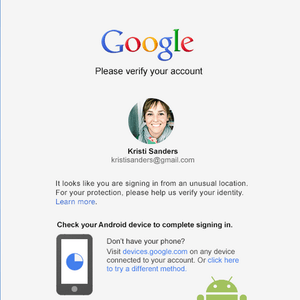
google-5-year-security-roadmap-3To start with, Google plans to make signing in to your account a lot more complex. Possibilities include having to pinpoint your location on a map, keying in one-time passwords generated by phone apps, using specialized hardware such as a card with NFC or a USB drive, or using an online portal that asks you to perform a set of tasks. 

Recommended Videos

“We will change sign-in to a once-per-device action and make it higher friction, not lower friction, for all users,” Google group product manager for identity, Eric Sachs, told ZDNet.”We don’t mind making it painful for users to sign into their device if they only have to do it once.”

Google will also eventually switch on two-step authentication by default to add another layer of security on top of the log-in process. 

The company released a similar plan back in 2008, but Google has had to rethink everything on account of smartphones becoming so advanced and popular. Sachs admitted Google didn’t see the high rate of smartphone adoption coming, hence the new roadmap. In addition to a more stringent login process on your main device, Google also has plans to make accessing your accounts on a second device more intricate. You’ll most likely need your first phone or tablet on hand to authenticate your second one via NFC or a similar technology.

These are but a few of the things Google hopes to accomplish within five years in an effort to combat increasingly more frequent security breaches. To read the full roadmap, check out the lengthy document the company has published. 

Mariella Moon
Mariella loves working on both helpful and awe-inspiring science and technology stories. When she's not at her desk writing…
AI is entering the Skynet debate moment in the social media hype circles
AI might end the world - but first, it’ll trend on social media
Representative Image

A growing wave of online voices warning about the dangers of artificial intelligence—often dubbed “AI doom influencers” - is reshaping how the public and policymakers view the technology. According to a report by The Washington Post, these influencers, including researchers, tech leaders, and content creators, are increasingly highlighting worst-case scenarios, from mass job loss to existential risks posed by advanced AI systems.

While critics argue that some of this messaging borders on alarmism, the conversation is no longer confined to speculation. Real-world developments in AI are beginning to mirror some of the concerns being raised, blurring the line between hype and legitimate risk.

Read more
You won’t believe it, but Motorola actually makes a terrific head-turner of a laptop
Motorola’s Moto Book 60 Pro is surprisingly stylish, and the pricing makes it even better
Moto Book 60 Pro in PANTONE Bronze Green

Motorola is not the name I expect to see on a genuinely good laptop. A stylish phone? Sure. A foldable with some personality? Absolutely. But a thin-and-light notebook that actually feels well judged on both design and value was a genuine surprise. And yet, the Moto Book 60 Pro is one of the more quietly impressive laptops in its segment.

With the broader laptop market being in a mess, Motorola's laptops feel refreshing. It is capable, attractive, and still approachable at a time when pricing elsewhere has become increasingly rough.

Read more
Zoom will now check if you are a human or an AI imposter during video meetings
Biometric badges, iris scans, and AI bouncers: welcome to the future of your Monday morning standup.
Zoom face scan technology.

Zoom video calls just got a new kind of awkward small feature. The platform will now ask you whether you’re human. It has partnered with World, Sam Altman’s iris-scanning identity company (previously known as Worldcoin), to add real-time human verification inside meetings. 

The feature, launched on April 17, 2026, is a part of World’s ID 4.0 rollout. It lets hosts confirm that every face on the call belongs to a real person, not an AI-generated imposter. 

Read more