  1. Home
  2. Computing
  3. News

Zoom will now check if you are a human or an AI imposter during video meetings

Biometric badges, iris scans, and AI bouncers: welcome to the future of your Monday morning standup.

Add as a preferred source on Google
Zoom face scan technology.
Zoom

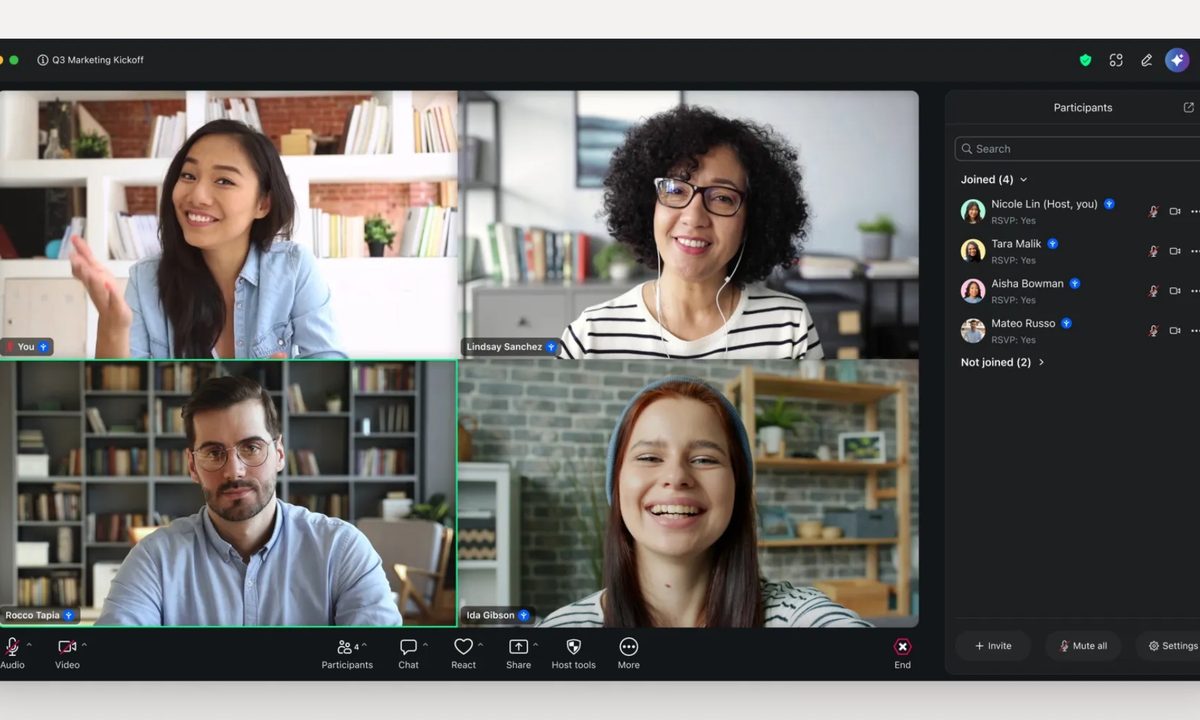
Zoom video calls just got a new kind of awkward small feature. The platform will now ask you whether you’re human. It has partnered with World, Sam Altman’s iris-scanning identity company (previously known as Worldcoin), to add real-time human verification inside meetings

The feature, launched on April 17, 2026, is a part of World’s ID 4.0 rollout. It lets hosts confirm that every face on the call belongs to a real person, not an AI-generated imposter. 

How does the “verified human” badge actually work?

For those wondering how World’s Deep Face technology works, it includes a three-step process. It cross-references a signed image from a user’s original Orb registration, a live face scan from the device, and the frame of the video that’s visible to the other participants in the meeting. 

Recommended Videos

Only when the three samples match does a “Verified Human” badge appear next to the user’s name. To me, it feels weird and ironic that I’d need to prove that I’m a human, just to be seen as one in a Zoom meeting

Hosts can also make Deep Face verification mandatory for joining meetings, preventing unverified participants from joining entirely. Mid-call, on-the-spot checks are also possible. So, whether you think your colleague is looking a bit funny, or you simply want to annoy someone, you can demand a check in real time.

Why is this even necessary?

Simple: deepfake fraud is no longer something that you hear about from a friend’s friend or something that you read about in weekend blogs. In early 2024, engineering firm Arup lost $25 million after an employee in Hong Kong authorized wire transfers during a video call, where everyone except the victim turned out to be a deepfake

Something similar happened with a multinational firm in Singapore in 2025. Moreover, financial losses from deepfake-enabled fraud exceeded $200 million in the first quarter of last year alone. The threat is no longer hypothetical; it’s something that a growing number of people and enterprises are facing. 

The direction is clear: biometric proof of personhood is becoming a workplace norm by the day. 

Shikhar Mehrotra
For more than five years, Shikhar has consistently simplified developments in the field of consumer tech and presented them…
Sci-fi got the gadgets right, but the vibes wrong
Sci-fi got plenty of consumer tech right, but reality keeps delivering the useful, compromised version of the dream
Officer K looking up at a neon-colored hologram in Blade Runner 2049.

I was recently waiting for an Uber when the GPS decided to lie for sport. The car was somewhere nearby, I was somewhere nearby, and somehow both of us were trapped in that modern ritual of wrong pins, slow turns, vague waving, and "I'm here" messages that help absolutely no one.

That was when I had a very reasonable thought: this is exactly where a hologram of a giant arrow pointing at me would be useful.

Read more
Apple could go back to Intel for chips, but not how you would expect (or dread)
Apple MacBook

Apple and Intel are reportedly exploring a manufacturing partnership that could reshape how future Apple chips are produced. But despite the headline, this does not mean Apple is abandoning Apple Silicon or returning to Intel-powered Macs.

According to a new Wall Street Journal report, Apple and Intel have reached a preliminary agreement for Intel to manufacture some chips designed by Apple. Bloomberg’s Mark Gurman later clarified on X that there is still no finalized production agreement in place and discussions remain at an early stage. His post also noted that Apple continues to have concerns about Intel’s manufacturing technology and long-term competitiveness.

Read more
Apple wants you to verify your identity before you get Education discount on products
Apple moving the US Education Store off the honor system also seems about making a globally consistent verification infrastructure that could eventually support more aggressive Education Store expansion.
Computer, Electronics, Laptop

Getting an Apple Education discount in the United States used to be as simple as claiming you’re a student or a teacher; it didn’t need a formal verification. That era is officially over. 

Starting May 8, 2026, Apple now requires formal identity verification for all Education Store purchases in the US, ending the informal honor system that was in place for years (via MacRumors). 

Read more