  1. Home
  2. Computing
  3. News

Watch this humanoid robot demonstrate ‘anti-gravity’ mode

It gets knocked down, but it gets up again.

Add as a preferred source on Google
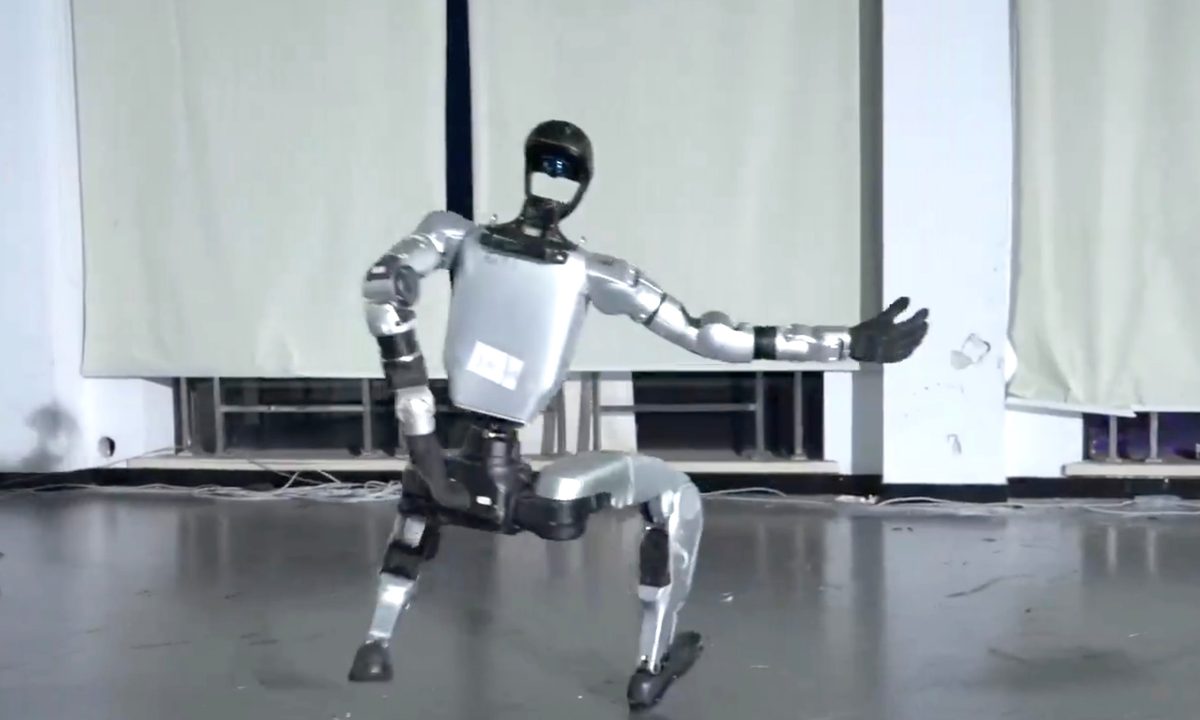
Unitree's G1 robot showing off its skills.
Unitree

Robotics specialist Unitree has released another video showing its G1 humanoid robot recovering quickly and easily after being knocked to the ground.

“Unitree G1 has learned the ‘Anti-Gravity’ mode,” Unitree said in a comment alongside the footage. “Stability is greatly improved under any action sequence, and even if it falls, it can quickly get back up.”

Check it out below:

Unitree G1 has mastered more quirky skills 🤩
Unitree G1 has learned the “Anti-Gravity” mode: stability is greatly improved under any action sequence, and even if it falls, it can quickly get back up. pic.twitter.com/gDR0n0eIXl

— Unitree (@UnitreeRobotics) September 22, 2025

It’s an impressive display of balance and agility — not to mention robustness — with the robot seemingly untroubled by being repeatedly kicked to the ground. Its recovery speed is particularly impressive, but some are starting to wonder … what’s it all for?

Recommended Videos

If the goal is to create an army of humanoid robots capable of hand-to-hand combat, then it’s heading in the right direction. But if the aim is to deploy G1 in industrial settings like warehouses and factories, then we’d love to see more of what it can do in those locations, too.

Indeed, some folks on X dropping comments on the video are making similar points.

“These demos mean nothing,” said one. “You should show video where the robot is actually doing some useful work without human intervention.”

Another comments: “Stunning progress in humanoid robotics with Unitree’s achievements standing out. Stability matters, but focus must be on practical uses that uplift human lives.”

While someone else quips: “I’m going to laugh so hard when the robot finally figures out that it can stop from getting knocked over by beating the guy up preemptively.”

Unitree’s G1 robot stands at 52 inches (132 centimeters) and tips the scales at 77 pounds (35 kilograms). It’s fully electric and comes with dexterous robotic hands.

The Hangzhou, China-based company actually started selling the G1 humanoid robot in 2024 for the competitive price of $16,000. The bipedal bot is aimed primarily at researchers and businesses looking for an adaptable platform for AI-driven automation and manipulation.

The market for humanoid robots is likely to grow significantly in the coming years, with improving AI and sensor technologies expected to give the robots more capabilities than ever. Unitree is one of a growing number of companies developing humanoid robots, with many eyeing mass deployment in industrial settings.

Trevor Mogg
Contributing Editor
Not so many moons ago, Trevor moved from one tea-loving island nation that drives on the left (Britain) to another (Japan)…
Apple’s M6 chip isn’t even here yet, but you’ll see M7 Macs early in 2027
Apple is reportedly already accelerating its next-generation silicon roadmap, even before the M6 has launched.
Apple MacBook

The M6 chip is still expected to debut later this year, but Apple may already be preparing for what comes next. According to Mark Gurman's latest report for Bloomberg, the company is aiming to introduce its first M7-powered devices as early as the first half of 2027, hinting at a much faster silicon refresh than many expected.

M7 could arrive alongside new Macs and iPads

Read more
The entry-level MacBook Pro could get a design refresh in 2027, and it’s about time
Five years on the same chassis, and now both tiers of the MacBook Pro are getting a new look at once.
MacBook Pro in space grey sitting on a desk.

Apple has a new MacBook Pro lined up for launch early next year, according to Bloomberg. The company will introduce a 14-inch laptop in the first half of 2027. 

The biggest surprise, however, will be a brand-new design language. The outlet describes it as "a revamped entry-level MacBook Pro, code-named K104."

Read more
Study finds humans will talk to AI ghosts of the dead as reincarnations, and it’s pretty grim
The first AI ghost study is in. The results are about as complicated as you'd expect.
VR Headset, Person, Face

A new study from the University of Colorado Boulder confirms something that sounds both impressive and concerning. People find interacting with AI simulations of their dead loved ones deeply meaningful, and most will come away wanting to do it again.

The researchers call it a "generative ghost," which is a clear reference to generative AI, but I’d still prefer to call it unsettling.

Read more