
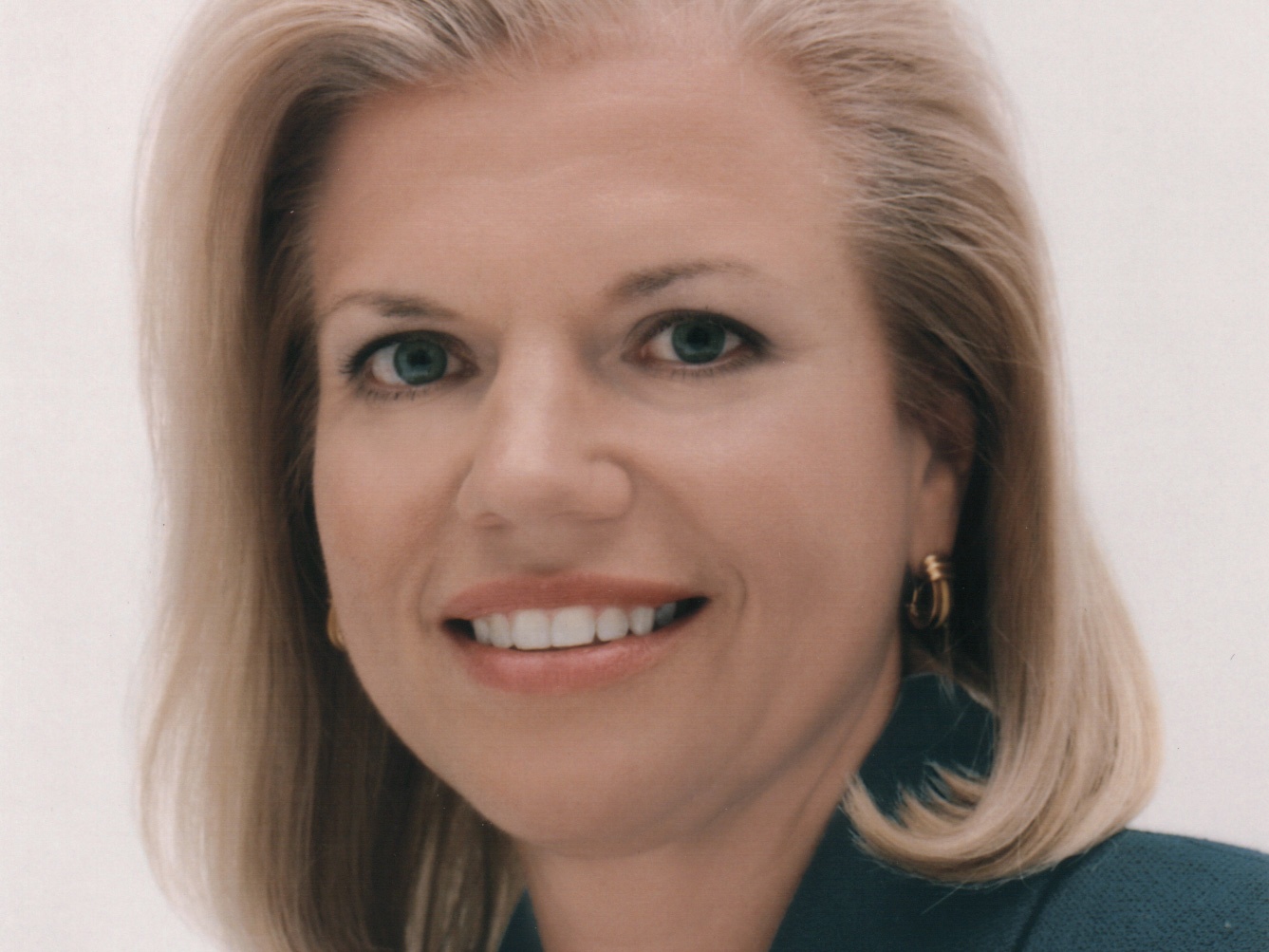
 After 30 years with the company, IBM senior vice president and group executive for sales, marketing and strategy Virginia Rometty has been named the company’s new chief executive officer, the company announced today. Her tenure as CEO will begin at the start of next year, after current CEO, Sam Palmisano, retires. Palmisano will remain on IBM’s board of directors.
“There is no greater privilege in business than to be asked to lead IBM, especially at this moment,” said Rometty in a statement. “Sam had the courage to transform the company based on his belief that computing technology, our industry, even world economies would shift in historic ways. All of that has come to pass. Today, IBM’s strategies and business model are correct. Our ability to execute and deliver consistent results for clients and shareholders is strong. This is due to Sam’s leadership, his discipline, and his unshakable belief in the ability of IBM and IBMers to lead into the future. Sam taught us, above all, that we must never stop reinventing IBM.”
According to IBM, Rometty is responsible for revenue, profit and client satisfaction for all 170 global markets in which IBM does business.
“She is responsible for IBM’s worldwide results, which exceeded $99 billion in 2010,” says IBM in its official release. “She also is responsible for leading IBM’s global strategy, marketing and communications functions.”
In other words, Rometty – who joined IBM as a systems engineer in 1981 – has been largely responsible for the success of IBM, in recent years at least, which not long ago surpassed Microsoft in market value to become the second-most-valuable technology company in the world, after Apple. (At least, this is the message IBM wants to convey — that it’s new CEO comes from a place of strength.) So Rometty’s succession should come as little surprise.
What’s most surprising about this, in fact, is that anyone still stays with a company for 30 years. These days, few people, it seems, stay with one employer for more than 30 months, let alone 30 years. And for IBM to hoist one of its own to the company’s top position is also a relative rarity, when so many new chief executives come from outside sources.
Read IBM’s full release on the matter below:
ARMONK, N.Y.–(BUSINESS WIRE)– The IBM (NYSE:IBM – News) board of directors has elected Virginia M. Rometty president and chief executive officer of the company, effective January 1, 2012. She was also elected a member of the board of directors, effective at that time. Ms. Rometty is currently IBM senior vice president and group executive for sales, marketing and strategy. She succeeds Samuel J. Palmisano, who currently is IBM chairman, president and chief executive officer. Mr. Palmisano will remain chairman of the board.
“Ginni Rometty has successfully led several of IBM’s most important businesses over the past decade – from the formation of IBM Global Business Services to the build-out of our Growth Markets Unit,” Mr. Palmisano said. “But she is more than a superb operational executive. With every leadership role, she has strengthened our ability to integrate IBM’s capabilities for our clients. She has spurred us to keep pace with the needs and aspirations of our clients by deepening our expertise and industry knowledge. Ginni’s long-term strategic thinking and client focus are seen in our growth initiatives, from cloud computing and analytics to the commercialization of Watson. She brings to the role of CEO a unique combination of vision, client focus, unrelenting drive, and passion for IBMers and the company’s future. I know the board agrees with me that Ginni is the ideal CEO to lead IBM into its second century.”
Ms. Rometty said: “There is no greater privilege in business than to be asked to lead IBM, especially at this moment. Sam had the courage to transform the company based on his belief that computing technology, our industry, even world economies would shift in historic ways. All of that has come to pass. Today, IBM’s strategies and business model are correct. Our ability to execute and deliver consistent results for clients and shareholders is strong. This is due to Sam’s leadership, his discipline, and his unshakable belief in the ability of IBM and IBMers to lead into the future. Sam taught us, above all, that we must never stop reinventing IBM.”
Mr. Palmisano, 60, became IBM chief executive officer in 2002 and chairman of the board in 2003. During his tenure, IBM exited commoditizing businesses, including PCs, printers and hard disk drives, and greatly increased investments in high-value businesses and technologies. He has overseen the significant expansion of IBM in the emerging markets of China, India, Brazil, Russia and dozens of other developing countries, transforming IBM from a multinational into a globally integrated enterprise. In 2008, he launched IBM’s Smarter Planet strategy, which describes the company’s view of the next era of information technology and its impact on business and society.
Since Mr. Palmisano became CEO, IBM has set records in pre-tax earnings, earnings per share, and free cash flow. During Mr. Palmisano’s tenure, IBM increased EPS by almost five times, generated over $100 billion in free cash flow, and invested more than $50 billion in research and development – creating over $100 billion of shareholder value since 2002 through an increase in market capitalization and dividends paid.
As global sales leader for IBM, Ms. Rometty, 54, is accountable for revenue, profit, and client satisfaction in the 170 global markets in which IBM does business. She is responsible for IBM’s worldwide results, which exceeded $99 billion in 2010. She also is responsible for leading IBM’s global strategy, marketing and communications functions. Previously, Ms. Rometty was senior vice president of IBM Global Business Services. In that role, she led the successful integration of PricewaterhouseCoopers Consulting — the largest acquisition in professional services history, building a global team of more than 100,000 business consultants and services experts. She has also served as general manager of IBM Global Services, Americas, and of IBM’s Global Insurance and Financial Services Sector.
Ms. Rometty joined IBM in 1981 as a systems engineer. She holds a Bachelor of Science degree with high honors in computer science and electrical engineering from Northwestern University.


