  1. Home
  2. Computing
  3. Legacy Archives

IBM’s Watson gets job in health care

Add as a preferred source on Google

It didn’t take long for IBM’s demonstration of the question-answering prowess in the Jeopardy-winning Watson system to find some backers: IBM has announced a deal with Nuance Communications to apply Watson’s Deep Question Answering technology the healthcare field. The research partnership will also address one of the key shortcomings Watson demonstrated on Jeopardy, combining Watson’s analytical skills with speech recognition technology so the system can understand what people say, rather than having to have queries posed to it as pure text.
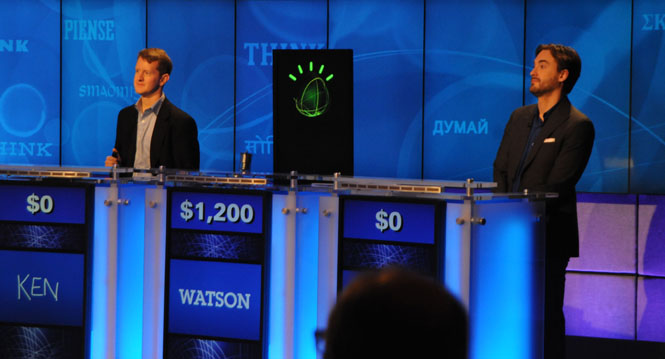
Image used with permission by copyright holder

“Combining our analytics expertise with the experience and technology of Nuance, we can transform the way that healthcare professionals accomplish everyday tasks by enabling them to work smarter and more efficiently,” said IBM senior VP and director of research Dr. John E. Kelly III, in a statement. “This initiative demonstrates how we plan to apply Watson’s capabilities into new areas, such as healthcare with Nuance.”

Recommended Videos

The Columbia University Medical Center and the University of Maryland School of Medicine will also work on the project. Nuance and IBM hope to have the direct products based on the technology ready to come to market in 18 to 24 months. The project will also leverage Nuance’s Clinical Language Understanding solutions to improve Watson’s understanding of medical vocabulary and terminology.

The healthcare industry’s interest in Watson comes from the system’s seeming ability to quickly process information available in natural language—rather than deliberately encoded for computer processing—and make rapid, high-level connections between key items of information from disparate sources. The technology could be applied to help healthcare professional keep up with the vast amounts of clinical data and scientific research being published in the healthcare field every day; looking forward, Watson technology could be applied to some of the applications that have along been envisioned for so-called “strong AI” systems, like drug interactions and real-time diagnoses.

[Image: IBM]

Geoff Duncan
Former Contributor
Geoff Duncan writes, programs, edits, plays music, and delights in making software misbehave. He's probably the only member…
Microsoft Edge is about to get more frequent updates, but don’t expect more features
Starting with Edge 152 on August 27, Microsoft is cutting its release cycle in half, with smaller but more frequent updates for Stable channel users.
Microsoft Edge illustration official

Microsoft is accelerating updates to its Edge browser, switching from a monthly release schedule to a biweekly one. The change takes effect with Edge 152, due on August 27, and puts the browser on the same cadence as Google Chrome.

More updates, not more features

Read more
What makes a laptop good for both work and entertainment?
Computer, Electronics, Laptop

This post is brought to you in paid partnership with HP.

The HP OmniBook X Flip is designed as an all‑day AI PC that adapts seamlessly from productivity to entertainment without switching devices.

Read more
Your Windows 11 PC can now natively run AI workloads, even if it lacks the Copilot+ badge
Windows 11 laptop on a table

For the better part of a year, Microsoft has been telling us that the future of AI on Windows belongs to Copilot+ PCs. If you wanted Microsoft’s most advanced local AI features, you needed a machine with a dedicated Neural Processing Unit (NPU). That was the deal. Now, Microsoft appears to be rewriting the rules.

According to updated documentation, Windows 11’s local Language Model APIs can now run on non-Copilot+ PCs, provided they have an Nvidia GeForce RTX 30-series GPU (or newer) with at least 6GB of VRAM. On the surface, this sounds like a developer-focused update. In reality, it could be one of the most significant shifts in Microsoft’s AI PC strategy since Copilot+ PCs launched last year. More importantly, it raises a question that has been lingering ever since the AI PC era began: Did we really need NPUs for all of this in the first place?

Read more