

A leaked roadmap for Intel’s CPU division paints a discouraging picture of the chip giant’s plans for a 10nm die shrink. Although these slides claim that its 10nm Ice Lake mobile CPUs are slated to make an appearance in 2019, the desktop division won’t see a hint of anything that size until 2021 and even then, only in a low power form. It may be that desktop gamers and hardware enthusiasts won’t see Intel make anything for them at the 10nm die size until 2022 or beyond.
For years, the shrink to 10nm has been an albatross around Intel’s neck. Originally planned to debut in 2015, it was then pushed to 2016, 2017, and beyond. Reportedly yield issues have been the main cause of these delays, but today there is still little sign of anything 10nm on the desktop. The last we heard of it Intel had effectively skipped its 10nm Cannon Lake generation and was instead refocusing on Ice Lake, a reportedly 10nm+ process that would first be introduced in laptops towards the end of 2019, with desktop chips potentially coming later.

But these newly leaked roadmaps from Tweakers, via WCCFTech, show that even in 2018, when it appears these roadmaps were created, Intel had no plans for 10nm desktop CPUs in the near future. Up until the end of 2021, Intel’s desktop “S-Series” chips will still use a 14nm process, even though two new architectures, Comet Lake S, and Rocket Lake S, will be introduced in 2020 and 2021, respectively.
While these roadmaps may not be legitimate, Intel has so far refused to comment on or deny them, which is rather damning.
The first roadmap suggests that the existing Coffee Lake S refresh with its two, four, six, and eight-core CPUs will remain relevant until the middle of next year, where Comet Lake will take over and offer a 10-core variant at the top end of the spectrum. Rocket Lake S will again take over in spring 2021 with the same spread of core counts.
Intel does have some 10nm chips planned for mid-2021 in the form of low-power, Tiger Lake U designs, which will be four-core only, according to the roadmap. Tiger Lake Y chips, with a maximum TDP of 5w, will also launch at the same time.
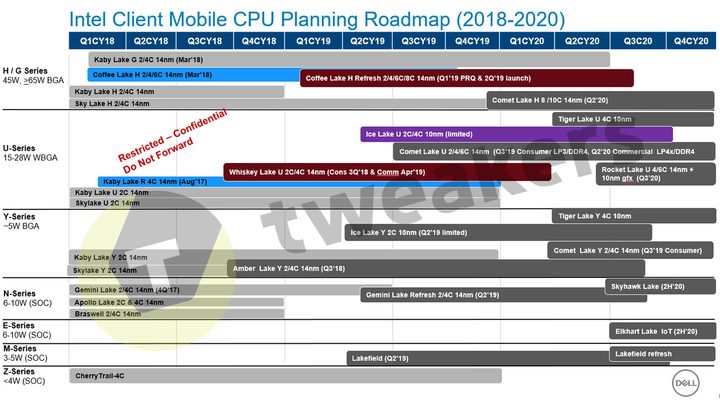
The mobile slide suggests that Ice Lake will still be the first 10nm chips from Intel to ship in volume, but that they may still be “limited” during their initial launch. This roadmap pins them at a mid-2019 released, which would fit in line with promises made by Dell for Ice Lake-equipped XPS laptops for this summer.
Although that could mean that we’ll see 10nm desktop CPUs sooner, that doesn’t seem particularly likely considering all we’ve heard in recent months. These slides may not be completely up to date, but they paint a poor picture of Intel’s future CPU generations. AMD’s upcoming 7nm Ryzen 3000 series will put a lot of pressure on Intel’s existing chips, and if this roadmap proves accurate and Intel doesn’t have anything new to offer gamers and high-end desktop users until mid 2020 (around when AMD could launch its fourth-generation Zen 3 Ryzen chips) Intel could be in a lot of trouble in the desktop market.
Beyond the die shrink with its Zen 2 architecture, AMD is expected to use a more advanced node with its Zen 4 architecture (which could power a speculative Ryzen 5000 generation). That could mean a shrink to 5nm which would see AMD CPUs hitting that diminutive node size before Intel has even managed to produce a single high-power 10nm desktop chip.


