  1. Home
  2. Computing
  3. News

Leaked image reveals future Intel exascale chips with PCIe 5.0 and DDR5 memory

Add as a preferred source on Google
 

Intel’s next-generation Xeon processors could come with support for new technologies to make servers fast, according to the latest leaked images. Leaked schematics for an engineering sample of Intel’s 4th-gen Xeon — which has a code name of Sapphire Rapids — indicate that the processor may add support for PCIe 5.0 and new eight-channel DDR5 memory. Support for the former would make Sapphire Rapids the first server processor to add PCIe 5.0 support, while support for the latter would bring Intel’s server into memory parity with its recently unveiled Alder Lake processors, which will arrive later this year.

Recommended Videos

For its part, Intel has not confirmed any information in the leak, but Wccftech reported that the schematics posted by YuuKi-AnS show that Intel’s powerful server processor can be used in high-performance computing (HPC) systems like exascale computers. In one slide deck, a configuration shows that two Sapphire Rapids processors would be paired with six Intel Xe-based graphics with unified system memory.

Image credit: YuuKi-AnS, via Wccftech Image used with permission by copyright holder

The GPU in this system is the Ponte Vecchio GPU that Intel recently unveiled, which shows off the full capabilities of what the company’s Xe architecture can do on the graphics side. The chipset comes in a two-tile design with a total of 8,192 cores capable of 21.1 TFLOPs of power. A separate four-tile design is also being developed that will double the power to 42 TFLOPs. For comparison, the GPU on Microsoft’s Xbox Series X game console is described to be capable of 12 TFLOPs of power.

Intel’s exascale computer system is expected to be delivered in 2021, according to the leaked slide.
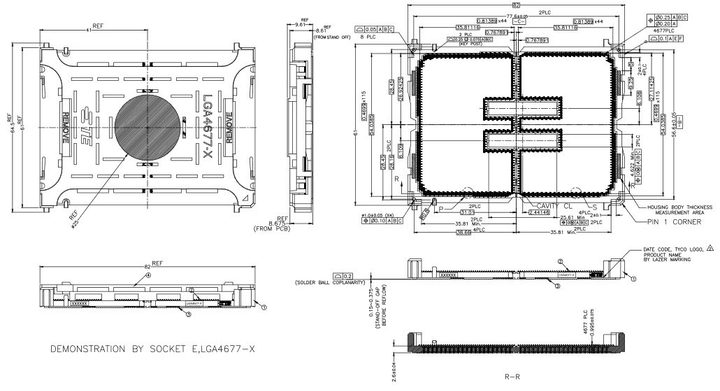
Image credit: YuuKi-AnS via Wccftech Image used with permission by copyright holder

Moving from the Ice Lake SP architecture to the Sapphire Rapids SP, a separate slide noted that Intel will use a new core design, though it’s expected that both Ice Lake SP and Sapphire Rapids SP will be based on a 10nm process and will be used on the Eagle Stream platform. The leaked sample revealed that the Sapphire Rapids chip comes with a base clock speed of 1.3GHz and will be manufactured on Intel’s 10nm Enhanced SuperFin process. The chipset features four compute cores and four HBM stacks. It will use a new LGA4677-X socket.

The star of the show, however, is support for PCI Express 5.0, which brings onboard high-bandwidth memory and Compute Express Link 1.1. Compared to PCIe 4.0, the new standard doubles the throughput bandwidth with a data rate of 32 GT/s. Reduced latency is also a big part of PCI Express 5.0, so you can expect faster data center performance with Intel’s new Xeon processors.

Chuong Nguyen
Silicon Valley-based technology reporter and Giants baseball fan who splits his time between Northern California and Southern…
Sci-fi got the gadgets right, but the vibes wrong
Sci-fi got plenty of consumer tech right, but reality keeps delivering the useful, compromised version of the dream
Officer K looking up at a neon-colored hologram in Blade Runner 2049.

I was recently waiting for an Uber when the GPS decided to lie for sport. The car was somewhere nearby, I was somewhere nearby, and somehow both of us were trapped in that modern ritual of wrong pins, slow turns, vague waving, and "I'm here" messages that help absolutely no one.

That was when I had a very reasonable thought: this is exactly where a hologram of a giant arrow pointing at me would be useful.

Read more
Apple could go back to Intel for chips, but not how you would expect (or dread)
Apple MacBook

Apple and Intel are reportedly exploring a manufacturing partnership that could reshape how future Apple chips are produced. But despite the headline, this does not mean Apple is abandoning Apple Silicon or returning to Intel-powered Macs.

According to a new Wall Street Journal report, Apple and Intel have reached a preliminary agreement for Intel to manufacture some chips designed by Apple. Bloomberg’s Mark Gurman later clarified on X that there is still no finalized production agreement in place and discussions remain at an early stage. His post also noted that Apple continues to have concerns about Intel’s manufacturing technology and long-term competitiveness.

Read more
Apple wants you to verify your identity before you get Education discount on products
Apple moving the US Education Store off the honor system also seems about making a globally consistent verification infrastructure that could eventually support more aggressive Education Store expansion.
Computer, Electronics, Laptop

Getting an Apple Education discount in the United States used to be as simple as claiming you’re a student or a teacher; it didn’t need a formal verification. That era is officially over. 

Starting May 8, 2026, Apple now requires formal identity verification for all Education Store purchases in the US, ending the informal honor system that was in place for years (via MacRumors). 

Read more